As you read this blog post, take a moment to marvel at the sheer power of your brain to instantly and effortlessly recognize printed words. Did you know that brains aren’t naturally pre-wired to read? The complex neurological process that allows us to read developed after an alphabetic system was invented a few thousand years ago. This system requires the repurposing of several brain regions to turn visual input into a word that can be read and paired to meaning.
Phonemic Awareness Activities to Support Early Literacy
Early instruction activities to develop phonemic awareness can begin in preschool with formal instruction that typically spans through early first grade.
Phonemic awareness (PA), which refers to the awareness of individual speech sounds in words, is thoroughly researched and directly related to later reading success. Phonemic awareness consists of a continuum of skills, as detailed in the chart below.
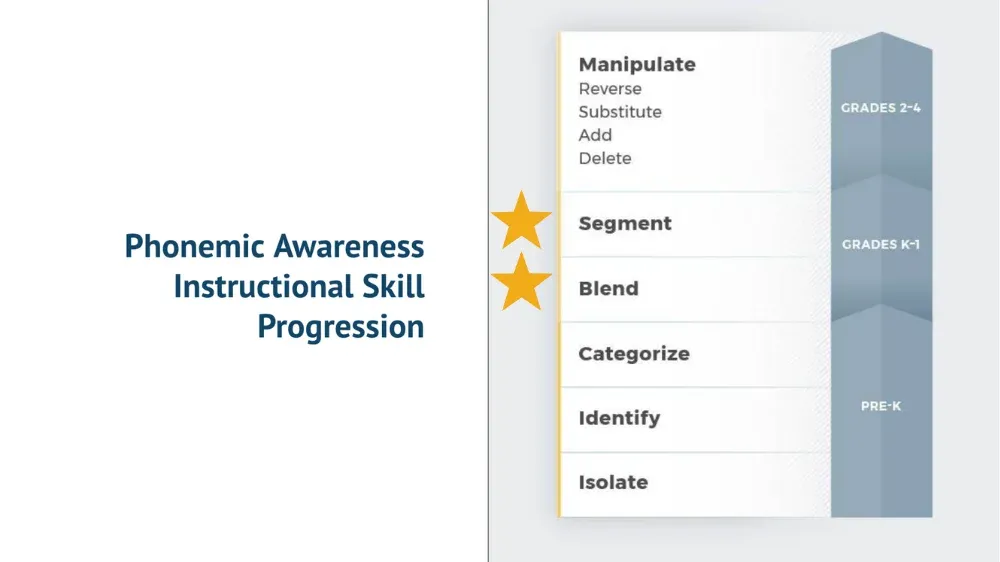
Emergent readers don’t need to sit down for long stretches of time to practice these skills, but rather, a few minutes of daily instruction is sufficient. Each task should follow an instructional routine using an “I do, we do, you do” gradual release of responsibility. Of the skills in the continuum, research directly supports three essential PA skills.
Sound isolation: To isolate phonemes, a student needs to recognize an individual sound and note its position within the word.
- First sound - Say kept. What’s the first sound in the word kept? /k/
- Final sound - Say frame. What’s the last sound in the word frame? /m/
- Medial sound - Say soap. What’s the middle sound in the word soap? /o/
Blending: To blend phonemes, a student needs to hear the individual sounds in a word, put the sounds together, and say the word that is made. Students love to name the ‘magic word’ that comes together from individual sounds!
- What word do these sounds make: /b/ /l/ /ŏ/ /k/? block
- What word do these sounds make: /s/ /t/ /ē/ /p/? steep
- What word do these sounds make: /b/ /r/ /ā/ /d/? braid
Segmentation: To segment phonemes, a student needs to pull a word apart into its individual sounds. Elkonin boxes are a great resource when teaching segmentation initially. One sound represents one box.
- Say shop. What sounds are in the word shop? /sh/ /o/ /p/
- Say bit. What sounds are in the word bit? /b/ /i/ /t/
- Say fetch. What sounds are in the word fetch? /f/ /e/ /ch/
Manipulatives are helpful tools to scaffold students’ understanding of phonemes. Manipulatives, such as cubes or blocks shown in the picture, serve as visual representation of individual speech sounds. As students segment, blend, or isolate phonemes, they physically move the manipulative as needed. Not every student will need a scaffold to engage in phonemic awareness activities, and once students demonstrate proficiency with these tasks the scaffold should be removed.

Phonics is the connection between spoken sounds (phonemes) and written symbols (graphemes). While the above tasks are oral language tasks, they can and should be done in tandem with phonics instruction once a few letter-sound correspondences are taught.
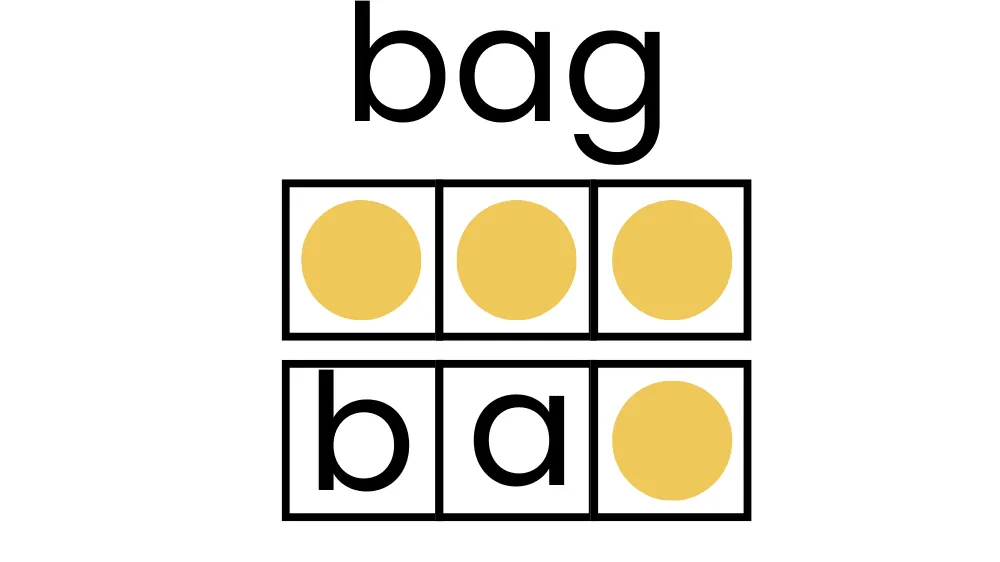
In this example, the student segmented the word ‘bag’ with letters. Both ‘b’ and ‘a’ are known letter-sound correspondences. Because the grapheme ‘g’ has not yet been taught, the student used a sound chip as a placeholder.
Supporting Early Reading, Writing, and Spelling
Prekindergarten through first grade serves as a critical developmental period for students’ phonological processes. Blending and segmenting phonemes are most strongly correlated to reading outcomes. These foundational skills serve as a necessary prerequisite to learning how to read, write, and spell.
Letters should be integrated into phoneme instruction as appropriate. How can we support students’ alphabetic knowledge? Find out next Tuesday!