
Intro to Activity
The Simple Decoding Routine helps students consistently apply their knowledge of grapheme-phoneme (letter-sound) correspondences to decode unknown words rather than guessing or skipping them. The routine prompts students to sound out the word and then confirm it as a word they know. Although these steps may seem basic, they help establish strong foundational reading skills, including reinforcing left-to-right orientation and attention to every letter when reading. This foundation prepares students to successfully read longer, more complex words and build the habit of monitoring comprehension while reading.
Students
Discover the types of students who may benefit from this activity.
This routine is especially beneficial for students in the Partial Alphabetic Phase (students recognize some letter-sound relationships) and students in the Full Alphabetic Phase (students have most major phoneme-grapheme correspondences in place).
Most students can blend phonemes of short, two- to three-sound words by 6 years old. Therefore, instruction and practice with the Simple Decoding Routine can typically begin in Kindergarten once students have mastered a few grapheme-phoneme correspondences and continue with older readers in the Full Alphabetic Phase.
Getting Started
The steps outlined in the tabs below provide a clear and structured approach for teaching this activity to students.
Prepare a word list, sentence, or passage containing previously taught phoneme-grapheme correspondences. One-syllable words are typically best for the Simple Decoding Routine.
Be cautious of decodable word lists and texts that are not aligned with your scope and sequence. For example, chirp is decodable only if students have been taught the graphemes <ch>, <ir>, and <p>. Consider selecting words from a recent or upcoming text to increase relevance and transfer.
Remind students that letters represent sounds in spoken words. Explain the purpose of the routine.
Example:
"Today, we're going to use the letter sounds we've learned to sound out and read unfamiliar words."
In the first step, students sound out the word. In the second step, students confirm the word by connecting the blended parts to a known word in their oral vocabulary. This teaches students to self-monitor and check whether the word is familiar and, when reading the word in a sentence, check that the sentence makes sense. While we don't want students to guess at words based on what makes sense in a sentence, this is a way to help students confirm they decoded a word accurately. Sometimes they may need to sound the word out again, but sometimes they need to adjust their pronunciation slightly to turn the blended phonemes into a recognizable word (e.g., catch is sounded out as /kăch/, but many readers will need to shift this pronunciation to /kĕch/ to better match the way they say the word).
Model the routine with a teacher-led demonstration. This example uses a single word, but the routine can be applied in connected text by stopping to model the Simple Decoding Routine for unknown words.
Example for the word hop:
"Watch me read this word."
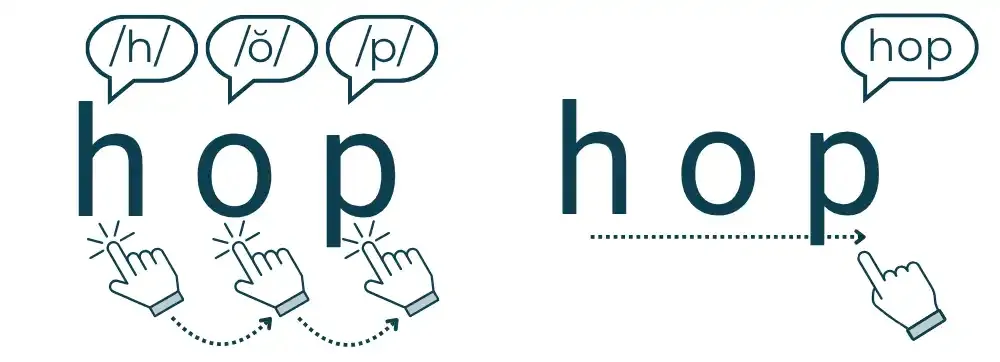
Step 1: Sound Out
- [Point under each grapheme as you say the phoneme.]
- "Listen to the sounds /h/.../ŏ/.../p/."
- [Point under each grapheme as you repeat the phonemes.]
- "Now I'll say the sounds again without pausing. /h/.../ŏ/.../p/..."
Step 2: Confirm
- [Point from left to right to blend and decode the word. Provide sentence context and/or brief definitions as needed.]
- "Hop! Hop is a word. Frogs and rabbits can hop."
Provide additional words or text for students to decode and guide students through the two steps in the routine. Use a choral response to maximize participation.
Example for the word nut:
Step 1: Sound Out
- "Point under the letters and say the sounds with me /n/.../ŭ/.../t/. Now blend the sounds together: /n/.../ŭ/.../t/..."
Step 2: Confirm
- "Nut! Nut is a word. Squirrels eat nuts."
Provide additional words or text for students to decode independently. Fade prompting as students internalize the routine. Monitor responses for accuracy throughout the activity.
Immediately support students who make an error.
Example:
If a student reads past as pat, point to the missed <s> and prompt them to try again. If needed, model the word again, emphasizing the missed phoneme.
- "Watch and listen as I read: /p/.../ă/.../s/.../t/. Read with me: /p/.../ă/.../s/.../t/. What's the word?"
- If the student cannot blend the word appropriately on the second attempt, provide the appropriate response.
For more information on supporting students with blending, review Phoneme Blending.
Take Note!
Here are some special considerations when using this activity:
- Early decoding should be audible. While fluent readers can read silently, verbal practice strengthens the connection between spelling and pronunciation and is appropriate for beginning readers. It also enables teachers to provide affirmative and corrective feedback.
- Include minimal pairs for discrimination practice. Help students fine-tune their decoding by practicing words that differ by a single phoneme, especially those that are commonly confused (e.g., get→ jet; pet→ pit; cap→ cab).
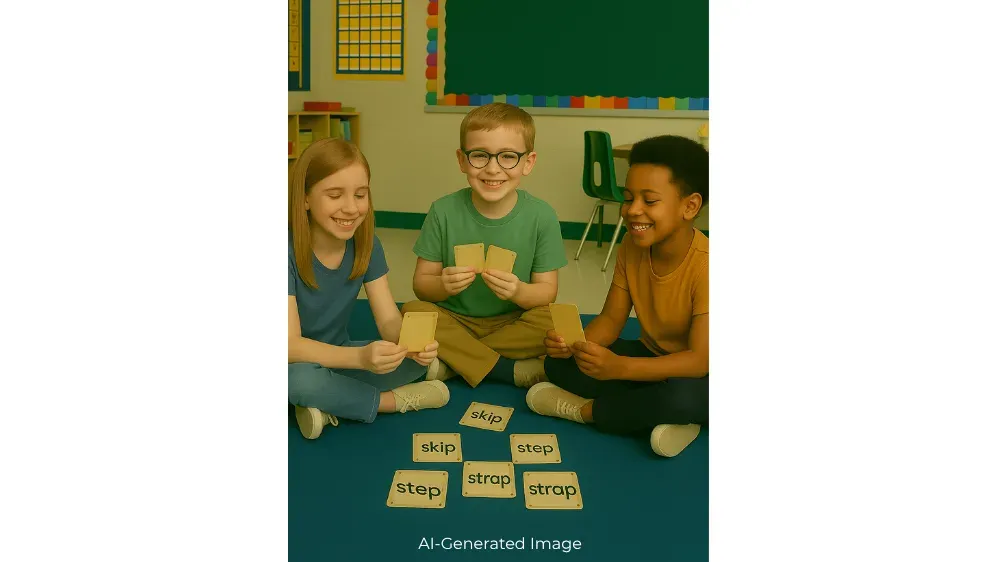
- Use blends to vary word lengths. Some students overgeneralize the CVC (consonant-vowel-consonant) structure and attempt to make all words fit this pattern. As students become more skilled with blending, incorporate practice with longer words (e.g., skip, step, strap, stand, sprints). Keep in mind the more graphemes in a word, the more difficult it will be to decode.
- Always expect eyes on text. To read a word, students must look at it. Some teachers have students point to the graphemes while decoding to reinforce this expectation. Struggling readers often look away from a word and to an adult when they get stuck, or to ask if they have read the word accurately. When this happens, redirect the student's attention to the word. While providing support, continue to put the onus on students, requiring them to make the first attempt at sounding out and confirming the word rather than looking away from the text to ask for help.
- Not every word needs to be sounded out. The Simple Decoding Routine helps students orthographically map words. Once a word is orthographically mapped, it is recognized automatically. Sometimes this takes a few exposures and other times it takes many. Students should continue to use the Simple Decoding Routine for unknown words, but words read automatically do not need to continue to be sounded out.
- Repetition builds automaticity. Beginning and struggling readers often need to decode a word numerous times before the word becomes automatic. While it may be tempting to say, "You just read this word!", encourage continued use of the Simple Decoding Routine instead. This repetition is a necessary part of learning. For more information on supporting effortless retrieval, see Subskill Automaticity.
- Use the routine consistently. Students should not be taught one decoding strategy during phonics instruction and then prompted to use a different one elsewhere. Anytime students encounter an unfamiliar word, prompt them to use the Simple Decoding Routine (or the Advanced Decoding Routine for unknown multisyllabic words).
- Review skill overview. For additional considerations when targeting this skill, see the Decoding Overview.
Classroom Connection
See this activity in action through a teacher-led demonstration.
This video begins with an orientation on how the Simple Decoding Routine lays the foundation for the Advanced Decoding Routine. Then, a young reader applies the Simple Decoding Routine to read unknown words within sentences his teacher has prepared. As you watch, notice how the focus remains on the letters in the word. The teacher avoids prompting strategies that promote ineffective habits, such as predicting the word based on what would make sense, guessing the word after producing the first few letters, being reminded that it's a word they've read before, and so on. Instead, the student is consistently directed to look at all the letters from left to right to produce sounds and read the word.
Differentiation
Learn how you can enhance instruction to meet the needs of diverse learners.
- For students struggling to apply learned grapheme-phoneme correspondences, try highlighting or otherwise drawing attention to newly learned patterns. For example, when practicing the grapheme <sh>, you might temporarily highlight this pattern in words to draw students' attention to it (e.g., ship, cash, wishes).
- For students struggling to attend to individual graphemes in words, try using a word chain. Select a carefully sequenced list of words with minimal grapheme changes. Chains that change the initial grapheme (e.g., hop→ top→ cop→ pop) are easier than those with medial or final grapheme changes (e.g., hop→ hip→ hit→ hat). The most challenging chains are those that require adding or removing medial graphemes (e.g., sip→ slip→ slap→ sap).
- Most students naturally transition from sounding out words to reading them fluently as whole words. However, some readers may need explicit prompting to make the transition from sound-by-sound reading to reading whole words. For students who accurately, but habitually, sound out every word letter-by-letter, try prompting students to "think the sounds" and make step 1 of the routine silent.
- When a student blends sounds and produces a word that’s close but not quite right—maybe the vowel is slightly off or their voice lacks confidence—it may signal that they haven’t fully connected the blended sounds to a known word in their oral vocabulary. To support this with words that you are confident the student is familiar with, ask the student to use the word in a sentence or provide a synonym. If the word doesn't "click" for them, provide a helpful clue (e.g., It's a body part).
- Other times, students may be blending words unfamiliar to them. The use of picture cues after the student has blended the word can help reinforce or introduce new vocabulary. This can be especially helpful for English Learners and students with language difficulties.
- The Getting Started and Classroom Connection sections above demonstrate decoding using whole-word blending. Students who struggle to produce the word after blending may benefit from continuous or additive blending. See the Blending Techniques video demonstration below. Note that continuous blending (also referred to as connected phonation) is easiest to implement with words that begin with continuant phonemes (the phoneme can be stretched and held), so these words may be prioritized when first teaching the routine.
- For additional differentiation when targeting this skill, see the Decoding Overview.
Coaching Corner
For occasional use: optional ideas to bring energy, engagement, or ease to the activity.

Some teachers like to visually show blending by moving their hand from right to left (so it appears left-to-right for students). This is optional. What is important is that students are blending the sounds together.
Resource(s)
Explore the resource(s) to support your implementation of this activity.
Toolkit resources help you implement high-quality instruction. To guarantee student success, these tools must be used in tandem with direct, systematic, mastery-oriented instruction and a high-quality curriculum.