
Intro to Activity
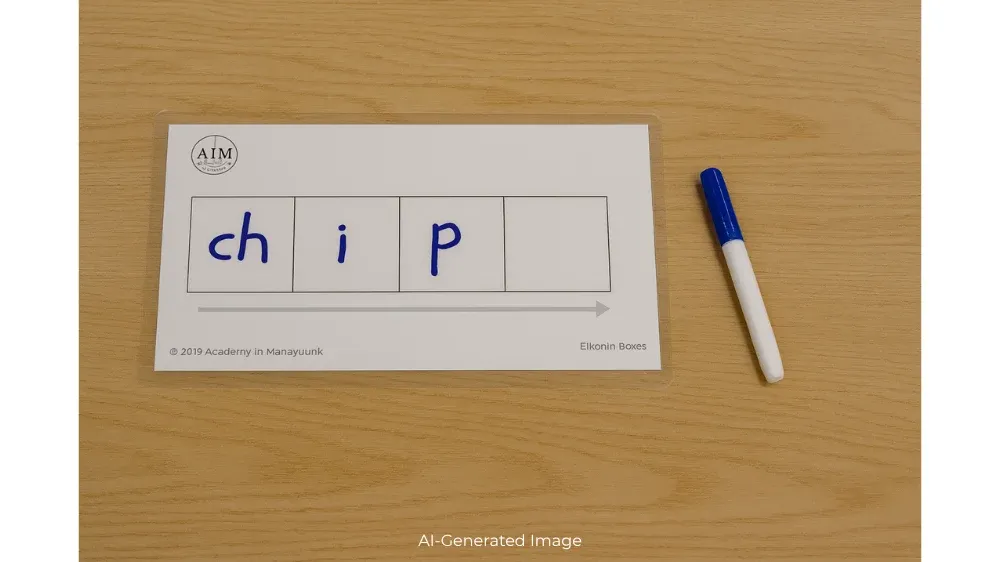
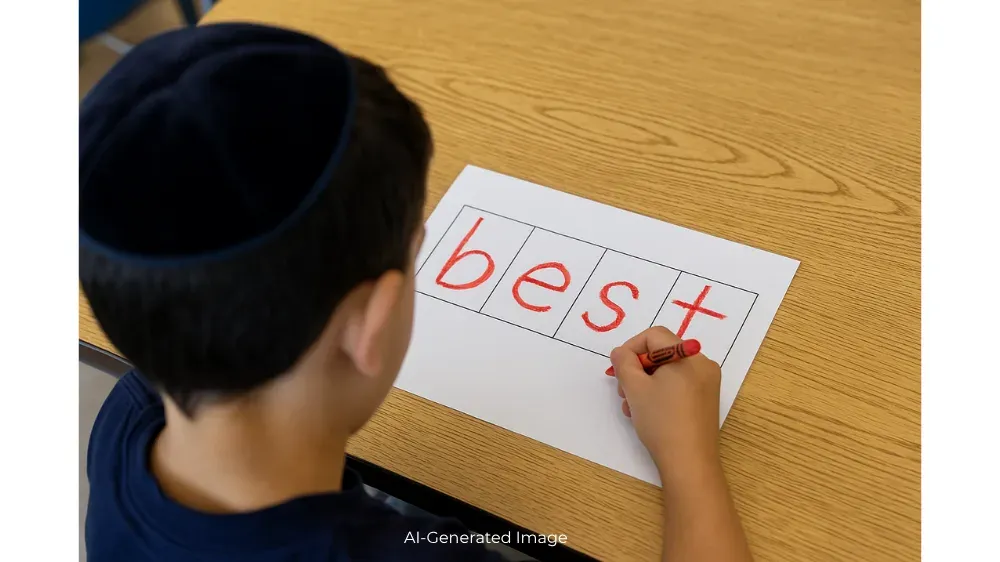
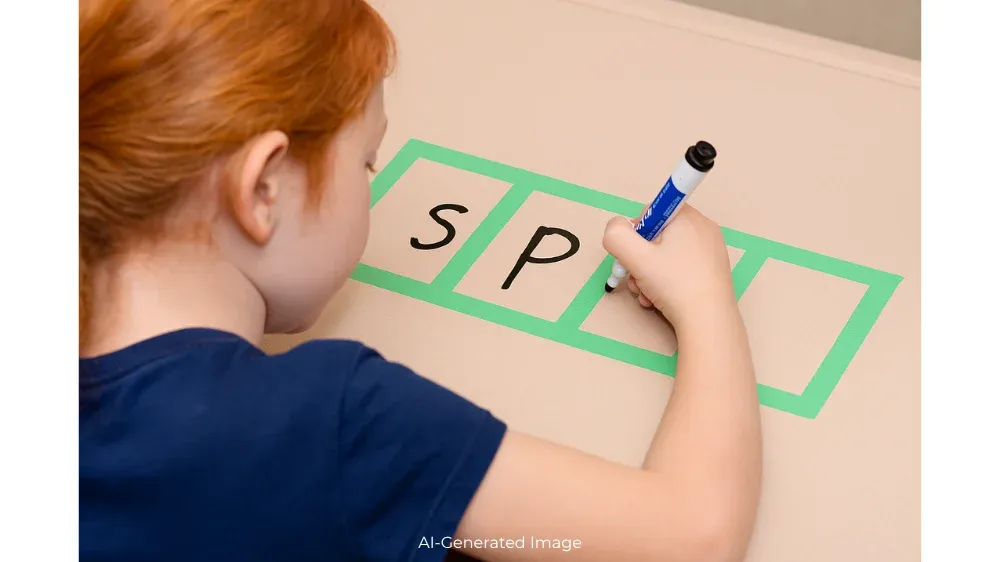
Phoneme-grapheme mapping encourages students to use a simple and consistent method to encode words. It is a routine intended to provide temporary support as students transition from orally segmenting words to writing them. The teacher says a word containing phonemes (sounds) that students have previously learned to spell. Students orally segment the word into individual phonemes and write the grapheme (letter or group of letters) used to represent the phoneme using a tool called an Elkonin box. The instructional routine reinforces phoneme-grapheme correspondences and helps students internalize the alphabetic principle and, over time, recognize words "on sight" by building an orthographic memory of words. Phoneme-grapheme mapping is a powerful way to bridge phonemic awareness to alphabet knowledge and develop early reading and spelling skills.
Students
Discover the types of students who may benefit from this activity.
Teachers select words for this activity based on their phonics scope and sequence and student needs. Because of this flexibility, phoneme-grapheme mapping is appropriate for students across a wide range of abilities. It is best suited for students who can segment phonemes, are beginning to connect phonemes to graphemes, and are developing foundational knowledge of conventional spelling patterns.
Phoneme-grapheme mapping is most researched as part of effective phonemic awareness and phonics instruction for students in grades K-1. However, the underlying principles of this routine are grounded in established research on connecting phonemes and graphemes to support accurate decoding and encoding. Therefore, this may be a promising strategy for older students and struggling readers needing additional sound-to-symbol practice.
Getting Started
The steps outlined in the tabs below provide a clear and structured approach for teaching this activity to students.
Compile a list of words containing previously taught phoneme-grapheme correspondences. Many phoneme segmentation lists (sometimes labeled as VC, CV, and CVC lists based on their sounds) may not be appropriate for phoneme-grapheme mapping for young students because they contain spelling patterns students have not learned (e.g., eat, to, pail). It may be helpful to select words from a recent decodable text or phonics lesson. For additional guidance on word selection, see Take Note!, below.
Provide each student with Elkonin boxes (also called sound boxes).
Let students know that we use letters to represent sounds. Explain the purpose of the routine.
Example:
"We know that words are made up of sounds. Today we are going to match each sound to a spelling to help us spell a whole word."
Model the routine with a teacher-led demonstration.
Example:
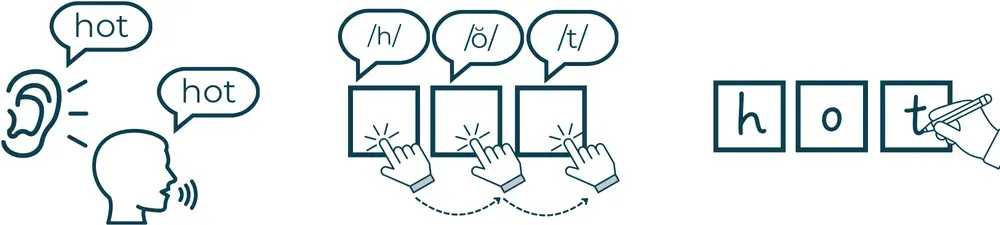
Step 1: Listen and Repeat
- "The word I will spell is hot. Say, hot (hot). I like to swim when it's hot."
Step 2: Break Apart into Sounds
- "The word is hot."
- "I hear," [point to a box, moving from left to right as you demonstrate segmenting the phonemes] "/h/.../ŏ/.../t/."
- Now, I'll spell those sounds. The first sound is /h/."
Step 3: Identify the Letters
- "<H> spells /h/."
Step 4: Write the Letters
- [Write <h>.]
- [Repeat Steps 2-4]
- "Listen again: /h/.../ŏ/. The next sound is /ŏ/. <o> spells /ŏ/."
- [Write <o>.]
- "Listen: /h/.../ŏ/.../t/. The last sound is /t/. <t> spells /t/."
- [Write <t>.]
Step 5: Read and Check
- "Watch me check my spelling."
- [point under each grapheme as you say the sound, then slide from left to right to blend and decode the word]
- "/h/.../ŏ/.../t/...hot. I spelled hot!"
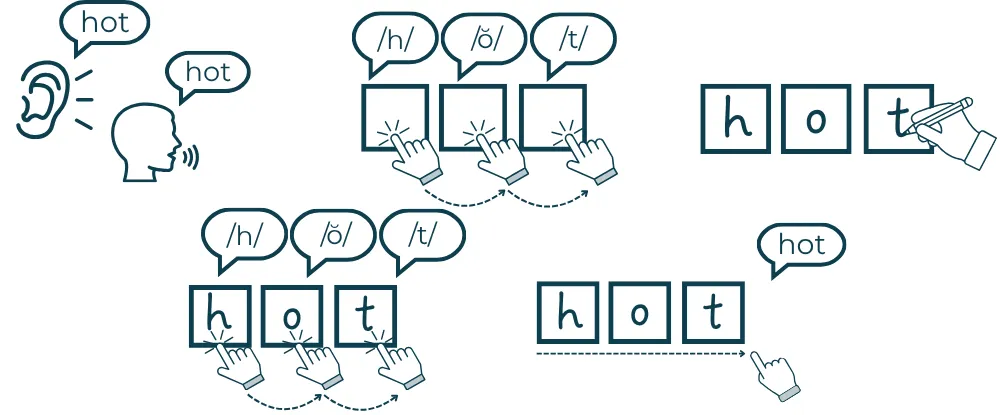
Dictate additional words and support students through the five steps described above. Avoid turn-taking formats that limit practice opportunities. Instead, ensure that every student writes each word.
Example:
Step 1: Listen and Repeat
- Dictate, "chart."
- Students repeat, "chart."
- Provide sentence context and/or brief definitions as needed, "We use a chart to track how many days we’ve been in school."
Step 2: Break Apart into Sounds
- Direct students to segment the word.
- "Sounds? (/ch/.../ar/.../t/) First sound? (/ch/)"
- Direct students to segment the word.
Step 3: Identify the Letters
- "How do you spell /ch/? (<ch>)"
Step 4: Write the Letters
- Write <ch>, erase, and have students write <ch>.
- Repeat Steps 2-4
- Ensure students segment the word. This should not become a sound dictation activity.
- "Next sound? (/ar/) <ar> spells /ar/."
- [Write <ar>, erase, and have students write <ar>.]
- "Last sound? (/t/) <t> spells /t/."
- [Write <t>, erase, and have students write <t>.]
Step 5: Read and Check
- "Let's check our spelling, /ch/.../ar/.../t/...chart."
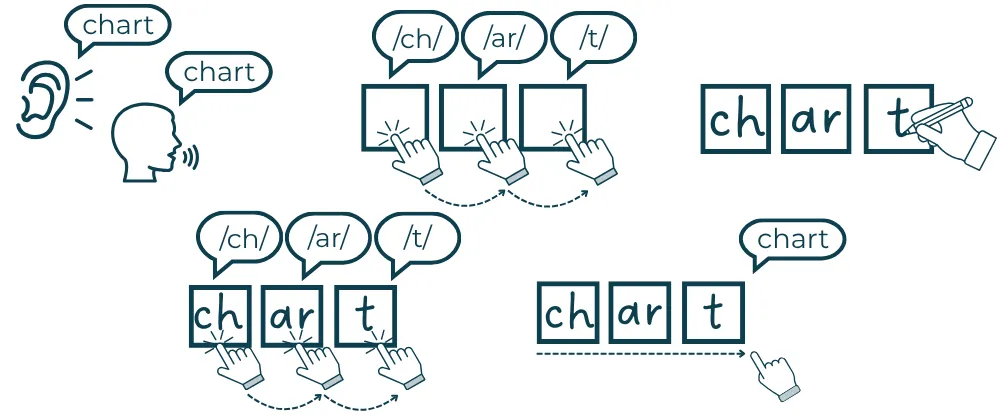
Continue dictating words for students to encode independently. After spelling, have students slide under each grapheme as they blend each sound to read the whole word. In addition to serving as a self-check, the step also helps to connect reading and writing. Fade prompting as students internalize the routine and monitor student responses for accuracy throughout the activity.
Phoneme-grapheme mapping should be used flexibly. As new phonics patterns are introduced, bring back the scaffold to support transfer, then gradually fade it again as students gain independence.
Immediately support students who make an error. As feasible, also monitor for correct letter formation.
Example:
"Hmm...the word is slip, but listen as I read what you wrote. /s/.../ĭ/.../p/...sip. Watch my mouth and listen again: slip." If the student cannot segment the word appropriately on the second attempt, provide the appropriate response.
You can also cue students using learned keywords. For example in the word dog: "You know the next sound is /ŏ/. How do you spell /ŏ/ in octopus? <o>." If the students can't provide the grapheme on the second attempt, tell the students and have them repeat it.
Take Note!
Here are some special considerations when using this activity:
- Some words are not appropriate for Elkonin boxes. If a student can spell a word with ease, this scaffold is unnecessary. Additionally, words with unclear phoneme-grapheme correspondences (e.g., walk) are not ideal, particularly for beginning readers just learning the alphabetic principle.
- Use words of varying lengths. Some students overgeneralize CVC (consonant-vowel-consonant) and default to that structure when spelling. As students become more skilled with segmentation, be intentional about choosing words with varying phoneme lengths.
- The number of boxes maps to sounds, not letters. A single phoneme (e.g., /th/) may be represented by multiple letters, and a single grapheme (e.g., <x>) may represent more than one phoneme. For guidance on how to represent these in sound boxes and other tips, see 4:55 in Classroom Connection, below.
- Provide the correct number of sound boxes to scaffold segmentation. As students gain skill with phoneme segmentation, transition to having them segment the word and determine the number of boxes themselves. You may use tokens to do this, as demonstrated in the Classroom Connection, below, or tap the boxes, as pictured in the Guided Practice section of Getting Started, above.
- Emphasize the sound-symbol connection. While students need to know and use letter names, the emphasis for phoneme-grapheme mapping is on sounds. Encouraging students to subvocalize phonemes as they write may help to build this connection.
- Reinforce taught spelling generalization. Many phonemes with multiple graphemes follow spelling generalizations (e.g., <ck> after a short vowel). Once taught, support students in applying these generalizations when choosing which grapheme to write (see 6:02 in Classroom Connection).
- Review skill overview. For additional considerations when targeting this skill, see the Encoding and Spelling Overview.
Classroom Connection
See this activity in action through a teacher-led demonstration.
Here, a teacher uses phoneme-grapheme mapping with a small group of young students. Then, she demonstrates how the same activity can be applied to words with more advanced phonics patterns. Notice how when the teacher asks for sounds, she only accepts sounds as responses—not letters! This distinction is critical. Students must understand the difference between these terms.
Differentiation
Learn how you can enhance instruction to meet the needs of diverse learners.
- For students with limited alphabet knowledge, have them spell only certain parts of the word (such as the first phoneme) rather than the entire word. Choose words that allow you to target the phoneme-grapheme correspondences students are still mastering, and have students place a sound chip as a placeholder for the other phonemes.
- Students with limited alphabet knowledge may struggle to name the grapheme before writing the phoneme. If so, reverse Steps 3 and 4. With this sequence, students would first isolate the phoneme, then write it, and finally name the grapheme.
- For students struggling to attend to individual graphemes in words, try using a word chain. Select a carefully sequenced list of words with minimal changes. Instead of rewriting each word in full, students erase or replace only the grapheme that changes in the next word. Chains that change the initial grapheme (e.g., hop, top, cop, pop) are easier than those with medial or final grapheme changes (e.g., hop, hip, hit, hat). The most challenging chains are those that require adding or removing graphemes (e.g., sip, slip, slap, sap).
- For students with working memory or attention challenges, break the routine into manageable steps. Post the routine for reference and cue steps as needed. You also may need to repeat the word frequently. For example, if the target word is flip: "Let's read what you wrote. (/f/). Our word is flip. Say the sounds again to remember what sound comes next. (/f/.../l/..). Our next sound is /l/.”
- Use grapheme tiles to make the activity more supportive. Letter tiles make the activity easier for students because they don’t have to recall the correct letter sequence for graphemes with more than one letter (e.g., <sh>, <igh>, <tch>) or handwriting formation. Limiting the tile choices further simplified the task. Transition to writing the letters as students are able.
- A variation of this activity can be used for students ready to work on encoding multisyllabic words. See the Spelling Multisyllabic Words for more information.
- For additional differentiation when targeting this skill, see the Encoding and Spelling Overview.
Coaching Corner
For occasional use: optional ideas to bring energy, engagement, or ease to the activity.
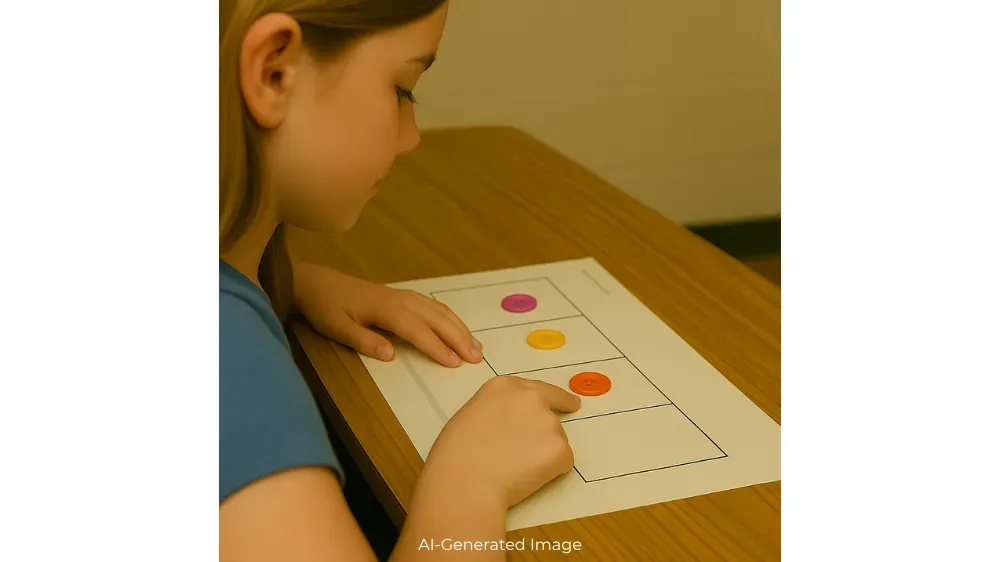
If using "tokens" to segment phonemes, mix up the tool students use. Try counters, buttons, mini-erasers, felt squares, etc.
Resource(s)
Explore the resource(s) to support your implementation of this activity.
Toolkit resources help you implement high-quality instruction. To guarantee student success, these tools must be used in tandem with direct, systematic, mastery-oriented instruction and a high-quality curriculum.