It’s important that teachers can analyze the data they have collected, apply their analysis when making instructional decisions about individual students, and feel confident with implementing appropriate next steps. The purpose of a student analysis is to use information from screeners, test trackers, and other informal or formal assessments to make informed long-term and short-term educational decisions. For the long-term, teachers should walk away with an overall sense of the student’s profile and consider what the consistent needs may be. Short-term instructional decisions involve determining an appropriate intervention grouping and activities based on current data.
It can be overwhelming to attempt to analyze so much student data on every individual student within a classroom, but it can be accomplished by thinking about long-term goals and student profiles. Further, teachers want each student to benefit from individualized work and may wonder if that’s possible with a whole classroom of students. Again, by switching their thinking to student profiles, teachers will get more “bang for their buck” on the interventions they design.
Quick Guide for Reading Assessment
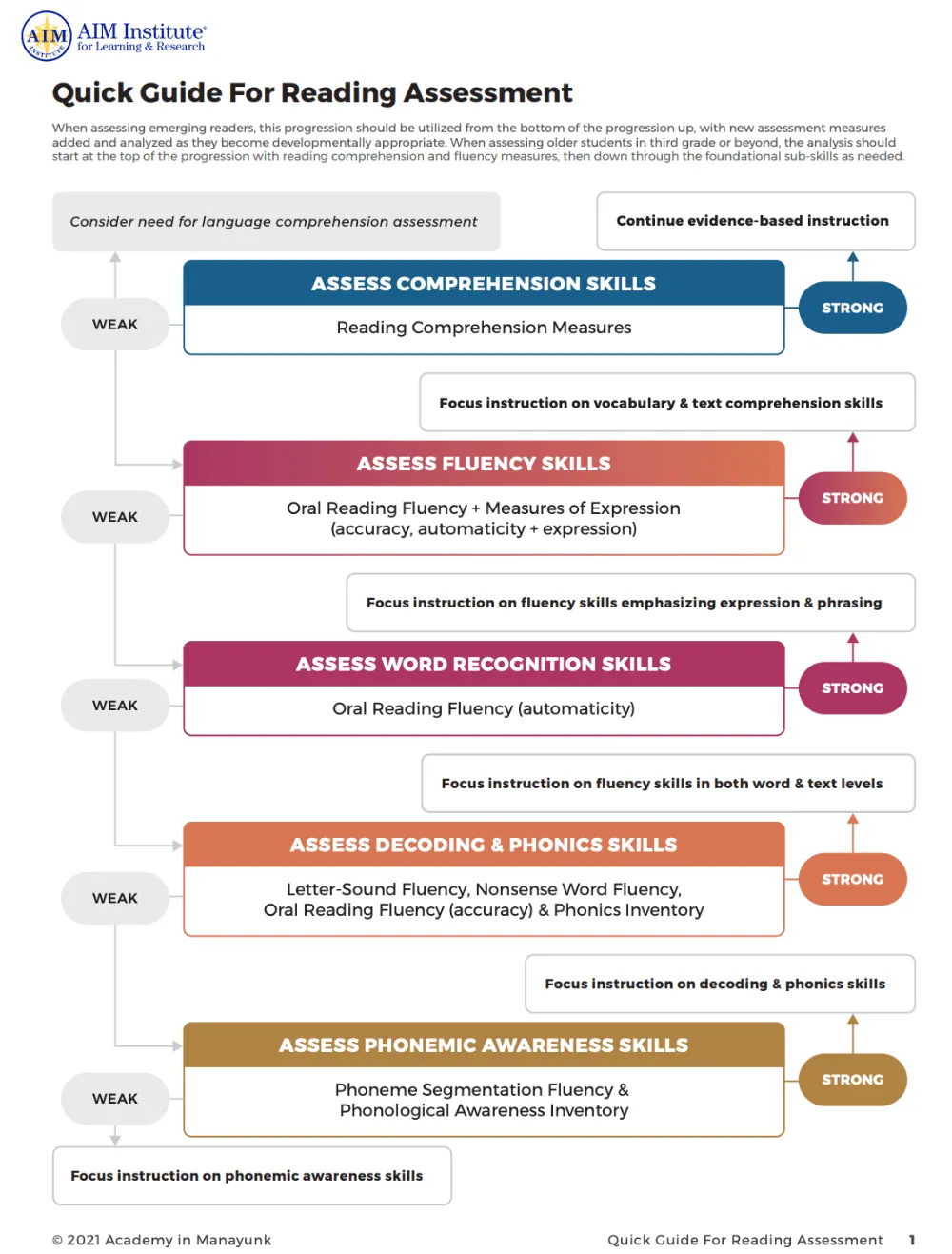
The Quick Guide for Reading Assessment is a flowchart that demonstrates how skills build on each other and how a good benchmarking system is based on a developmental progression of skills. This Quick Guide illustrates that skill progression can help teachers use student data to decide how far back in the progression they need to go with interventions.
For example, when assessing emerging readers, this Quick Guide should be utilized from the bottom of the progression up, with new assessment measures added as they become developmentally appropriate. When assessing older students in third grade or beyond, the assessment should start at the top of the Quick Guide progression with reading comprehension and fluency measures working down through the foundational sub-skills as needed.
Phonemic Awareness
Starting at the bottom of the Quick Guide, the assessment progression begins with phonemic awareness using measures of phoneme segmentation fluency and a phonological awareness inventory. If this data is strong, teachers can move up the skill progression as they focus instruction on decoding and phonics skills. However, if phonemic awareness is weak, teachers should focus instruction on continuing to build these critical foundational skills based on the needs identified through a phonological awareness inventory.
Decoding & Phonics
Moving up the chart, the next section shows decoding and phonics skills, such as letter-sound fluency, nonsense word fluency, accuracy of oral reading fluency, and a phonics inventory. If this data is strong, teachers should focus instruction on fluency skills at both the word (letter-sound correspondence, phonic decoding) and text levels. However, if decoding and phonics skills are weak, teachers should assess and analyze phonemic awareness data to determine if any additional instructional needs are uncovered in this foundational skill area. If phonemic awareness is strong, teachers should continue to focus instruction on decoding and phonics skills based on the needs identified through a phonics inventory.
Word Recognition
The next section of the chart shows word recognition skills, specifically the automaticity component of oral reading fluency. If this data is strong, teachers should focus instruction on the expression and phrasing aspects of reading fluency. However, if automaticity of oral reading fluency is weak, teachers should assess and analyze decoding and phonics data to determine if any instructional needs are uncovered in this foundational skill area. If word reading accuracy is strong, teachers should continue to focus instruction on fluency skills at both the word and text levels.
Fluency
Moving up the chart, the next section is a comprehensive assessment of reading fluency, including not only accuracy and automaticity but also expression. If all of these component skills are strong, teachers should continue to focus instruction on vocabulary and text comprehension skills. However, if any of these skills are weak, teachers should assess and analyze the component data to determine the specific instructional needs.
Comprehension
At the top of the Quick Guide, the progression ends with a comprehension skills assessment. If reading comprehension skills are strong, the student is a skilled reader and teachers should continue with grade-appropriate evidence-based instruction. However, if these skills are weak, teachers should assess and analyze the reading fluency data to determine if any instructional needs are uncovered in any of the foundational skill areas. If reading fluency skills are strong or if there are other concerns about the student’s overall language skills, then teachers should consider the need for a comprehensive language comprehension assessment.
Decision-Making Flowcharts
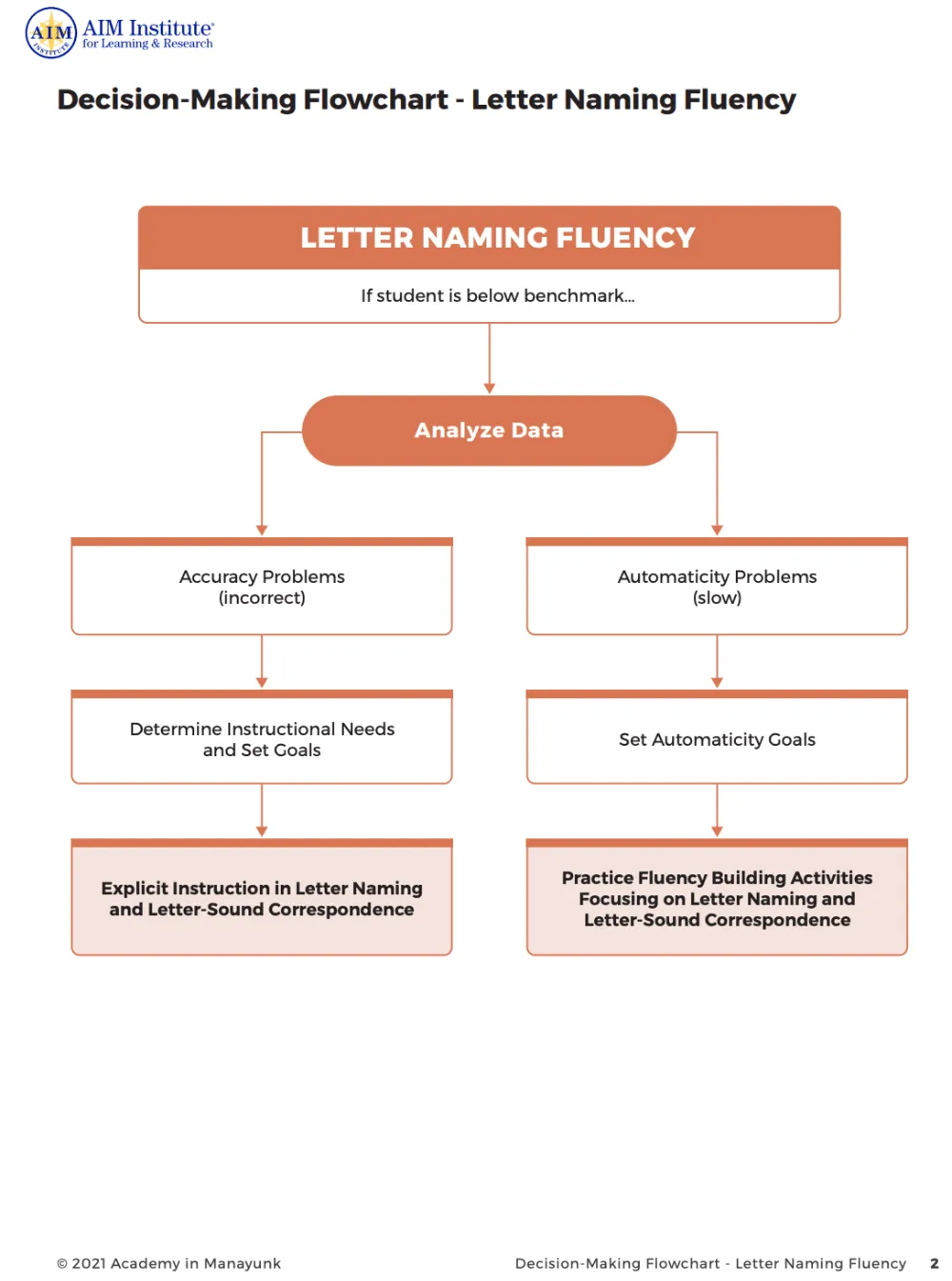
The decision-making flowcharts are designed to complement the Quick Guide. They further assist teachers in making strategic instructional decisions based on student assessment data. These charts prompt an instructor to collect additional student data and make a decision about which intervention(s) to apply.
They are color-coded to align with the strands of Scarborough’s reading rope. The three middle probes in the Quick Guide are color-coordinated to illustrate that those components should be analyzed together as part of overall reading fluency. Word reading accuracy and automaticity (rate) are dependent on the student’s underlying foundational skills in word or sight recognition and decoding and phonics skills.
It is vitally important for teachers to feel confident in their ability to analyze and use student data to drive their instructional decision-making process. This Quick Guide can assist in outlining a general assessment progression that can be used to think about instructional recommendations to meet students’ needs.
A Notation About Assessment and English Learners
All students should be evaluated each year with a screening assessment. For English learners, it is helpful to gather additional information such as the number of years of instruction in English, the students’ response to that instruction thus far, the language of instruction in previous grades, and the student’s performance compared to similar peers. If a teacher is concerned that a student is not responding to effective classroom instruction, then it may be necessary to recommend that student for further evaluation. Often a valid comprehensive dual language assessment is most appropriate because it provides a thorough look into the student’s foundational reading skills, word recognition skills, comprehension, written language, and even mathematics.
Teachers of English learners need to be aware of the interpretive issues that can arise when assessing these students in English before they have adequately acquired the language. When assessing the English learner, it’s important to test in both English and the native language, so you can compare whether the difficulties present in English are also present in the native language. Doing so will help to tease out whether a student simply needs more time and instruction in acquiring the English language or if a learning disability is present that is impeding progress. A bilingual professional should administer the assessment and evaluate the results so that appropriate instructional goals can be developed.