
Intro to Activity
Phoneme isolation is a phonemic awareness task in which students identify individual phonemes (sounds) in spoken words—specifically the initial (beginning), medial (middle), or final (ending) phoneme. This skill can be practiced orally, without any letters involved, making it an ideal activity for students who are still developing foundational sound awareness and have not yet learned the corresponding graphemes (letters). For example, even if a student has not yet been introduced to the digraph <sh>, you can still ask, “What is the first sound in the word ship?” and guide them to respond with the sound /sh/. Like all phonemic awareness activities, however, phoneme isolation tasks should incorporate letters once the appropriate correspondences have been introduced.
Phoneme isolation helps children learn that words are made up of discrete, identifiable sounds—an essential building block for later phoneme-grapheme mapping, decoding, and spelling. Practicing this skill lays the groundwork for more advanced phonemic awareness tasks such as blending and segmenting.
Students
Discover the types of students who may benefit from this activity.
Most students can isolate phonemes by five and a half years of age. Therefore, instruction in phoneme isolation can typically begin in preschool or Kindergarten when students show sensitivity to the sounds in spoken language. About 20% of students need explicit instruction to acquire phonemic awareness skills such as phoneme isolation.
Younger students may not be ready to demonstrate this skill yet, whereas it might be an appropriate target for older students who continue to be in the Partial-Alphabetic Phase of word-reading development. In this phase, students recognize some letter-sound relationships and can read some words by priming partial letter-sound connections. Yet, because they lack strong decoding skills, they often depend on visual cues and context to guess rather than accurately read words. Students with this profile typically benefit from explicit phonemic awareness instruction to strengthen the connection between speech sounds and letter representations.
Getting Started
The steps outlined in the tabs below provide a clear and structured approach for teaching this activity to students.
Prepare a word list at the appropriate difficulty level for your students. Isolating the initial sound of words will be the easiest, followed by the final sound. Isolating the medial sound of a word (often a vowel sound) will be most challenging.
Keep in mind how the phonemes used in the target words will impact difficulty. Continuant phonemes (those that can be held out, such as /m/) that are present in a student's home language or dialect will be easiest. See also Take Note!, below.
Remind students that words are made up of sounds. Explain that today you will practice pulling off the first sound, away from all of the other sounds that make up the word.
Model the process:
"Listen to this word: mug.
The first sound in mug is /m/. Listen again: mug (you may want to slightly prolong the initial /m/ sound when first introducing this activity to students).
Now you try. First say /m/. Now say the whole word: mug."
Next, practice this skill with your students. First, say a word, and then have students repeat it. Then ask students to identify the first sound they hear in the word. Because students are only identifying the initial phoneme, the number of sounds in a word does not impact its difficulty as much as in other phonemic awareness activities.
Example:
"Listen to this word: soap.
Say the word (soap).
What's the first sound in soap?" (/s/)
Students now provide responses independently. In whole-class instruction, students can respond chorally together, or take turns with a partner if they have a prepared list of picture prompts.
Provide immediate corrective feedback when students provide an inappropriate response. For example, if a student says the first sound in cat is /kă/ rather than just /k/, you would say "Try again! I hear two sounds in /kă/- listen! /k/... /ă/.../kă/. What is just the first sound in cat?
If the student is unable to isolate the sound on the second attempt, provide the answer /k/.
Take Note!
Here are some special considerations when using this activity:
- Some sounds are harder than others. Words that use continuant consonant sounds (those that can be held out with sustained breath /s, z, f, v, n, m, sh, th, th/) in simple consonant-vowel-consonant (CVC) word forms will be easiest for students. Words that begin with <h> or <w>, or end with <r>, will be especially tricky for students because of how their respective sounds interact with neighboring vowel sounds. And words that end in the letter <x> might be challenging, as it represents two phonemes (/ks/).
- 'Sounds' and 'letters' are not synonymous. Ask for sounds, and accept sounds as responses—not letters! It is important that students understand the difference between these terms and provide answers such as /b/, not the letter <b>.
- Clip all consonants. Make sure that you and your students are articulating only the targeted, individual sound, such as /b/, and not adding a vowel sound after (such as 'buh').
- Encourage simultaneous learning. Students should not wait to begin learning sound-letter correspondences until they have mastered phoneme isolation. Once students have learned the sound-letter correspondences for a given phoneme, they can practice writing the appropriate letter(s) after isolating the sound. Although this activity can be done without showing letters, pairing the corresponding graphemes to the phonemes will be the next step to bridging this phonemic awareness task to reading and spelling.
- Review skill overview. For additional considerations when targeting this skill, see the Phonological/Phonemic Awareness Overview.
Classroom Connection
See this activity in action through a teacher-led demonstration.
Here, a teacher uses phoneme isolation as a warm-up before a small group phonics lesson. Notice both the pace of the activity and the words the teacher has chosen.
Differentiation
Learn how you can enhance instruction to meet the needs of diverse learners.
- Consider that many words have pronunciation variations due to dialect and/or the effect of coarticulation. For example, while some may pronounce the first sound in drum as /d/, many of us articulate a /j/ sound instead. Acknowledge these differences as part of the rich variations of English, rather than a "right" or "wrong" response.
- If a student substitutes sounds in their speech (such as pronouncing write like white), it might not be clear if they are trying to produce the correct phoneme but doing so incorrectly. If so, check if they can discriminate between these sounds with a receptive task. So rather than, "What is the first sound in red?" you provide choices to gain valuable insight. For example, you might say, "Listen to the word red. Is the first sound in the word red a /r/, like rain, or is the first sound in red a /w/, like wet?" Allowing students respond with the word (rain or wet) will help prevent their articulation differences from masking their phonemic awareness, and using several words will help decrease the influence of chance on the student's answers.
- Some students may pronounce most words correctly, but have an unexpected amount of difficulty discriminating between similar-sounding phonemes. In these cases, it might be helpful to provide oral and visual cues for mouth placements when articulating the confusing sounds. You might ask the student who confuses /sh/ and /s/ to say the word ship, and continue, "When you say the word ship, do your lips pucker out like a kissy face? Or do your lips spread out in a smile?" Mouth pictures and mirrors may also help.
- If, after continued modeling and corrective feedback, a student continues to struggle with phoneme isolation, consider providing choices to scaffold the task. For example, if a student is unable to respond when you ask, "What is the first sound in sun," try continuing with, "Do you hear /s/ or /ch/ in the beginning of sun?" Phonemes with larger contrasts in voicing, place, and manner are easier to distinguish than phonemes with shared properties.
- Students who have mastered phoneme isolation tasks may be ready for phoneme categorization. Phoneme categorization tasks expect a student to match words/pictures that share the same beginning sound (such as kick and coin). These tasks require a student not only to isolate a phoneme in a word, but hold that sound in their working memory while isolating sounds in other words and determining whether or not the sounds match. See the attached Phoneme Categorization Treasure Hunt resource, below, for an example of this extension activity.
- For additional differentiation when targeting this skill, see the Phonological/Phonemic Awareness Overview.
Coaching Corner
For occasional use: optional ideas to bring energy, engagement, or ease to the activity.

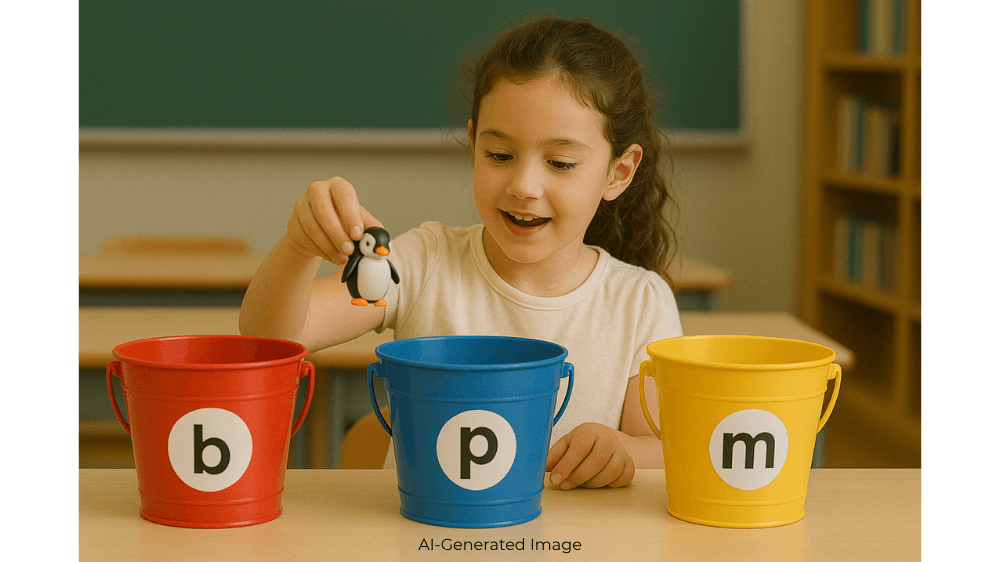
Teachers can tap their pointer finger against their thumb while saying the initial sound in a word to begin to familiarize children with the finger tapping routine, which many students use when segmenting whole words.


Resource(s)
Explore the resource(s) to support your implementation of this activity.
Toolkit resources help you implement high-quality instruction. To guarantee student success, these tools must be used in tandem with direct, systematic, mastery-oriented instruction and a high-quality curriculum.