/b/ /u/ /g/ - GUM? BAT?
We’ve all been there before. A student can segment words with ease, but when it comes time to blend all letter-sounds to produce the whole word, students often guess or make a mistake. Today’s blog post will focus on continuous blending as a promising technique to support early decoding efforts.
In order for students to become skilled phonic decoders, decoding requires students to recognize the relationship between each grapheme and its corresponding phoneme, and blend all sounds together to pronounce the word. Therefore, skilled phonic decoders possess strong phoneme-grapheme knowledge and automatic blending skills. There are several different blending techniques that can be modeled for students, and each should be taught explicitly through “I do, we do, you do” modeling or gradual release of responsibility. We’ll cover two techniques here.
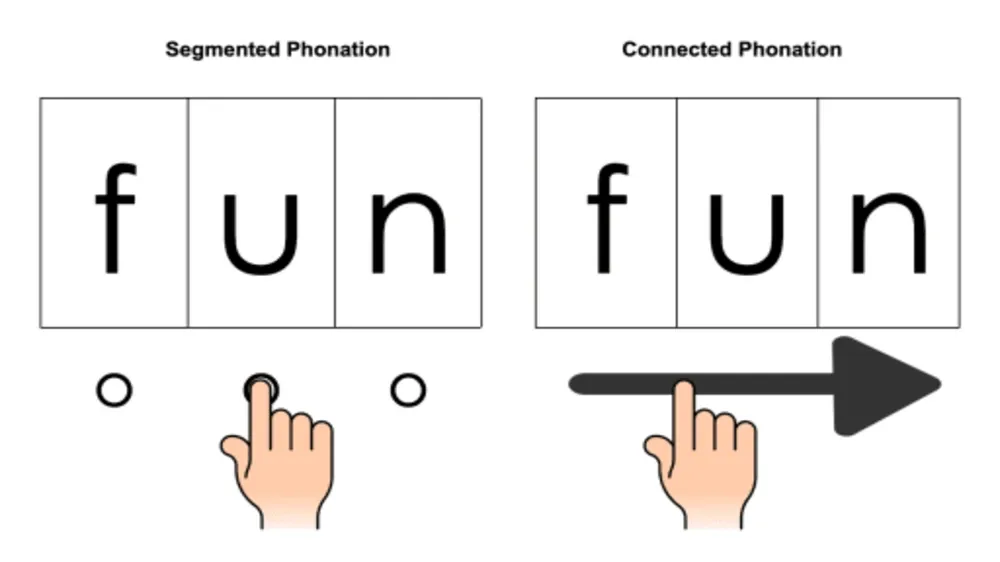
Segmented phonation is one of the most common approaches to blending. Segmented phonation involves teaching students to convert graphemes into phonemes by breaking up the speech stream, or pausing, between each sound. Typically, this decoding technique is first introduced with Elkonin boxes, where each individual box represents one phoneme. Students are required to say each individual phoneme /b/ /u/ /g/ before blending the word as ‘bug.’
Connected phonation involves teaching students to sound out consonant-vowel-consonant words without breaking the speech stream (Gonzalez-Frey & Ehri, 2021). Students are told to ‘keep their motors running’ by sliding their finger under continuant phonemes, phonemes that can easily be prolonged in one breath of air, to blend words. Say /m/, /n/ for /f/. Notice how each sound can be prolonged until you run out of breath. Since these sounds do not require us to break the speech stream, this is a more natural process of blending than segmenting each individual sound. In the referenced study, an error analysis suggested that pausing between phonemes caused students to forget initial phonemes during blending. When using connected phonation, students would read a word as /ffffffuuuuuuuunnnnnn/ instead of /f/ /u/ /n/.
So… Which phonemes should I use for this type of early decoding instruction?
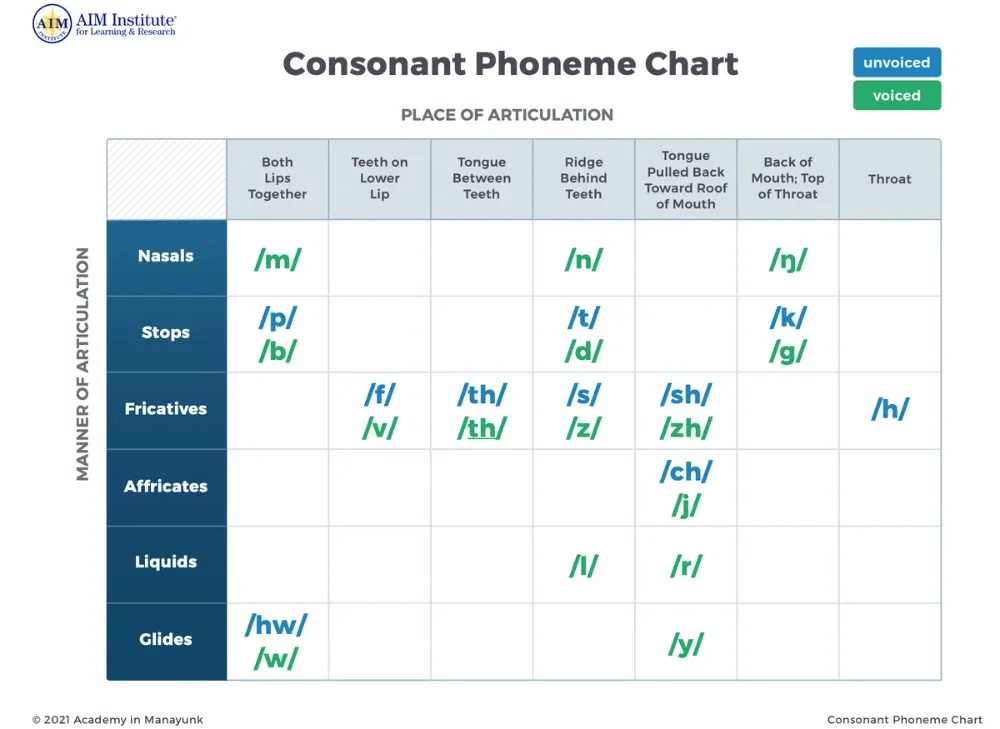
In addition to all short vowel phonemes, include consonant phonemes in the nasal, fricative and liquid rows for early readers. When building words for whole group decoding practice, educators can use both real words and nonwords. For example, words like an, in, if, fin, sin, and sam can all be taught after introducing just five correspondences - a, i, n, f, s.
So, do students need to know all sounds of the alphabet to begin blending?
No! Once students have mastered just two-three phoneme-grapheme correspondences, including one short vowel, blending instruction can and should begin. Doing so allows students to quickly experience success in decoding. Once they have a handful of correspondences underway they’ll be reading word lists, phrases, and sentences containing those patterns in no time!
Gonzalez-Frey, S.M. & Linnea C. Ehri, L. C. (2021). Connected phonation is more effective than segmented phonation for teaching beginning readers to decode unfamiliar words. Scientific Studies of Reading, 25(3), 272-285. https://doi.org/10.1080/10888438.2020.1776290