The Impact of Language Deficits on Comprehension
It is clear that a student needs to have strong word recognition skills in order to become a proficient reader, but accurate and automatic decoding alone is not sufficient. Proficient reading requires the development of both strong word recognition and strong language comprehension. Early literacy instruction focuses on building word recognition skills, but as students become skilled in decoding, the emphasis shifts to language comprehension. Not all students will develop both of these components of skilled reading with ease.
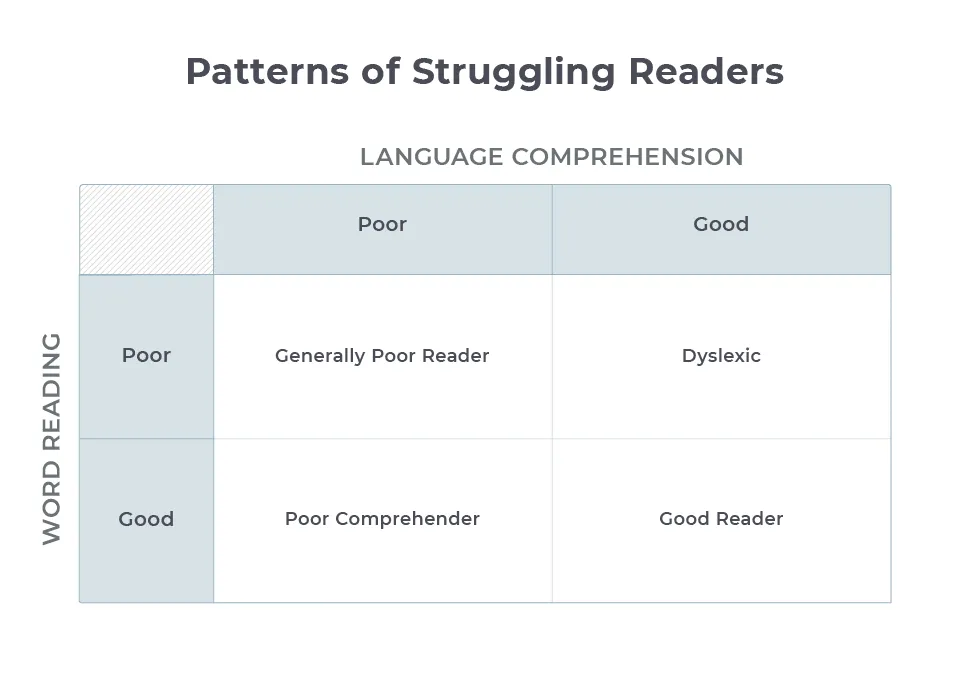 Adapted from Oakhill, Cain and Elbro, 2015
Individuals with reading problems in reading comprehension that are not attributable to poor word recognition may have comprehension problems that are general to language comprehension rather than specific to decoding (Spencer, Quinn, & Wagner, 2014).
A student’s language comprehension abilities also impact their overall reading proficiency. Students with specific reading comprehension problems are experiencing language-based difficulties that are not only limited to reading but also to their ability to listen and understand oral language. In order to better understand the impact of language comprehension deficits on reading ability, one can compare three profiles of reading difficulty: poor comprehenders, dyslexics, and poor readers with mixed-type difficulties.
While compromised reading comprehension can signal a language-based deficit, comprehension data mustn't be misinterpreted when working with English Learners. Unlike native English speakers, English Learners may read deceptively accurate and automatic, but struggle with comprehension due to limited background knowledge or vocabulary knowledge in the English language. If the learner were to be assessed in their native language, the deficit would not appear.
Poor Comprehender (or Specific Comprehension Deficit)
Students with poor comprehension can be competent, or even highly capable at word reading, but fail to recognize the author’s main takeaway or construct a mental model while reading due to language comprehension difficulties, also known as a specific comprehension deficit. The term hyperlexia refers to students who demonstrate advanced decoding ability and word recognition but still struggle to understand and use language and, therefore, fit this profile as well.
There are several components to language comprehension that impact a student’s ability to interact with text including background knowledge, vocabulary, language structures, verbal reasoning, and literacy knowledge. Students that are lacking background knowledge are unable to connect the text to the outside world or personal experiences. Those that struggle with vocabulary may be unable to derive accurate word meaning within the context of the text. Students with weak semantic and syntactic skills are unable to construct representations of sentences. Students who struggle with verbal reasoning may have difficulty understanding a character’s emotions, motivations, and intentions. They may also fail to understand symbolism and struggle with differentiating important parts from extraneous details. Those with poor literacy knowledge may insert, omit, or change the sequence of important story elements due to the inability to grasp text structure.
Memory and attention also play a critical role in processing text and monitoring for meaning. Long term memory impacts a student’s ability to store word meanings and information about text genre. Verbal memory, or recall of words and information, along with working memory are necessary to process, store, and integrate information from one sentence to the next in order to develop a coherent representation of text. Students with memory deficits will require repetition and multiple exposures and examples to support them in the comprehension process. In addition, sustained attention is necessary for processing information and constructing a mental model of the text. Students’ executive functions like attention and working memory can be compromised due to stress and anxiety. Therefore, teachers need to be aware of these various factors that can be impeding students’ comprehension, and provide additional support in the classroom accordingly.
To learn more about this specific comprehension deficit reading profile, check out the book, Understanding and Teaching Reading Comprehension: A Handbook, by authors Jane Oakhill, Kate Cain, and Carsten Elbro.
Dyslexia
In November 2002, the International Dyslexia Association’s Board of Directors adopted the following definition of dyslexia:
Dyslexia is a specific learning disability that is neurobiological in origin. It is characterized by difficulties with accurate and/or fluent word recognition and by poor spelling and decoding abilities. These difficulties typically result from a deficit in the phonological component of language that is often unexpected in relation to other cognitive abilities and the provision of effective classroom instruction.
Secondary consequences may include problems in reading comprehension and reduced reading experience that can impede growth of vocabulary and background knowledge.
A typical student with dyslexia demonstrates good language comprehension abilities when they are read to, but poor word recognition when reading independently. Language comprehension deficits are not the underlying core deficit of dyslexia. Students who struggle to decode with the proper fluency to understand what they are reading will experience problems with reading comprehension as compared to their relative strength in listening comprehension.
In addition, accurate and automatic word recognition is necessary for students to build language comprehension strategies when reading independently. If a student can’t decode text, they are going to have difficulty with vocabulary. They will struggle with words they should know at their grade level and that appear in appropriate grade-level text. Additionally, students that struggle to decode have limited access to texts and reduced reading experiences, which can prevent them from building background knowledge. However, it is important to recognize these difficulties as secondary consequences impacting their reading comprehension.
To learn more about this dyslexic reading profile, check out the book, Proust and the Squid: The Story and Science of the Reading Brain by Maryanne Wolf.
Generally Poor Reader (or Mixed Type Reading Difficulty)
Poor readers with Mixed-Type Reading Difficulty are those that decode below average and demonstrate poor language comprehension even in texts they can decode. Because of their poor decoding, these students often read below age-appropriate texts, and these texts may not provide adequate opportunities to develop language comprehension simultaneously. Even when the text does require children with this profile to activate language comprehension components, they typically have difficulty accessing background knowledge or integrating new ideas when reading independently. Similar to students with Specific Language Deficits, children with Mixed-Type Reading Difficulty often experience challenges with text processing skills like inference, comprehension monitoring, and text structure awareness. Working memory may contribute to these difficulties as well.
Understanding Reading Profiles
It is important to understand reading profiles in order to accurately identify the needs of students, effectively plan interventions, and determine appropriate accommodations to improve overall reading comprehension abilities. Students with reading difficulties may be eligible for special education services under the Individuals with Disabilities Education Act 2004 (IDEA) or Section 504 of the Rehabilitation Act of 1973.
Students may have an Individualized Education Program (IEP) or 504 plan listing the specialized instruction and accommodations needed to support their individual learning needs. Examples of common accommodations to support the various types of reading profiles may include extra or extended time for assignments, use of audiobooks, text-to-speech software and word prediction programs, note-taking support, and alternate means for assessment. These differentiation strategies enable students with disabilities to access the curriculum and maximize their success.
To learn more about all of these reading profiles, check out The Power of RTI and Reading Profiles: A Blueprint for Solving Reading Problems by Louise Spear-Swerling.