Intro to Activity
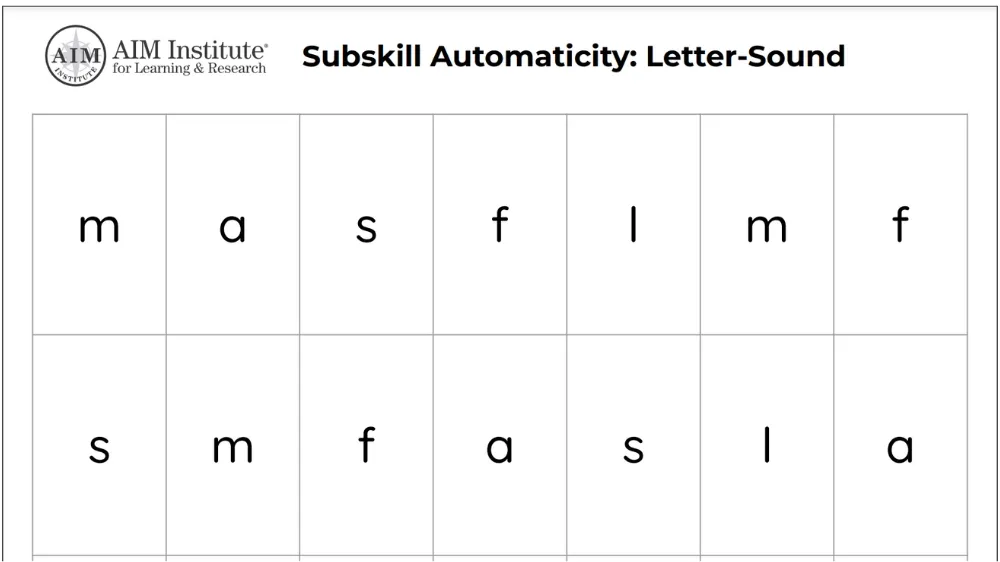
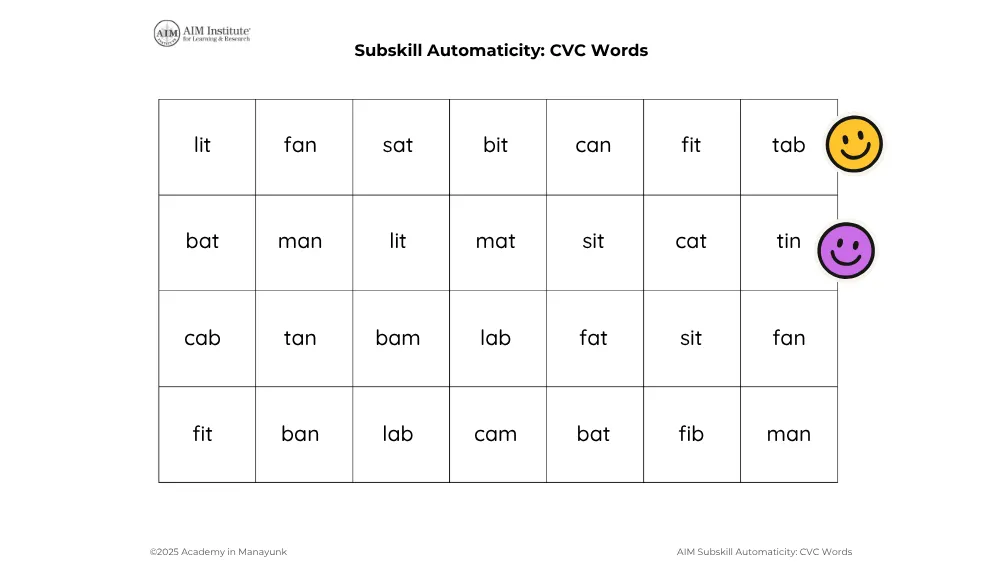
Subskill automaticity targets practicing a foundational reading subskill (e.g., letter names, letter-sound correspondences, word reading) with isolated, structured repetition to cement the skill to the point of effortless retrieval. For this activity, the teacher creates a practice line of the targeted subskill (for purposes of this page, we will primarily be referring to letter-sound correspondences) that students have previously learned. Students, either individually or in unison, recite the appropriate sound for each letter, reading from left to right across the line. The goal is not to encourage students to go as fast as possible to the point of being a tongue twister. Instead, the rate should allow students to clearly pronounce each sound at a brisk pace (about a one-second interval) to both reinforce accuracy and promote automaticity. A production is not automatic if a student pauses for more than one second before responding, and/or self-corrects before providing the appropriate sound.
This activity is described below to practice letter-sound correspondences, but it can be adapted for other skills, such as letter-name knowledge or practice reading whole words.
Students
Discover the types of students who may benefit from this activity.
Students in the Partial Alphabetic Phase (students recognize some letter-sound relationships) typically benefit from practice with letter-sound correspondences and can use subskill automaticity training drills to encourage quick and effortless retrieval of learned sounds. We recommend using this activity to practice letter-sound correspondences with Kindergarten students and with struggling readers in later grades needing additional support with this knowledge.
It is important to note that teachers select skills for this activity based on their phonics scope and sequence and student needs, as it can be adopted to meet a variety of needs. Because of this flexibility, practicing subskill automaticity can be appropriate for students across a wide range of abilities.
Getting Started
The steps outlined in the tabs below provide a clear and structured approach for teaching this activity to students.
Create lines of approximately ten items that integrate both previously taught skills with newly and accurately learned ones. While this drill can be done with whole words, this lesson plan focuses on practicing letter-sound correspondences.
Pair students with a partner (if not working individually or in a small group) and distribute a copy of the letter sheet to each student. If marking progress, you may wish to keep a copy of the practice strips or other prepared note-taking document.
Clearly explain the purpose of the activity.
"For this activity, we are going to practice reading the sounds of our letters until they come really easily to us, without having to think too hard to try to remember."
Hold up a line of letters as an example and read the sounds from left to right, pointing to each letter and saying the corresponding sound, at a pace of approximately 1-second intervals. It might be helpful to model stumbling over a correspondence, and then verbalizing at the end of the line that you want to try again to get the whole line smoothly.
Next, practice a line in unison with the student(s).
The student next practices this skill independently. Students may recite each item chorally as a small group, or take individual turns.
When students practice independently, you may choose to keep track of their automaticity progress by keeping a record of each accurate response that the student provided quickly and effortlessly. One way to do this is by marking a check by each read item on your own copy of the practice strip. Additional note-taking ideas are mentioned in Take Note!, below.
Note that for purposes of this drill, students should not name the letter before stating the sound, or audibly blend sounds if practicing this drill with whole words. The purpose of this activity is strictly to practice the automaticity of the learned skill.
Immediately support students if they produce an incorrect phoneme or add an additional vowel sound to the end of the phoneme (such as 'juh' vs. /j/).
Allow the student to take additional time to retrieve sounds if needed, and record this lack of automaticity accordingly. Encourage students to reattempt the skill line in order to reach the desired pace.
Take Note!
Here are some special considerations when using this activity:
- First accuracy, then automaticity. The majority of tasks in the repeated practice drills should be newly learned patterns that students have learned accurately, but have not yet mastered to the point of automaticity.
- Repetition is key. To increase practice opportunities, this activity can be done independently, with a partner, or sent home for practice.
- Build automaticity while monitoring growth. This activity helps students practice repeated retrieval of a learned skill, which in and of itself is beneficial to their learning. But it also provides educators with valuable insight into a students' mastery of those learned skills.
- Analyze your data. If tracking how many correct responses a student provides in a given timeframe, consider that fast, inaccurate responses may yield the same overall "score" as slow but accurate responses. Consider how more detailed data collection can have different instructional implications.
- Monitor more than errors. You may wish to keep track of which sound-symbol correspondences are tricky for students by making a note if the student is accurate but slow to produce a sound. Depending on how you are collecting data, this might be achieved by adding a second column to check off whether or not the skill was automatic (with the first column indicating accuracy), or by using a different way of marking a task (such as a ✔️ for accurate but a ✔️➕ when the student is both accurate and automatic).
- Provide spaced practice. Interleave current targets with previously learned knowledge to ensure retention and continued effortless recall.
- Review skill overview. For additional considerations when targeting this skill, see the Automaticity and Fluency Overview.
Classroom Connection
See this activity in action through a teacher-led demonstration.
Watch as this teacher practices subskill automaticity using whole words with a small group. She starts with guided practice and then has students take turns independently. Consider how, in a larger group, you might use partners to accomplish this goal. Which words would you record as accurate? Automatic?
Differentiation
Learn how you can enhance instruction to meet the needs of diverse learners.
- If a student appears overwhelmed with the amount of text on the activity page, consider either cutting the paper into strips so that they are given one line at a time or cover additional rows on the activity page with an additional sheet of paper.
- Some students benefit from tracking each item (be it a letter or word) with their finger.
- Note sound-letter correspondences that a student struggles with. Customize the repeated practice sheets to interleave additional practice with difficult pairings for the student.
- When several repetitions of a line are required to achieve automaticity, consider providing a model for the student. For example, after the student's second attempt, model the line at the target pace, while the student follows along with their finger or pointer. Next, practice the line together before the student attempts it independently again.
- For additional differentiation when targeting this skill, see the Automaticity and Fluency Overview.
Coaching Corner
For occasional use: optional ideas to bring energy, engagement, or ease to the activity.
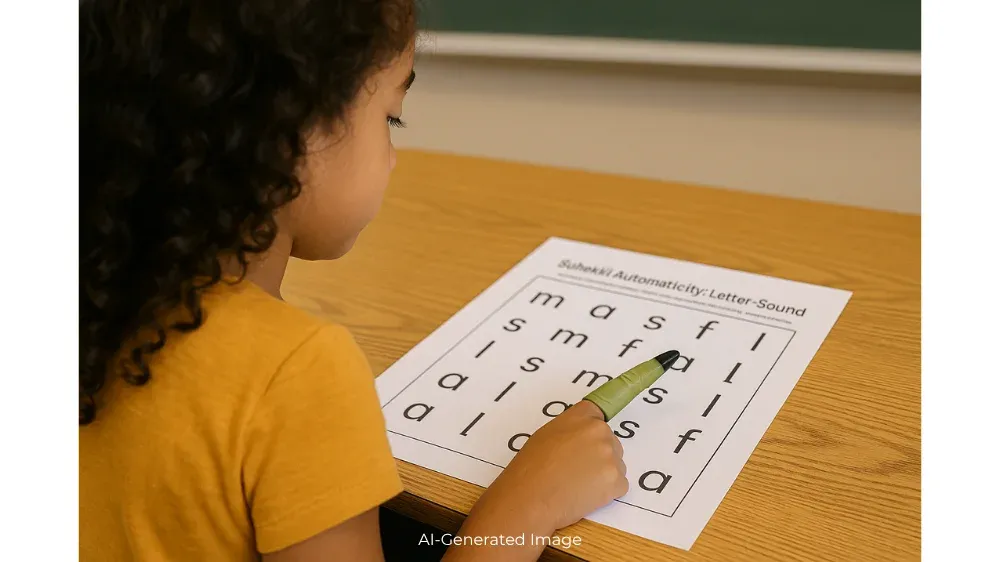
Offer students fun options to use when pointing to each letter in this activity. Some ideas include a plastic witch finger, wand, or decorated craft stick.
Resource(s)
Explore the resource(s) to support your implementation of this activity.
Toolkit resources help you implement high-quality instruction. To guarantee student success, these tools must be used in tandem with direct, systematic, mastery-oriented instruction and a high-quality curriculum.