Intro to Activity
The Advanced Decoding Routine equips students with a powerful tool for reading complex multisyllabic words. It guides students to identify and mark known prefixes and suffixes, use their knowledge of syllable division patterns to divide any portion of the word remaining, blend the parts together, and then confirm that their pronunciation matches a real word. These steps help students apply their knowledge of morphemes (meaningful word parts) and syllables to decode unknown words, rather than skipping the word, guessing, or inefficiently going sound by sound.
The routine builds on the skills and steps introduced with the Simple Decoding Routine. But the Advanced Decoding Routine layers on an attention to syllables and morphemes when decoding. This focus provides potentially helpful cues on stress patterns and even word meanings.
Students
Discover the types of students who may benefit from this activity.
Students transitioning from the Full Alphabetic Phase (students have most major phoneme-grapheme correspondences in place) to the Consolidated Alphabetic Phase (students rely more on larger units rather than individual graphemes to decode) could benefit from using the Advanced Decoding Routine to decode unknown words. It may be easier for students who are accurate and automatic in reading a variety of single-syllable words.
Instruction and practice can usually begin toward the end of grade 1 or the beginning of grade 2 when students typically begin to learn basic prefixes and suffixes (e.g., <re->, <-ing>) and read multisyllabic words (e.g., jumping). It can continue with older readers in the Consolidated Alphabetic Phase.
Getting Started
The steps outlined in the tabs below provide a clear and structured approach for teaching this activity to students.
Prepare a word list, sentence, or passage containing words with previously taught phoneme-grapheme correspondences and affixes (prefixes and suffixes).
Use words in a student’s oral vocabulary when possible. If a word is not in a student’s oral vocabulary, the student may not recognize the word even after sounding it out.
It may be helpful to select multisyllabic words students are reading in recent or upcoming texts to increase relevance and transfer. For additional guidance on word selection, see Take Note!, below.
Remind students that multisyllabic words are easier to read when they are broken into chunks. Explain the purpose of the routine.
Example:
"Today, we're going to break longer, unfamiliar words into smaller chunks to read them accurately."
This routine has several steps. In the first step, students box any affixes in the word. In the second step, students divide the remaining parts into syllables. Then, students may identify the syllable type to accurately sound out each word part. Finally, students confirm the word by connecting the blended parts to a known word in their oral vocabularies. This teaches students to self-monitor and check whether the word is familiar and makes sense. Sometimes they may need to sound the word out again, but sometimes they need to adjust their pronunciation slightly to turn the blended phonemes into a recognizable word.
Model the routine with a teacher-led demonstration. This example uses a single word, but the routine can be applied in connected text by stopping to model the Advanced Decoding Routine for unknown words.
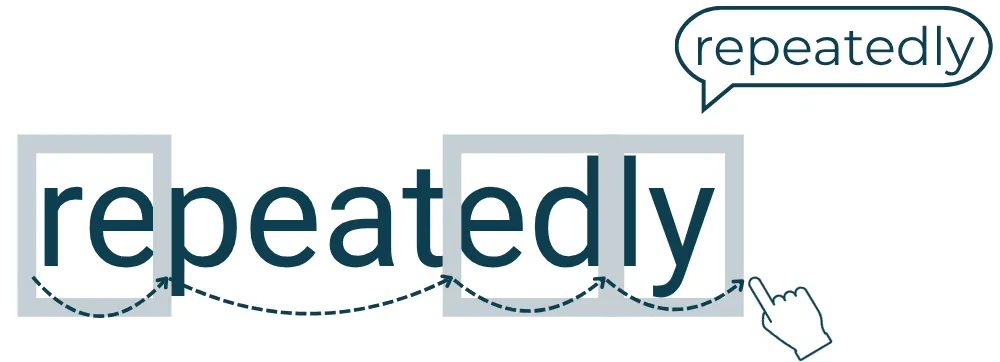
Example for the word repeatedly.
"Watch me read this word."
Step 1: Box Prefixes and Suffixes
- "First, I look for any prefixes or suffixes in the word."
- [Box the prefix <re->, and the suffixes <-ed> and <-ly>.]
- "This word has the prefix <re-> and the suffixes <-ed> and <-ly>."
Step 2: Divide Multisyllabic Words by Syllable
- "Next, I look at the remaining part. There is one vowel sound [point to <ea>], so there is one syllable. I don't need to break this part up."
Step 3: Identify Syllable Type (i.e closed, open, VCe, etc.)
- [If needed, remind students <ea> commonly represents /ē/, and/or label <peat> as a "vowel team" syllable.]
- "The vowel team represents /ē/."
Step 4: Sound Out
- [Point under each chunk (e.g., prefix, syllable, suffix) as you read the part.]
- "Listen to the parts /rē/.../pēt/.../ĕd/.../lē/..."
Step 5: Confirm
- "Now I make the parts sound like a real word...repeatedly.
- [Provide sentence context and/or brief definitions as needed.]
- "Jada checked on her sunflower repeatedly, looking at it over and over to see if it had grown."
Note: When reading multisyllabic words, there is often a mismatch between the sounded-out pronunciation (e.g., /rē/.../pēt/.../ĕd/.../lē/) and the pronunciation in spoken language (e.g., something closer to /rə/.../pē/.../təd/.../lē/). Notice that the first and third syllables, being unstressed, use a schwa vowel sound in most pronunciations. The purpose of this step is to connect the blended parts to a known word in students' oral vocabularies.
Provide additional words or text for students to decode and guide students through the steps in the routine. Have each student box the affixes and divide the word into syllables. Use a choral response to maximize participation during steps 4 and 5.
Example for the word coincidence:
- Step 1: Box Prefixes and Suffixes
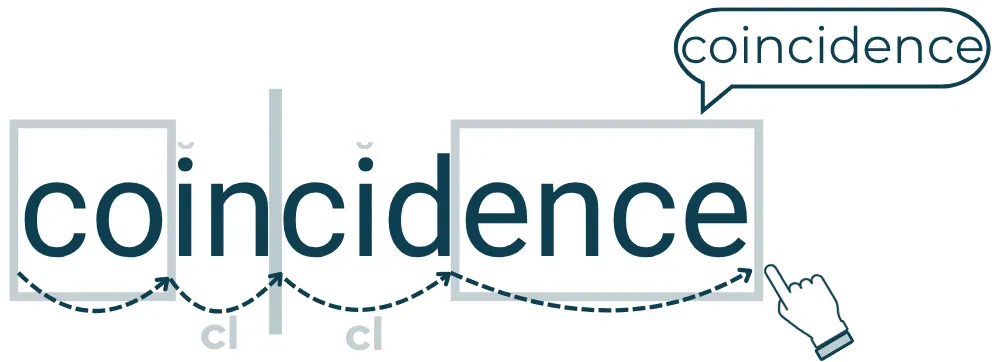
- "Box the prefixes and suffixes with me. What prefix do you see in this word? (<co->) What suffix do you see? (<-ence>)."
- Note: Boxing the prefix <co-> helps students notice this word doesn't have an /oi/ vowel team as it might otherwise look at first glance.
- Step 2: Divide Multisyllabic Words by Syllable
- "Let's break apart the syllables. Each syllable needs a vowel sound. Typically, we split between the consonants."
- [Indicate these parts with something like a slash. See image below.]
- Step 3: Identify Syllable Type
- "Let's identify these syllables to read them correctly. This syllable is...? Closed. The next syllable is...? Closed. So the vowel <i> in these syllables will make the short /ĭ/ sound."
- [If needed, add the short vowel symbol above the short <i> letters and/or add the closed syllable label. Now would also be an appropriate time to remind students that if <c> is followed by <i>, it often represents /s/.]
- Step 4: Sound Out
- "Point under the parts and read with me /cō/.../ĭn/.../sĭd/.../ĕnce/."
- Step 5: Confirm
- "Say the word with me: coincidence. Liam found a book about volcanoes at the library, and by coincidence, his class started learning about volcanoes in science the very next day."
Provide additional words or text for students to decode independently. Fade prompting as students internalize the routine. Monitor responses for accuracy throughout the activity.
Use the routine consistently. Students should not learn the Advanced Decoding Routine during phonics, but then be expected to use a different strategy at other times of the day. Anytime students encounter an unfamiliar multisyllabic word while reading, prompt them to use the Advanced Decoding Routine. However, words that are recognized automatically don’t require decoding. Similarly, if the word is first presented orally (such as introducing a vocabulary word), there would be no purpose in next making students walk through these steps.
In sum, continue using the routine on an as-needed basis for unknown words, but don’t force its use with known ones.
Immediately support students who make an error.
Example:
If a student reads coincidence as /koin/.../sĭd/.../əns/, with the first syllable pronounced like the word coin, they have missed that the word has a prefix. You could say,
"This word starts with the prefix <co->. Try boxing that prefix and reading the word again."
If the student cannot read the word appropriately on the second attempt, provide the appropriate response.
Take Note!
Here are some special considerations when using this activity:
- Two-syllable words follow division rules more reliably. Therefore, when first introducing the Advanced Decoding Routine, it may be helpful to begin with two-syllable words (e.g, basket, table, open). This also simplifies the routine by eliminating step 1: box prefixes and suffixes.
- Progress beyond two-syllable words. Longer words become more prominent as students progress through school and often are the words that convey the key content (e.g., metamorphosis). Provide explicit instruction and practice with longer words to support fluency, vocabulary, and overall reading comprehension outcomes.
- The confirm step is critical. The phonemes in spoken words are coarticulated. In other words, one phoneme influences how another will sound. For this reason, a "blended word" may sound different than the actual word even when sounded out correctly. In multisyllabic words, additional factors such as reduced syllables (e.g., every: which is typically pronounced more like /ĕv/.../rē/ rather than /ĕv/.../er/.../ē/) or syllable stress (e.g., record as a noun with the first syllable stressed versus record as a verb with the stress on the second syllable) further impact pronunciation. Students need regular practice blending syllables and practicing flexibility with different stress patterns to morph the "blended word" into a recognizable spoken word.
- Correct decoding attempts of unfamiliar words. While we typically choose words for instruction that are in a student’s oral vocabulary, as we get older, reading is a common way to learn new words. However, readers (adults and students) sometimes mispronounce words they’ve only seen in print (e.g., epitome: pronounced as /ĕp/.../ĭt/.../ōm/ rather than /ə/.../pĭt/.../ə/.../mē/). Therefore, if students decode a word, but can't confirm the word to land on a correct pronunciation, provide the correct pronunciation and repeat it several times naturally as you explain the meaning of the word and use it in a sentence.
- Include pronunciation variation in instruction. Due to the rich variances in language, there may be words (e.g., caramel and crayon) that are pronounced with a different number of syllables or different phonemes (e.g., aunt pronounced as /ănt/ ) based on dialect. When a decoded word is pronounced differently due to dialect, do not require a "corrected” pronunciation. Teachers should honor and recognize these as language variations.
- Students must be taught how to break words into readable parts. Oral syllable division, where a student says a word and breaks it into syllables (often by clapping), is a strategy that can be used to write a word, but it is not an appropriate way to divide a word to decode it (step 2). This approach would be ineffective because the students do not know what the word is to clap until they've decoded it. And if you tell the word to students, there is no need to decode it.
- The goal is readable word parts, not perfect division. Some words can be divided in more than one way but result in the same pronunciation (e.g., mitten: mit│ten versus mitt│en). There are many strategies to teach students how to divide words. They vary in the level of detail taught to students. One common approach is to use syllable division patterns (e.g., VC│CV). Another is to break words apart without rules, but using the principle that every syllable has a vowel sound. The specific method matters less than giving students a reliable way to chunk longer words into readable parts and the ability to adjust vowel sounds, because no division rule can always tell us if a vowel will be short, long, or a schwa.
- Don't get hung up on "true affixes." Similar to above, the goal of the Advanced Decoding Routine is to break words into manageable parts. In a word like understanding, <un-> is not truly a prefix because it does not hold the meaning "not or opposite" in this term. But, because students can't access the meaning of a word until they've decoded it, boxing the letter <un> supports decoding and should not be discouraged or corrected.
- Keep syllable type instruction brief and fade over time. Learning syllable types can support decoding and encoding, but instruction should be brief. In some studies, as little as two total hours of instruction was effective. Provide substantial practice in decoding multisyllabic words and use syllable types as tools to support decoding, not ends in themselves. Gradually remove this support as students increase their decoding accuracy.
- Ensure all students read the word. In some classrooms, all students participate in dividing the word, but then only one student or the teacher reads it for the class. This limits decoding practice to a few voices. Instead, to build decoding fluency, make sure each student gets a chance to sound out and read the word themselves.
- Not every word needs to be divided and sounded out. Words that are recognized automatically don’t require decoding. Similarly, if the word is first presented orally (such as introducing a vocabulary word), there would be no purpose in next making students walk through these steps. Continue using the routine on an as-needed basis for unknown words, but don’t force its use with known ones.
- Review skill overview. For additional considerations when targeting this skill, see the Decoding Overview.
Classroom Connection
See this activity in action through a teacher-led demonstration.
This video begins with an orientation on how to extend the Simple Decoding Routine until students can use the full Advanced Decoding Routine. Next, you'll watch an older reader applying the Advanced Decoding Routine to read unfamiliar words within sentences her teacher has prepared. The student has internalized the routine and independently uses it to decode challenging words. You may notice the student does not box the suffixes <-ion> and <-s> as two separate morphemes, yet still accurately reads the word. This flexibility is the intended outcome of the Advanced Decoding Routine. Mastery is not defined by strict adherence to every step, but by a student’s ability to apply the routine flexibly to decode most unfamiliar words. Keep this goal in mind to avoid overemphasizing mastery of extraneous details.
Differentiation
Learn how you can enhance instruction to meet the needs of diverse learners.
- Students who continue to struggle to connect the sounded-out pronunciation to a known word in their oral vocabulary may benefit from explicit instruction on how to correct mispronunciations. Not all words fall within our most common phonics patterns, so students need to learn to be flexible, especially when reading multisyllabic words. Part of this flexibility is learning to adjust the vowel and/or syllable stress. One helpful routine is to present a common phonetically decoded mispronunciation of a known word (e.g., "He nodded to show his.../ăp/.../prŏv/.../ăl/)," and then have the student say the real word (approval).
- Other times, students may be blending words unfamiliar to them. In this case, students may benefit from additional vocabulary support. Morphology instruction or using picture cues after the student has blended the word can help reinforce or introduce new vocabulary. This can be especially helpful for English Learners and students with language difficulties.
- For students struggling to remember and identify affixes, consider posting a list of common affixes for students to reference.
- For students struggling to attend to all the letters in a word and perhaps are just using the beginning few syllables to partially sound out and guess the word, try using a word chain. Select a carefully sequenced list of words that share a base word or syllable pattern (e.g., prepare → prepared → unprepared → preparation → preparatory). Present the chain one word at a time. You can do this on a whiteboard so that students can see you add or delete word parts before they attempt to read the word.
- For students who are still developing confidence or accuracy with the routine, consider starting with Step 4. Provide the word already segmented into decodable chunks, as shown in the image below.
- For additional differentiation when targeting this skill, see the Decoding Overview.
Coaching Corner
For occasional use: optional ideas to bring energy, engagement, or ease to the activity.
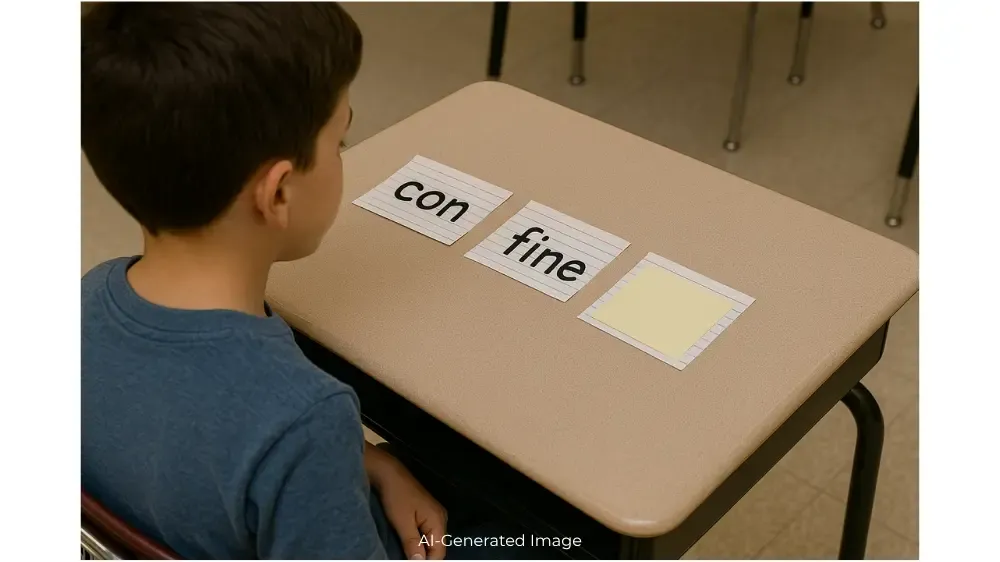
Sometimes, readers enjoy reading a word that is revealed syllable–by-syllable. When reading a multisyllabic word, you or your students may cover each syllable with a sticky note. Then, students would peel off note by note to read each syllable.


Resource(s)
Explore the resource(s) to support your implementation of this activity.
Toolkit resources help you implement high-quality instruction. To guarantee student success, these tools must be used in tandem with direct, systematic, mastery-oriented instruction and a high-quality curriculum.