
Core Skill
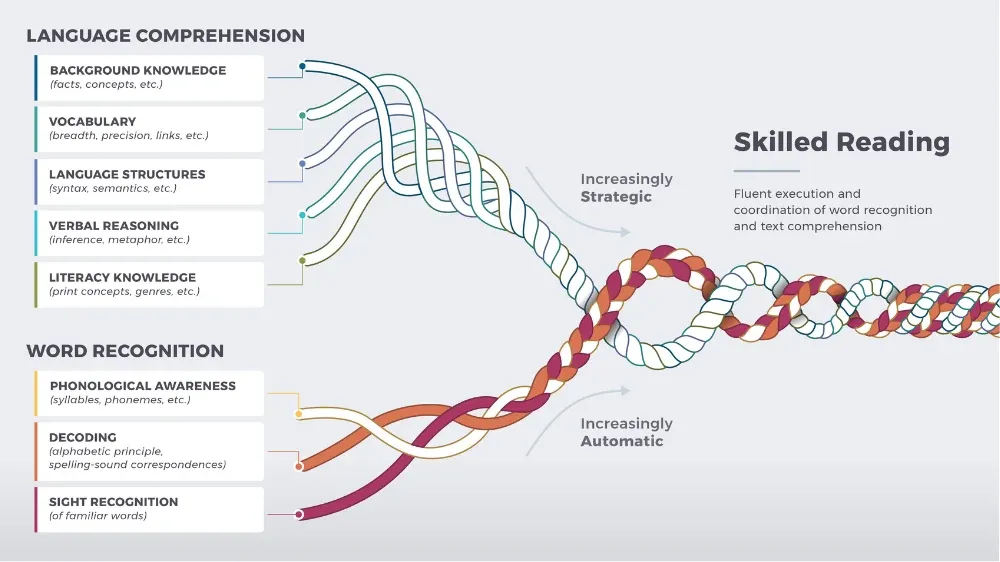
Decoding is the process of using learned letter-sound correspondences to sound out words and typically precedes more automatic, effortless word recognition. When a student demonstrates automatic word recognition, they access the word as if by sight. Decoding is the reverse process of encoding.
Expanded Definition
To learn to read and spell, students must develop an understanding of the alphabetic principle—the insight that letters systematically and predictably correspond to spoken sounds. Systematic phonics instruction is one of the most effective ways to develop this knowledge, especially for beginning and struggling readers. Systematic phonics instruction explicitly teaches students a planned, sequential set of relationships between graphemes (letters) and phonemes (sounds). This understanding then lays the foundation for more advanced instruction in how meaning and sound interact in English words. Students apply their phonics knowledge when they decode and encode. Decoding and encoding skills have a reciprocal relationship, meaning instruction in one often contributes to growth in the other.
For students to accurately decode, they must be able to blend phonemes. This requires both effortless retrieval of letter-sound correspondences and effortless blending of those speech sounds. Readers are then able to connect the produced word with one in their oral vocabulary and access its meaning. If students are not familiar with the produced word, they must either try other sounds the letters can represent (such as trying the short /ĕ/ sound for the grapheme <ea> in spread when “spreed” is not recognized) or acknowledge that they are learning new vocabulary. Continued practice decoding words accurately leads to automaticity with word recognition. As students transition away from sound-by-sound decoding to effortless, automatic word recognition, they will be better able to focus on the meaning of the overall text.
The Research
Research consistently shows that phonics is foundational for early reading acquisition. Effective decoding instruction helps students apply phonics knowledge to read unfamiliar words, and ultimately builds the foundation for automatic word reading (Ehri, 2005; Miles et al., 2018). Instruction typically begins in kindergarten and must follow a logical sequence, practicing words both in isolation and in connected text (Foorman et al., 2016; NRP, 2000). While the foundational role of phonics is well-established, the optimal duration of instruction and the ideal number of correspondences to be taught need further study (Castles et al., 2018; NRP, 2000).
Phonics and decoding practice should prioritize real words over nonsense words and high-utility words over rare ones (e.g., pram or vat). Exposure to words during decoding practice may lead to faster recognition of these words in future reading (Ehri, 2014; NRP, 2000; Share, 1995) and offer a chance to build vocabulary and tie decoding practice to oral language (Adams, 1990; NRP, 2000; Perfetti & Hart, 2001). It also supports students’ spelling. Multiple exposures to a word foster a familiarity that allows students to gain a sense of what “doesn’t look right” when attempting to spell a word. Therefore, nonsense words are generally reserved for assessing, rather than practicing, students’ decoding skills.
In early reading instruction, decoding instruction commonly uses decodable texts for additional practice. These phonetically-controlled texts align with taught phonics patterns and may be beneficial as students progress from the partial to full alphabetic phases of reading (Castles et al., 2018; Ehri, 2005; Mesmer, 2001; Murphy Odo, 2024). During this transition, students are developing a solid understanding of letter-sound relationships and learning to decode words by fully analyzing letter sequences. Because decodable texts sometimes rely on uncommon words and, at times, awkward language structures, and because researchers have not yet isolated their use as being beneficial for students, teachers should use these instructional tools judiciously, especially beyond the end of first grade.
Although not all words have phonetic spellings, students can still apply their phonics knowledge to most graphemes in the word. This is especially relevant for high-frequency words, which often include irregular spellings (e.g., was, said) but still contain some letter-sound correspondences that align with common phonics patterns (e.g., /w/ in was or /s/ and /d/ in said). For this reason, preliminary evidence suggests students may benefit from using grapheme-phoneme relations to decode these words (Miles et al., 2018).
As students progress through school, they encounter increasingly complex multisyllabic words, and some readers may require explicit instruction to decode these longer words (Vaughn et al., 2022). Research supports using a routine that teaches students to use morphemes (meaningful word parts) and syllables to read these complex words (Kearns & Whaley, 2018; Knight-McKenna, 2008; Bhattacharya & Ehri, 2005; Diliberto et al., 2008). An effective instructional routine will guide students to flexibly break a word into parts, blend the parts together, and then confirm the word. Studies have shown that learning to decode is a critical component of reading for all learners, and one that can be effectively taught and practiced.
Take Note: Additional Considerations for Targeting this Skill
1. Eliminate the schwa. When extra phonemes are added to the end of consonants (e.g., /buh/ for <b> instead of /b/), blending is more difficult. Model and expect precise phoneme pronunciation. This is sometimes referred to as "clipping your sounds."
2. Prioritize newly taught phonics patterns in practice. A helpful target is approximately 80% of practice devoted to new or unmastered grapheme-phoneme correspondences, with the remaining 20% focused on cumulative review. Provide multiple opportunities to decode words with the same newly introduced grapheme (e.g., thin, with, math) to promote retention.
3. Emphasize decoding, not guessing. Instruction that encourages students to predict words based on pictures, sentence meaning, or initial letters (e.g., MSV cueing strategies) can foster habits of guessing rather than decoding. Predictable texts may reinforce these habits by rewarding guessing instead of grapheme-phoneme analysis. Instead, teach students to use decoding as the primary strategy for identifying unfamiliar words and rely on context only to determine meaning.
4. Focus on decoding, but don't neglect meaning. After reading a word, ensure students confirm the word is a real, known word and support understanding as necessary with brief teachable moments.
5. Decodable texts are intended to be a scaffold. These texts provide critical practice for students to apply newly taught phonics patterns. However, they are intended to be used temporarily at the earliest stages of reading. Decodable texts should be used strategically within phonics instruction and should not be the only texts students read.
Differentiation
- For English Learners who have received literacy instruction in their native language, identify differences in phoneme-grapheme relationships between their language and English. In alphabetic languages, some graphemes may overlap with English but are used to represent different phonemes. When a phoneme-grapheme relationship differs from its English correspondence or a grapheme does not exist in a student’s native written language, provide additional instruction and practice to reinforce the relationship.
- Words that use phonemes absent from a student's native oral language or dialect can be especially difficult to accurately blend and decode. Provide additional instruction and practice opportunities as needed.
- Embed opportunities to build language. Consider that even simple CVC (consonant-vowel-consonant) words can provide opportunities for vocabulary enrichment and practice shifting between the multiple meanings that words such as pen and jam can have. The use of picture cues can help reinforce or introduce new meanings. This can be especially helpful for English Learners and students with language difficulties.
- If you notice a student says the individual phonemes or syllables correctly, but then reads the word incorrectly, this may indicate that they need more help with blending. For additional activities and guidance on instruction in this skill area, review our Phonological/Phonemic Awareness Skill Overview.
- Students with word-reading difficulties, including those with dyslexia, often benefit from highly explicit instruction, immediate feedback, and ample review. When students make an error, pause briefly to model the correct response and allow the group to repeat. Avoid lingering too long on any single item to preserve momentum. Provide multiple opportunities to decode words and repeated exposures with difficult patterns to ensure mastery.
Bhattacharya, A., & Ehri, L. C. (2004). Graphosyllabic analysis helps adolescent struggling readers read and spell words. Journal of Learning Disabilities, 37(4), 331–348. https://doi.org/10.1177/00222194040370040501
Castles, A., Rastle, K., & Nation, K. (2018). Ending the reading wars: Reading acquisition from novice to expert. Psychological Science in the Public Interest, 19(1), 5-51. https://doi.org/10.1177/1529100618772271
Diliberto, J. A., Beattie, J. R., Flowers, C. P., & Algozzine, R. F. (2008). Effects of teaching syllable skills instruction on reading achievement in struggling middle school readers. Literacy Research and Instruction, 48(1), 14–27. https://doi.org/10.1080/19388070802226253
Ehri, L. C. (2005). Development of sight word reading: Phases and findings. In M. J. Snowling & C. Hulme (Eds.), The science of reading: A handbook (pp. 135–154). Blackwell Publishing. https://doi.org/10.1002/9780470757642.ch8
Ehri, L. (2014). Orthographic mapping in the acquisition of sight word reading, spelling memory, and vocabulary learning. Scientific Studies of Reading, 18(1), 5–21. https://doi.org/10.1080/10888438.2013.819356
Kearns, D. M., & Whaley, V. M. (2018). Helping students with dyslexia read long words: Using syllables and morphemes. Teaching Exceptional Children, 51(3), 212-225. https://doi.org/10.1177/0040059918810010
Knight-McKenna, M. (2008). Syllable types: A strategy for reading multisyllabic words. Teaching Exceptional Children, 40(3), 18–24.
Mesmer, H. A. E. (2001). Decodable text: A review of what we know. Reading Research and Instruction, 40(2), 121–142. https://doi.org/10.1080/19388070109558338
Miles, K. P., McFadden, K. E., & Ehri, L. C. (2019). Associations between language and literacy skills and sight word learning for native and nonnative English-speaking kindergarteners. Reading and Writing: An Interdisciplinary Journal, 32(7), 1681–1704. https://doi.org/10.1007/s11145-018-9919-5
National Reading Panel. (2000). Teaching children to read: An evidence-based assessment of the scientific research literature on reading and its implications for reading instruction (NIH Publication No. 00-4769). U.S. Department of Health and Human Services, National Institutes of Health, National Institute of Child Health and Human Development.
Murphy Odo, D. (2024). The use of decodable texts in the teaching of reading in children without reading disabilities: A meta‐analysis. Literacy, 58(3), 267–277. https://doi.org/10.1111/lit.12368
Perfetti, C. A., & Hart, L. (2001). The lexical basis of comprehension skill. In D. S. Gorfein (Ed.), On the consequences of meaning selection: Perspectives on resolving lexical ambiguity (pp. 67–86). American Psychological Association. https://doi.org/10.1037/10459-004
Share D. L. (1995). Phonological recoding and self-teaching: sine qua non of reading acquisition. Cognition, 55(2), 151–226. https://doi.org/10.1016/0010-0277(94)00645-2
Vaughn, S., Solis, M., Miciak, J., Fletcher, J. M., & Roberts, G. (2022). Providing reading interventions for students in grades 4–9 (WWC 2022009). U.S. Department of Education, Institute of Education Sciences, National Center for Education Evaluation and Regional Assistance, What Works Clearinghouse. https://ies.ed.gov/ncee/wwc/PracticeGuide/29