What comes to mind when you think about your vocabulary instruction? Perhaps you provide a “student-friendly definition” or 4-square semantic map, like a Frayer Model, to help your students acquire an important word or concept. Typical Frayer models, like this one from Adlit.org include a space for a student-friendly definition, examples/non-examples, and important features/characteristics. This model is a really helpful tool to understand a vocabulary term, but let’s explore 3 additional options to develop word knowledge within the secondary classroom. While these components of explicit word learning experiences are helpful, building depth of word knowledge is much more complex. Deep word knowledge includes understanding a word’s nuanced use in a sentence, including morphological variations, semantic variations, and grammatical construction (August et al., 2005; Nagy & Scott, 2000).
Investigate Morphemes & Morphological Variations
Morphemes are the smallest units of meaning within a language. Developing a student’s morphological awareness by explicitly teaching the most common suffixes, prefixes, and Greek and Latin bases can help students infer the meaning of unknown words within the text.
Activity: Students investigate words that have the same morpheme and create a poster/chart displaying some of the more common usages and their definitions. For students who are just starting out, we recommend providing a list of words with the same base. Consider the following chart example for the bases scrib/script:
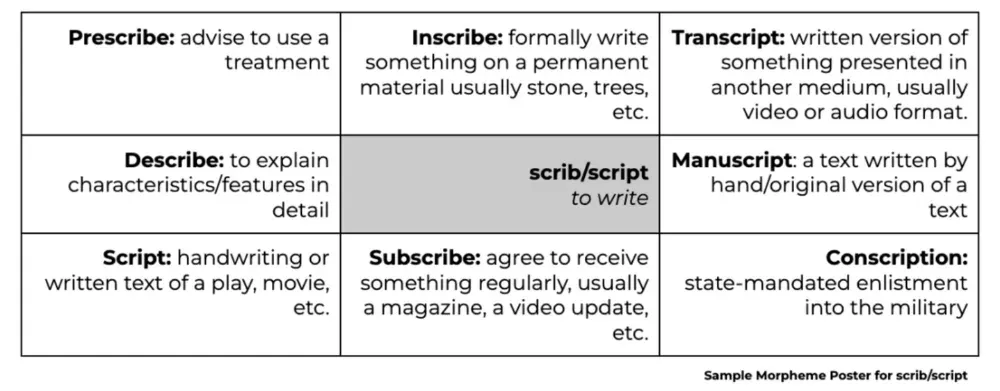
When working with English learners, teachers also use this opportunity to draw attention to the common word parts or the cognates to support students’ acquisition, e.g. describe/describir.
Once students have acquired a number of base elements, consider examining cross-curricular words that share the same prefix like <dis-> e.g. disrupt, displacement, discovery, disembark. It can be helpful to meet with your grade-level team at the beginning of the year to map out which morphemes are taught across content-area teachers, since this work is not sufficient if left solely to the English teacher.
Analyze Word Forms & Grammatical Construction
Another activity that helps to develop students’ word knowledge is to analyze the word forms (prefixes and suffixes) of a given word, as these units influence grammatical function within a sentence.
Activity: Teachers provide a base element and work with the students to apply suffixes that create a new word within a specific grammatical category. Then, teachers identify a sentence from a class text if applicable, or students work together to develop exemplar sentences. Consider the following example:
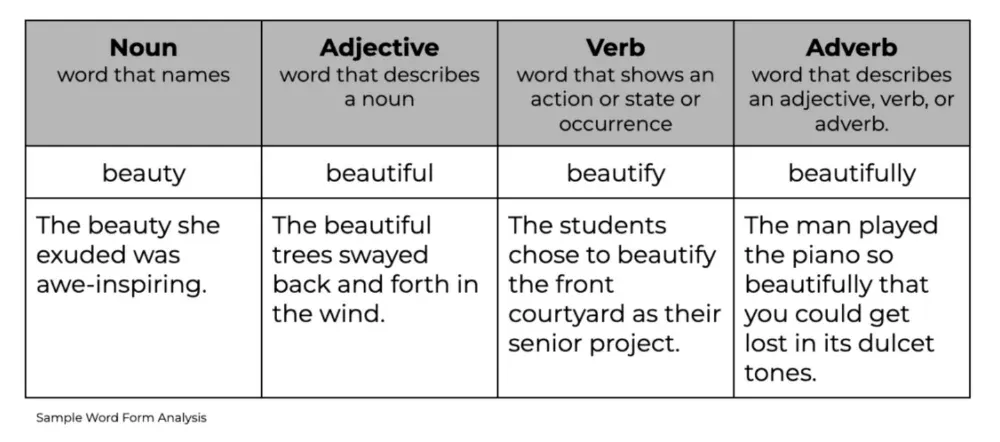 Note: You do not have to choose words that fit into all four categories.
Teach Literary Vocabulary & Semantic Variations
The strategies above are great for teaching about academic vocabulary and especially helpful for discipline-specific words and concepts, but what about those more nuanced terms like poise? vivacious? cumbersome? Words that need to be understood by their relationship to other words and how they are used in English grammatical construction? These words, sometimes called "literary vocabulary," portray complex situations, feelings, motivations, etc., often in relation to characters, settings, and plot elements. There are a variety of ways to teach these, the Frayer model being one of them, but consider the following example to add to your vocabulary instruction toolbox.
Activity: Students or teachers pull vocabulary from the text and discuss it in-depth over several days, considering its definition, how it is used in the text, how it might be used outside of the text, and its relationship to other words. By discussing a word and its nuances over an extended period, it allows students the opportunity to refine and consolidate their initial understanding of the word.
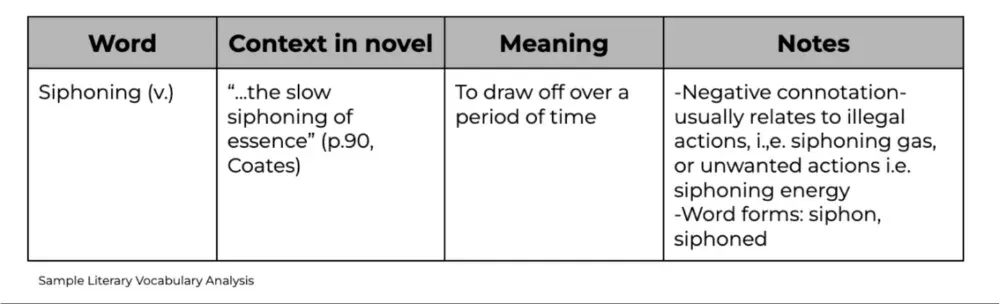
Sample teacher questions during word-learning conversations:
- How is Coates’ essence being siphoned?
- How is “siphoning” related to “funneling”?
- How might “stolen” be related to “siphoned”?
Vocabulary is critical to comprehension. These strategies and more can be used to build depth of word knowledge. After students acquire a target word, be sure to provide reinforcement and practice through lots of reading and writing experiences. If we want our students to use the words we teach them, we must facilitate continued practice. Happy Teaching!
- Nagy W. E. & Scott, J. A. (2000) Vocabulary processes. In M. Kamil, P. Mosenthal, P. Pearson & R. Barr (Eds.). Handbook of reading research. Mahwah, NJ: Erlbaum Associates.
- Hinchman, K. A., & Sheridan-Thomas, H.K. (2022). Best Practices in Adolescent Literacy Instruction, Third Edition, (pp. 117–136). New York, NY: Guilford Press.