Intro to Activity
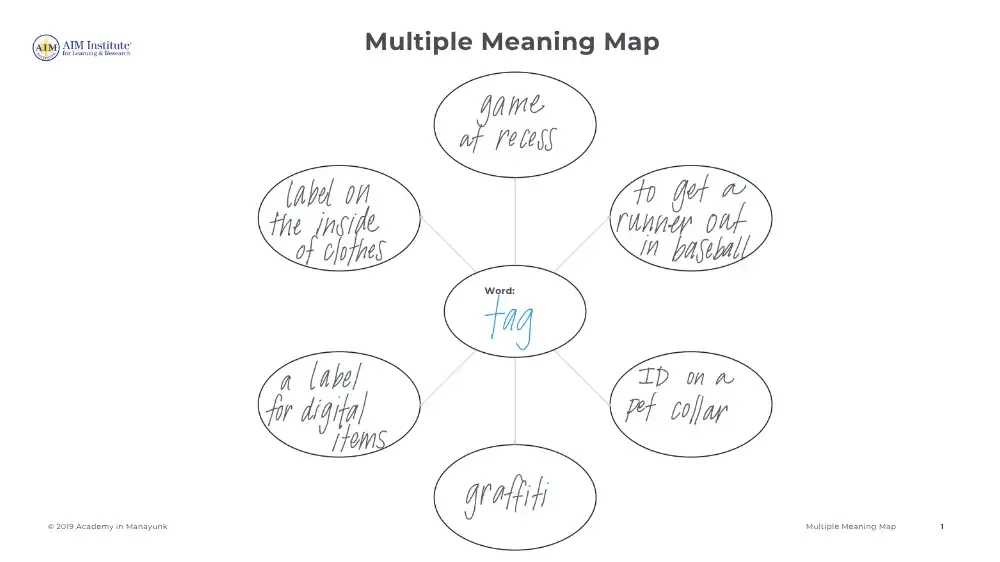
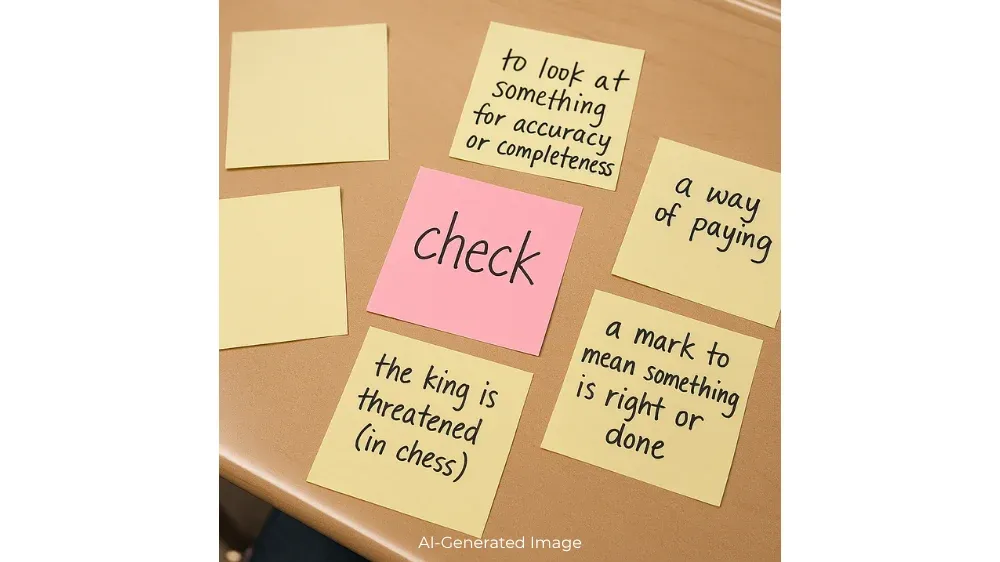
Multiple Meaning Maps visually demonstrate how a single word can have several distinct meanings. By organizing these meanings in a structured, connected way, the maps help students explore the breadth and nuance of word usage. This strategy particularly benefits students with executive function challenges, who may struggle with cognitive flexibility. Such students often fixate on a word’s most familiar or literal meaning and have difficulty considering alternate interpretations. Multiple Meaning Maps support these — and all — learners by making semantic flexibility more concrete and accessible, while also providing valuable vocabulary instruction. However, this tool is not intended for introducing entirely new words or unfamiliar meanings. Instead, it is most effective for deepening understanding of known words, strengthening students’ metalinguistic awareness (conscious thinking about language), linguistic flexibility, and ability to organize and retrieve multiple meanings within their existing vocabulary.
Students
Discover the types of students who may benefit from this activity.
Multiple Meaning Maps are generally considered most appropriate for students in upper elementary grades (3-5) and middle school, but the activity can be scaffolded for use with younger students. This activity may also be appropriate for students with language-based learning needs or English Learners of any age.
Depending on the grade and abilities of participating students, educators may choose to present this activity differently. For example, younger students may contribute ideas orally while the teacher completes the map (effectively staying at the Guided Practice level, as outlined in the Getting Started section below), and will likely provide examples ("I have to run to the store") more successfully than definitions ("Run can mean to go somewhere for a brief and/or hurried errand"), whereas older students may be challenged to provide a definition, part of speech, and usage example while working more independently.
Getting Started
The steps outlined in the tabs below provide a clear and structured approach for teaching this activity to students.
Select a familiar word with at least three distinct meanings (e.g., ring, bug, scale). Ensure it’s known to most students in at least one context. Gather visual aids and sentence examples for each relevant meaning of the word, focusing on those that students are most likely to encounter in texts or conversation. Teachers are free to omit obscure or rarely used meanings.
Print the Multiple Meaning Map Resource (one per student), and prepare a sample map on chart paper, whiteboard, or a slide with one word in the center (such as point), but no meanings filled in yet.
Introduce the activity with a brief discussion to activate prior knowledge. You may ask, “Have you ever heard the same word used in different ways?” For example, prompt students to consider the word bat and share what comes to mind.
Then, explain that some words have more than one meaning depending on how they are used. Introduce the objective of the lesson: learning to map out the different meanings of a word to understand and use it flexibly in reading, writing, and conversation.
After you’ve explained the purpose of the map, it’s important to model what it looks and sounds like so students know what to expect. Display the prepared sample map with one word in the center (e.g., point). Say, “One meaning of the word point is the sharp end of something, like the point of a pencil." Touch the tip of a pencil to reinforce this definition, and write this meaning (or provide an appropriate visual) in one of the outside circles on the map.
Continue to explain, "But, sometimes, the word point can mean something entirely different! Sometimes we use the word point to mean an idea or an argument. We might say, 'Ohh, that's a good point I hadn't thought of!'" Write this idea in a second outside circle of the sample map.
Next, elicit additional meanings of point from the students. Ask, "What is another meaning the word point can have?" If students appear stuck and don't contribute meanings that you think they are familiar with, prompt them with clues ("What if I'm playing basketball?") or sentence starters (What about if I say, "Point to...").
After completing a map, allow students to deepen their understanding and use of the targeted words in differing ways with an extension activity. For example, perhaps students work in pairs, taking turns writing or saying a sentence using the target word while their partner identifies the meaning used.
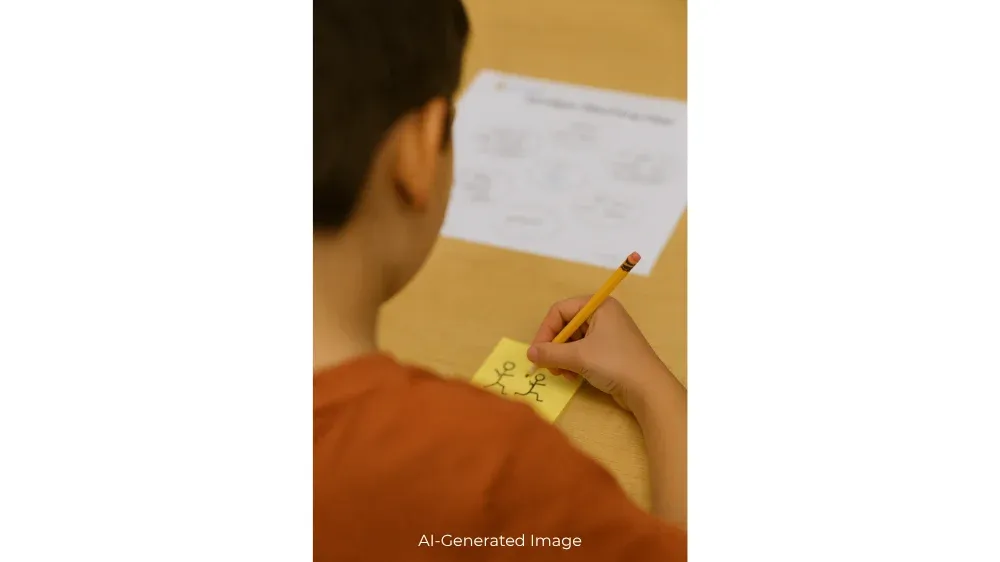
Alternatively, have students complete their own Multiple Meaning Map Resource with a new word. Give each student, pair, or small group a familiar word from the prepared list and have them identify at least two meanings. Students should write short definitions or descriptions, generate example sentences, and draw simple illustrations to represent each meaning. Circulate throughout the class to support students, providing prompts and clarification as needed.
Offer corrective feedback by checking for accuracy and clarity in student responses in both the Guided Practice and Student Practice portions of this activity. Reinforce that this activity elicits multiple meanings of words, not multiple examples. Use your discretion if you think it is appropriate to use affixed words with their own unique meanings (such as a pointed expression).
Take Note!
Here are some special considerations when using this activity:
- Adjust to the needs of your students. While the Multiple Meaning Map Resource allows for six meanings of a word, this may be insufficient for some words (such as run), and may be too many for other words (such as bark). Similarly, students will vary widely in how many meanings they are familiar with, due to age, grade, and/or language abilities. For these reasons, educators may choose to modify multiple-meaning maps to target fewer or more meanings of a target word, as needed.
- Aim for meanings, not examples. It's often easier for students to provide examples of how to use a word in a phrase or sentence (e.g., watch a movie) rather than the meaning (e.g., watch can mean to look at something or someone for a period of time). While you might want to challenge older students to provide meanings themselves, you may need to give the meaning when students- especially younger students- offer an example instead. When you discuss and add meanings (rather than examples) to the maps, you help minimize redundant responses and multiple examples of the target word used in the same way (e.g., watch television; watch my dad make dinner).
- Use decodable words. While this activity supports students' oral language development, it can also directly support their reading comprehension, no matter what their reading ability is. Many words encountered by beginning readers (e.g. tip, jam, bat) lend themselves well to this activity. In these cases, teachers may represent various meanings with pictures, rather than words.
- Make it formal or informal. Quickly draw and complete a multiple-meaning map on the whiteboard when a relevant word comes up in a lesson, or plan a lesson in advance with worksheets that students complete.
- Practice across subjects. This activity needn't stay directly within an ELA block. Multiple Meaning Maps can be a great way to reinforce vocabulary across subject areas (e.g., cell, note, bill, scale).
- Review skill overview. For additional considerations when targeting this skill, see the Vocabulary Overview.
Classroom Connection
See this activity in action through a teacher-led demonstration.
Watch as this teacher creates a Multiple Meaning Map for the word free with a small group. Although it is difficult to hear all of the student responses, notice how the teacher guides students to provide a word meaning, despite their initial attempt being an example of the word being used.
Differentiation
Learn how you can enhance instruction to meet the needs of diverse learners.
- Remember, the goal of this activity is to deepen students' knowledge, use, and flexibility with known words, not to introduce entirely new vocabulary or obscure meanings. In a class-wide activity with a wide range of language skills present, allow students to contribute as many meanings as they can, but emphasize the most commonly used meanings of a word to support students less familiar with the word. For example, the word pitch has many meanings, some common and some more obscure. Hearing all the potential meanings of this word may overwhelm many students with limited familiarity due to age or language skills. To help, emphasize the most common usages, throwing a baseball or the highness or lowness of a sound, over less frequently encountered meanings, like the slope of a roof.
- Teachers can support English Learners by explicitly pointing out and discussing how some words can take on new meanings as part of idioms. For example, teachers may include the meaning of the phrase “break the ice” when discussing multiple meanings of break. Drawing attention to these nonliteral uses helps students better understand how word meanings can shift across contexts.
- Teachers can use Multiple Meaning Maps to highlight not only the different meanings a word can have, but also how the word can function as different parts of speech— for example, play as a noun (e.g., a school play) and a verb (e.g., to play a game). Explicitly drawing attention to these shifts supports English Learners and students with language-based differences, who may need direct instruction to understand how word meaning and grammatical function change depending on context.
- For additional differentiation when targeting this skill, see the Vocabulary Overview.
Coaching Corner
For occasional use: optional ideas to bring energy, engagement, or ease to the activity.
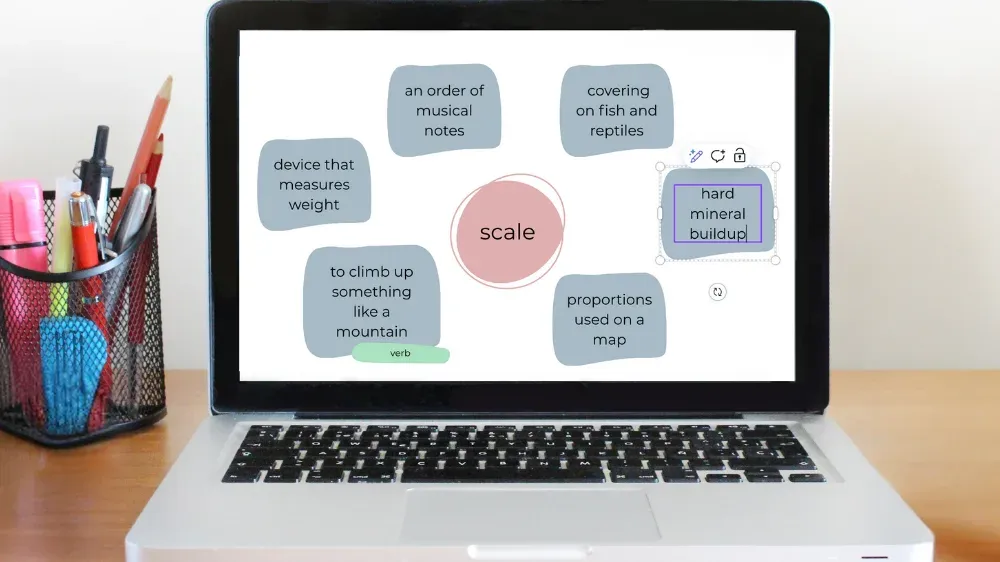
Older students can practice creating multiple meaning maps using various digital tools.
Resource(s)
Explore the resource(s) to support your implementation of this activity.
Toolkit resources help you implement high-quality instruction. To guarantee student success, these tools must be used in tandem with direct, systematic, mastery-oriented instruction and a high-quality curriculum.