Intro to Activity
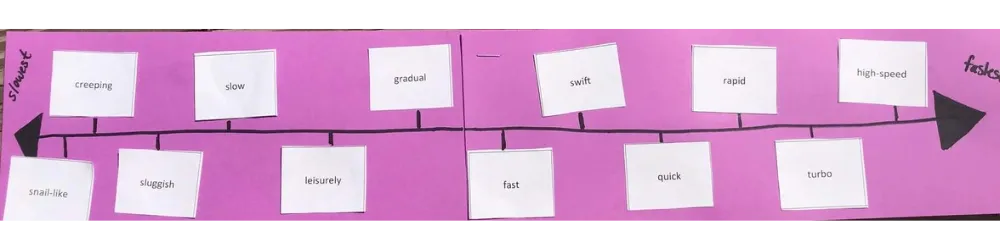
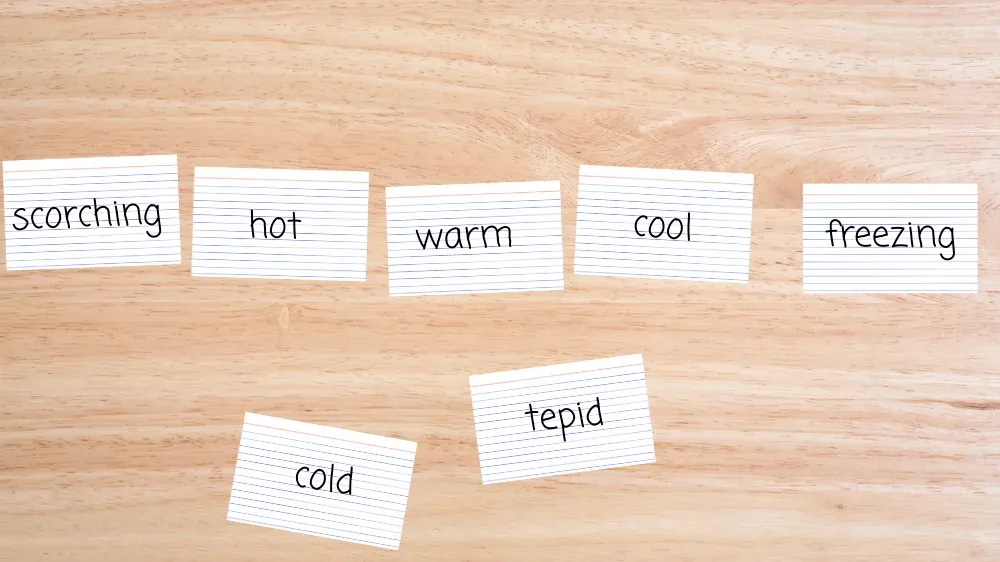
Semantic gradients are an instructional strategy to help students explore the subtle differences in word meanings. Also known as shades of meaning, this is a visual way of organizing words along a continuum of intensity or degree. Oftentimes, but not always, semantic gradients can include gradable antonyms, or opposites that are scalable. For example, the opposites hot and cold fall within a continuum of temperature: there are words that mean both a little hot or cold (warm, cool) and very hot or cold (scorching, freezing). These words (along with several other potential adjectives for temperature) could thus be arranged in order of intensity: scorching, hot, warm, cool, cold, freezing. By arranging related words in order from least to most intense, students build a deeper understanding of the nuance of words and have the opportunity to practice thinking about and using word choices that they may be familiar with, but are not yet using independently. This strategy supports vocabulary development by promoting more precise and sophisticated word choices in speaking and writing, while also enhancing comprehension through a more refined understanding of related terms.
Please note that this tool is not intended for introducing entirely new words. Instead, it is most effective for deepening understandings of familiar words, strengthening students’ metalinguistic awareness (conscious thinking about language), and supporting their ability to organize and retrieve related words within their existing vocabulary. It is especially effective at steering students away from using overly generic words, such as happy and sad.
Students
Discover the types of students who may benefit from this activity.
Semantic gradients are generally considered most appropriate for students in upper elementary grades (3–5) and middle school, but they can be effectively scaffolded for use with younger students as well. This strategy also benefits students with language-based learning needs or English Learners across grade levels.
Depending on the grade level and language proficiency of the students, educators may introduce semantic gradients in different ways. For example, younger students may arrange three or four teacher-provided words, or the teacher may show a small, completed semantic gradient as a visual to help clarify the meaning and nuance of a newly introduced word. On the other hand, educators may ask older or more advanced students to work more independently — generating words appropriate to the target concept, ordering them by intensity, and potentially providing contextualized examples for each.
Getting Started
The steps outlined in the tabs below provide a clear and structured approach for teaching this activity to students.
Select a common word or a pair of gradable antonyms, along with at least three related terms that can be placed along a continuum. Choose continuum words that are generally familiar to most students, but some of which are not commonly used independently.
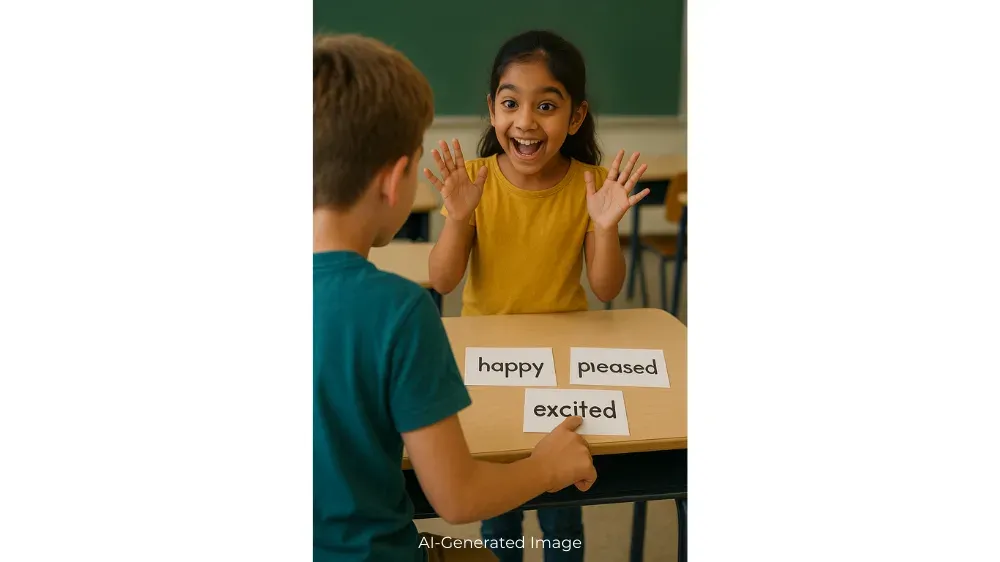
Print the Semantic Gradient Resource (one per student), and prepare a sample gradient on chart paper, whiteboard, or a slide with either a chosen pair of opposites (happy/sad) or one word (happy) that you would like to expand upon. Be thoughtful about where to place the word(s) to allow for additional words on either side of the continuum. For example, if choosing to focus the semantic gradient only on the term happy, you might write this initial word in the third position to allow for a few milder terms (e.g., content, pleased), and several words of increased intensity (e.g., excited, thrilled, ecstatic).
Explain to your students that some words have similar definitions but vary in intensity or strength — for example, cool and freezing both relate to temperature, but one feels much stronger than the other.
You might say, "We can make a graph of these words from least to most intense to make it really clear how meanings shift slightly between terms. The more we explore, work with, and think about these words, the more likely we will be able to use them when we're trying to think of a better, more precise word choice."
After you’ve explained the purpose of the activity, it’s important to model what it looks and sounds like so students know what to expect. Display the prepared sample semantic gradient with the word happy in the center.
- Say, “Happy is a perfectly fine word to use sometimes, like if your grandpa surprised you with a trip to get ice cream, that would make you happy, right? But sometimes, something really special happens. If you found out that you won the lottery, the word happy really wouldn't be strong enough to describe how you're feeling, would it? You might say that you are ecstatic! We can put the word ecstatic here all the way on the right, because this means you don't just feel happy, you feel very, very happy, a more intense, stronger version of happy." Write the word ecstatic in the appropriate location.
Continue to model a milder version of the word.
- You might say, "Sometimes, though, everything is good and fine. If I'm a passenger in a car, looking out at the trees while we're driving, humming along to the radio, I might say that I'm content. If I'm feeling content, everything is going well, and I'm comfortable, but I don't feel quite strongly enough to say that I'm happy. We can write content on the left side of this graph, because it's a very mild, light version of happy." Write the word content in the appropriate place.
Next, elicit additional related words from the students.
- Say, "Let's think of some other words I can put on this graph. What is another word that means just a little bit happy that I can add?"
Continue on this way, encouraging contributions for both halves of the graph.
If students appear stuck and don't contribute words that you think they are familiar with, prompt them with clues. One type of clue you can provide is a phonetic prompt, such as "I just found out I'm going to Disneyland! I'm so thr...." and let your students complete the word thrilled. You may also want to provide an expected word and ask your students where on the continuum it should go.
Decide if students would benefit from additional practice with the terms. Consider extending the practice by providing example situations (e.g., a picture of a child sitting in a comfortable chair while coloring) and having students match each example to an appropriate term and write a corresponding sentence.
Alternatively, have students complete their own Semantic Gradient Resource. Give each student, pair, or group a familiar word or pair of gradable antonyms from the prepared list and have them identify related words, organizing them by intensity along the continuum. Circulate throughout the class to support students, providing prompts and clarification as needed.
Offer corrective feedback by checking for completion and accuracy of student responses in both the Guided Practice and Student Practice portions of this activity. Remind students as needed that they are trying to think of entirely new words, not adding qualifiers like "very" or "a little" before the provided terms. Some students will find the most success when the words are provided by the teacher for them to sequence
Take Note!
Here are some special considerations when using this activity:
- Adjust to the needs of your students. While the attached worksheet allows for seven related words, this may be insufficient for some concepts (such as the speed adjectives in the image at the top of the page), and may be too many for other concepts. Similarly, students will vary widely in how many related words they are familiar with, due to age, grade, and/or language abilities. For these reasons, educators may choose to modify semantic gradients to target fewer or more terms, as needed.
- Choose your opposites thoughtfully. Remember that not all antonyms are gradable. Some (like on/off) are binary, and don't have related words that fall between them on a continuum.
- Antonyms are not necessary. Use semantic gradients to fit the needs of your students. This may mean that you only list a few synonyms by intensity (such as content, happy, ecstatic), rather than also including opposites.
- There may be some discrepancies. At times, there may be some incongruities in the order students place some words. This can lead to interesting discussions among classmates, and ultimately fosters an environment that is interested and curious about language. Remind your students that there won't always be one "correct" way to organize words.
- Sometimes, there are perfect synonyms. Similar to the above note, sometimes words will seem completely synonymous and unable to be ranked by intensity (big/large, scorching/blazing). Write these words next to each other at the same point on the continuum.
- Make it formal or informal. Quickly draw and complete a semantic gradient on the whiteboard when a relevant word comes up in a lesson, or plan a lesson in advance with printables that students complete.
- Review skill overview. For additional considerations when targeting this skill, see the Vocabulary Overview.
Classroom Connection
See this activity in action through a teacher-led demonstration.
Watch as this teacher uses a word from a recent reading to create a semantic gradient with a small group. Notice the amount and type of follow-up questions she asks after students provide placement suggestions for each word. How does she respond when she doesn't fully agree with a student's answer?
Differentiation
Learn how you can enhance instruction to meet the needs of diverse learners.
- Some semantic gradients are helpful to keep readily available to encourage and elicit more sophisticated word choices in students' oral and written language. For example, if a student answers "sad" in response to a comprehension question about how a character is feeling, you might prompt them by saying something like, "Hmm, I'm having a hard time picturing sad. Is she the kind of 'sad' you feel when there is only one cookie left? Or is she the kind of 'sad' you'd feel if your dog ran away? What's another word you might use so I can better understand just how sad she is?" If needed, a previously reviewed semantic gradient could then be provided as a scaffold to aid in the student's word retrieval.
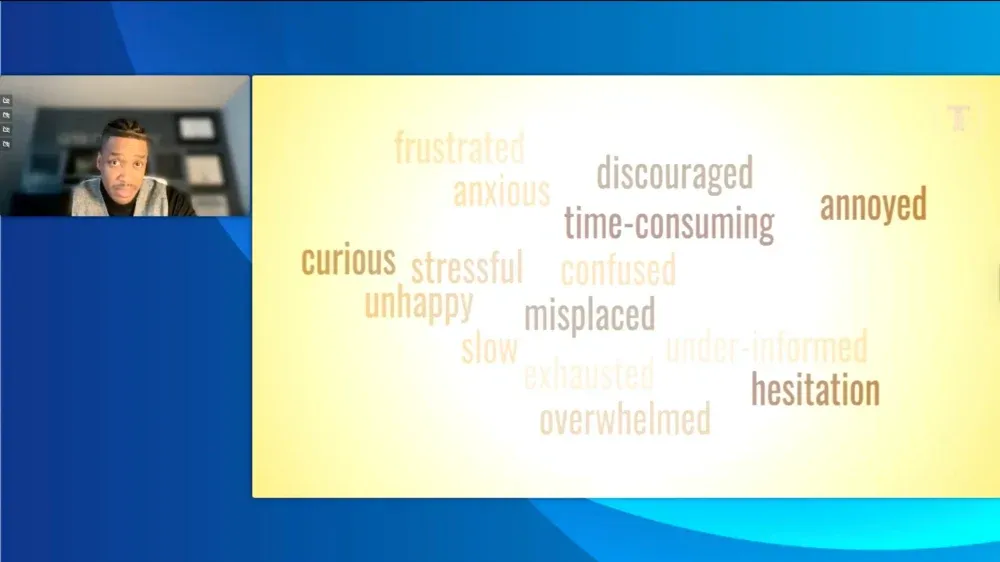
- Remember, the goal of this activity is to deepen students' knowledge, use, and flexibility with known words, not to introduce several entirely new words. To this end, you may choose to omit some terms that would be appropriate on the scale, but too advanced for the language abilities of your students. For example, in a continuum of words related to the concept of anger, you might choose to include annoyed, irritated, frustrated, and outraged, but omit perturbed, incensed, and irate if all of these would be brand new terms for your students.
- Teachers can support English Learners by explicitly teaching the meaning of common idioms, some of which may be appropriate in the context of semantic gradients. Continuing with the example of a semantic gradient with words related to anger, you may want to include phrases such as "lost your cool" or "saw red." Drawing attention to these nonliteral uses helps students better understand how word meanings can shift across contexts.
- For additional differentiation when targeting this skill, see the Vocabulary Overview.
Coaching Corner
For occasional use: optional ideas to bring energy, engagement, or ease to the activity.
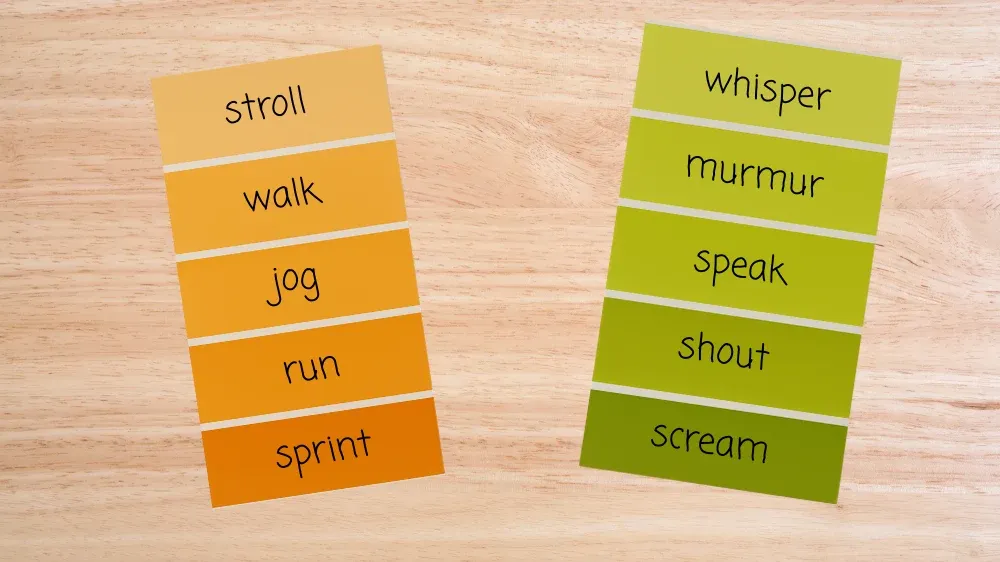
A fun way students can visualize the varying degrees of intensity of words can be seeing different shade of the same color, like those used on paint sample cards.
Resource(s)
Explore the resource(s) to support your implementation of this activity.
Toolkit resources help you implement high-quality instruction. To guarantee student success, these tools must be used in tandem with direct, systematic, mastery-oriented instruction and a high-quality curriculum.