If you’ve taught an English learner in your class, you’re not alone. English learners (ELs) are a rapidly growing demographic in United States schools and teachers should expect to have ELs in their classrooms. In the last 20 years, 1.5 million English learners have been added to classrooms around the country, yet only 3% of teachers have the necessary qualification to teach these students (Rahman et al., 2017).
The map below illustrates the percentage of ELs state by state in the United States public school system. If you’re a seasoned teacher, you may notice these numbers have increased exponentially over time. In 2000, 8.1% of the school population was classified as ELs. Currently, ELs comprise 10.4% of the population, representing over 5 million students in today’s classrooms (National Center for Education Statistics, 2022).
Check out the map below to see the percentage of public school students who are English learners in your particular state:
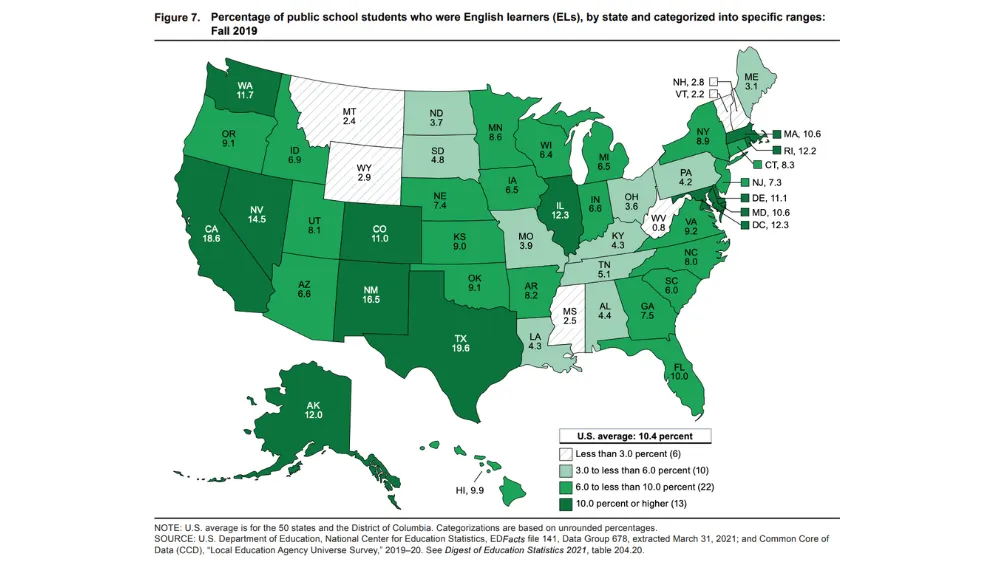
This map represents over 400 different languages that are spoken by students in United States public schools. More than 77% of our English learners speak Spanish in their home. The second most common home language is Arabic, which comprises 2.6% of English learners, followed by Chinese, Vietnamese, and Portuguese with less than 2% (NCES, 2022). Some ELs possess only oral language skills in the native language, while others may possess literacy in that language. In addition, some ELs may come to school with basic literacy skills in English, while others are new to the journey (Cardenas-Hagan, 2020).
While the prevalence of ELs in classrooms continues to increase, most teachers are not equipped with the knowledge and practices to meet the needs of these learners and accelerate their acquisition of English proficiency. The consequences are detrimental. “Students who speak English as a second language face a 13% chance of not graduating from high school” and “are twice as likely to drop out of high-school in comparison to their non-Hispanic White peers” (Cardenas-Hagan, 2020; National Assessment of Educational Progress, 2019).
AIM's Specialized Reading Knowledge: English Learners module equips teachers with tools and resources to deliver effective language-focused instruction to English learners. Learn more and register today.