Intro to Activity
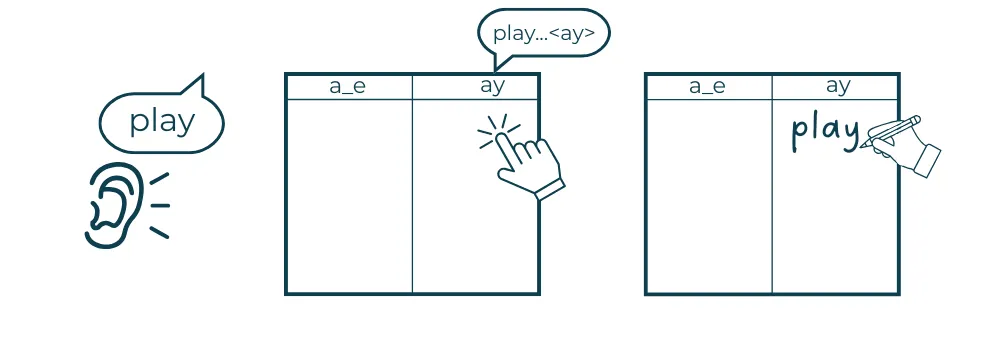
Word sorts are categorization activities that reinforce previously taught phoneme-grapheme (sound-letter) correspondences. Sorting words helps students attend to orthographic details (patterns of the written language system), supporting the precision needed for accurate spelling and fluent reading. In the vowel spelling variation presented here, students sort words based on how the vowel phoneme is spelled (e.g., sorting words with <ay> vs. <a_e>). The routine begins with students hearing a word read aloud. They identify the vowel phoneme (e.g., /ā/ in play), determine the grapheme that represents the phoneme (e.g., <ay>), and then write or place the word in the appropriate category. The activity is easy to use because it requires little to no preparation, and it can be repeated with different target skills (e.g., initial or final phoneme spellings, syllable types, or spelling generalizations). For example, it can be used to contrast initial or final vowel spellings (e.g., <ai> or <ay>), consonant phoneme spellings (e.g., <ch> or <tch>), new and/or confusing spelling patterns (e.g., <a> or <a_e>), similar-sounding phonemes (e.g., /ĕ/ or /ĭ/), or sorting syllable types.
Students
Discover the types of students who may benefit from this activity.
Teachers select words for this activity based on their phonics scope and sequence and student needs. Because of this flexibility, a word sort is appropriate for students across a wide range of abilities. It is best suited for students who can isolate and segment phonemes, are beginning to connect phonemes to graphemes, and are developing foundational knowledge of conventional spelling patterns.
The vowel spelling variation emphasizes vowel spelling patterns, which are typically included in a K-2 phonics scope and sequence. Therefore, this activity is especially appropriate for those grades. However, the underlying principles of this activity are grounded in established research on connecting phonemes and graphemes to support accurate decoding and encoding. Therefore, this may be a promising strategy for older students and struggling readers needing additional spelling practice.
Getting Started
The steps outlined in the tabs below provide a clear and structured approach for teaching this activity to students.
Determine the categories students will use to sort words. Then, compile a list of real words containing previously taught phoneme-grapheme correspondences that fit each category. Be aware that pre-made phonics word lists may contain spelling patterns students have not learned (e.g., 'write' in a list of words reinforcing <i_e>). This activity is intended to reinforce previously taught phonics skills, therefore, it may be helpful to select words from a recent decodable text or phonics lesson. For additional guidance on category and word selection, see Take Note!, below.
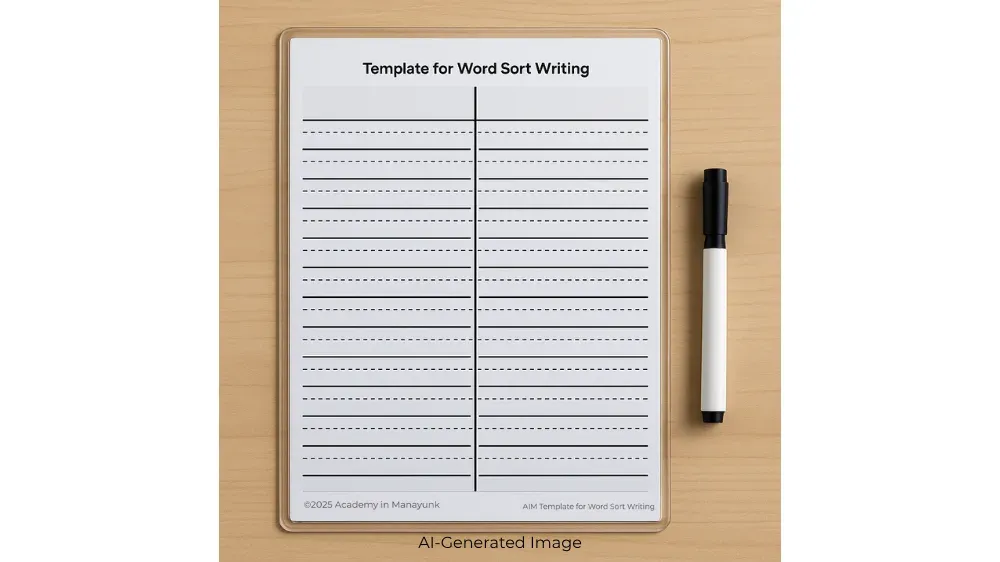
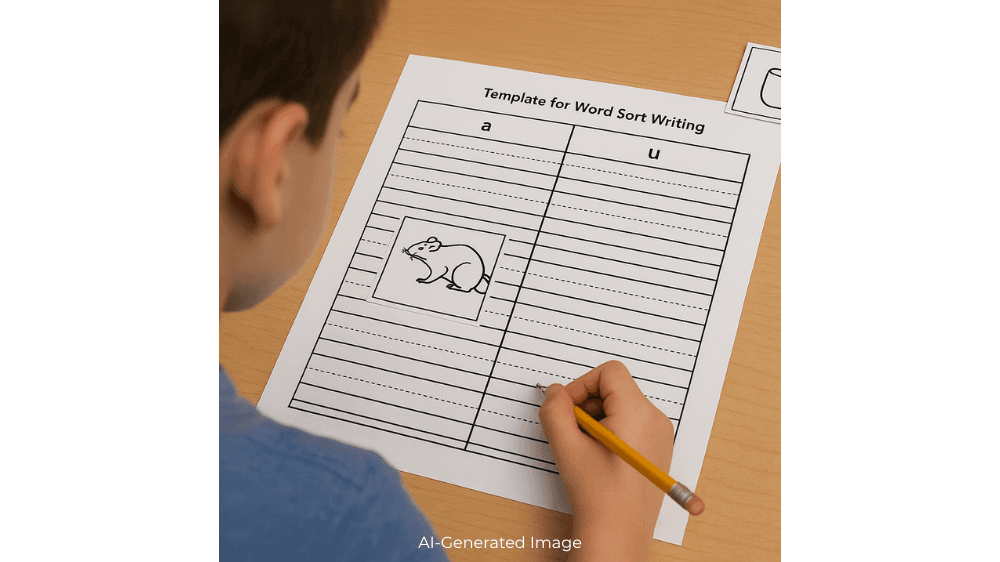
Provide each student with a Word Sort Writing Template (see attached resource, below).
Introduce and explain the purpose of the activity.
Example:
"Today we’re going to play a sorting game with words! In this activity, you’ll listen to a word, figure out the vowel sound, and then determine how that sound is spelled. This helps you become a stronger speller and reader because you’re training your brain to notice patterns in how sounds and letters work together."
Explain the word sort categories. Then, model how to respond with a teacher-led demonstration.
Example:
Explain Categories (a_e, ay, a)
- "We'll be sorting words that have the long /ā/ sound. We've learned that words with an /ā/ sound in the middle of the word can be spelled with the <a>-consonant-<e> pattern. That will be our first category."
- [Write <a_e> at the top of one column on the Word Sort Writing Template.]
- "We've also learned that words that end with the /ā/ sound can be spelled <ay>."
- [Write <ay> at the top of one column on the Word Sort Writing Template.]
- "Finally, we are also going to hear some words that have the /ă/ sound. /ă/ is spelled <a>."
- [Write <a> at the top of one column on the Word Sort Writing Template.]
- *Note: You may want to practice this word sort again, replacing <a> with <ai> once this vowel team has been introduced.
Listen and Repeat
- "The first word is play. Say, play (play). The middle school students are putting on a play, a show where they act out a story on stage, in a few weeks."
Isolate the Vowel Phoneme
- "Now I have to listen for the vowel sound. I'm listening for either the /ă/ or /ā/ sound: /p/.../l/.../ā/. I hear /ā/ in play."
Determine the Grapheme Spelling
- "Today, we are looking at two ways to spell /ā/. I hear /ā/ at the end of play, so I know this word is spelled with the letters <ay>."
Write (or Sort) the Word
- "I'll write the word play in the <ay> column."
Read and Check
- "Watch me check my spelling."
- [Point under each grapheme as you say the sound, then slide from left to right to blend and decode the word.]
- "/p/.../l/.../ā/...play. I spelled play with the letters <ay>!"
Dictate additional words and support students through the process described above. Avoid turn-taking formats that limit practice opportunities. Instead, ensure that every student sorts and writes each word. After spelling, have students read each word. In addition to serving as a self-check, this step also helps to connect reading and writing.
Example:
Listen and Repeat
- Dictate, "plate."
- Students repeat, "plate."
- Provide sentence context and/or brief definitions as needed, "She dropped her plate, and it broke, sending her dinner across the floor."
Isolate the Vowel Phoneme
- "What's the vowel sound? (/ā/)"
Determine the Grapheme Spelling
- "Right, the vowel sound /ā/ is in the middle of the word. What letters will we use to spell /ā/ in the middle of the word (<a>-consonant-<e>)?"
Write (or Sort) the Word
- "Write the word plate in the <a>-consonant-<e> column."
Read and Check
- "Let's check our spelling, /p/.../l/.../ā/.../t/...plate. We spelled plate with the letters <a>-consonant-<e>."
Continue dictating words for students to sort independently. Fade prompting as students internalize the routine. As always, monitor student responses for accuracy throughout the activity.
Immediately support students who make an error. An error could occur by incorrectly sorting the word. The error could also occur when spelling the word. As feasible, also monitor for correct letter formation.
Example:
"You're right, grape has the long /ā/ in the middle of the word /g/.../r/.../ā/.../p/. You were right to put grape in the <a>-consonant-<e> column. But, let's check your spelling (grap). What pattern do we use to spell /ā/ in grape?"
If the student cannot sort or spell the word appropriately on the second attempt, provide the appropriate response.
Take Note!
Here are some special considerations when using this activity:
- Word sorts are not explicit instruction. They are not designed for introducing new phonics patterns. Instead, it is an activity designed to reinforce previously taught phoneme–grapheme correspondences. Students should receive explicit phonics instruction and be somewhat familiar with the target spelling patterns before engaging in this activity.
- Change the number of categories to adjust the challenge. Limiting the number of categories makes the activity easier, while increasing the number of categories makes the activity harder.
- Adjust category contrasts to match students' needs. Some vowel phonemes are more difficult because they are produced similarly and, therefore, commonly confused. For example, /ĭ/ and /ĕ/ are harder to distinguish than /ĭ/ and /ŏ/.
- Select categories that highlight common confusions. For example, sorting words spelled with <a_e> and <a> can help students attend to the salient phonemes (/ā/, /ă/) and their corresponding graphemes, which differentiate similarly spelled words from one another (e.g., cap, cape) and frequently lead to decoding and encoding mistakes.
- Use a category to spotlight outliers. Including a category like “Other” or “Surprise Spellings” helps students recognize exceptions. For example, in the Getting Started sort (above), a teacher could consider dictating the word 'have.' Although 'have' contains the /ă/ vowel phoneme, it appears to follow the <a_e> spelling pattern. Because English words don’t end in <v>, the final <e> is added as an orthographic (spelling) convention, not to mark a long vowel.
- Provide abundant practice reading and writing words. Keep in mind that students need repeated exposure to develop correct spellings, especially for patterns that don't have positional constraints. For example, in an <er> versus <ir> sort, a student needs to have enough practice seeing first spelled correctly to recognize that ferst looks wrong.
- Use words of varying lengths. Some students overgeneralize CVC (consonant-vowel-consonant) and default to that structure when spelling. As students become more skilled with segmentation, be intentional about choosing words with varying phoneme lengths.
- Vary the number of words in each category. Using unequal group sizes prevents students from guessing where a word goes based on how many words are already in the category. This also mirrors real orthography as some spelling patterns are more common than others (e.g., in an /ou/ sort, you might include more words with <ou> than <ow> to reflect their relative frequency in print).
- Consider labeling each column with a keyword. Including an example word or embedded alphabet image (e.g., apple-/ă/ and octopus-/ŏ/) in the Word Sort Writing Template may help some students connect the spelling pattern to a familiar word, especially during initial practice.
- Avoid making this a visual matching activity. Not all word sorts require students to read or spell words, which limits their effectiveness. Avoid sorting variations that students can successfully complete by simply looking for the spelling pattern and matching letters.
- Review skill overview. For additional considerations when targeting this skill, see the Encoding and Spelling Overview.
Classroom Connection
See this activity in action through a teacher-led demonstration.
Watch as this teacher uses a highly scaffolded variation of a word sort in which students are shown the words before sorting them. This should be reserved for an initial introduction to a phonics skill to support decoding, then removed to focus on segmenting and encoding. As you watch, consider how you would fade this scaffold and transition the activity from a decoding activity to an encoding activity.
Differentiation
Learn how you can enhance instruction to meet the needs of diverse learners.
- For students who struggle with handwriting and/or spelling (such as students with dysgraphia), printed word cards can provide additional support. To prevent this from becoming a visual matching activity, after reading the word aloud, have students point to the correct category before seeing the word. Then, give them the printed word card to place in the category. Consider having students highlight the pattern in the word. This reduces the writing demand while still reinforcing phoneme–grapheme connections and orthographic patterns.
- A highly scaffolded variation in which students are shown the words before sorting them (as seen in the Classroom Connection, above) should be reserved for initial introduction to the skill to support decoding. Then, removed to focus on segmenting and encoding.
- Use small group or individualized practice that targets a student's specific phoneme confusions. For example, have a student sort words with /s/ versus /sh/ or /f/ versus /th/.
- For additional differentiation when targeting this skill, see the Encoding and Spelling Overview.
Coaching Corner
For occasional use: optional ideas to bring energy, engagement, or ease to the activity.

Make it a partner activity. One student serves as the reader and reads words aloud from a teacher-provided list. The other is the writer, responsible for identifying the vowel sound, selecting the correct category, and spelling the word.
Resource(s)
Explore the resource(s) to support your implementation of this activity.
Toolkit resources help you implement high-quality instruction. To guarantee student success, these tools must be used in tandem with direct, systematic, mastery-oriented instruction and a high-quality curriculum.