Intro to Activity
This routine for spelling multisyllabic words supports students in applying a simple and consistent strategy to encode multisyllabic (more than one syllable) words. Students segment a word into syllables and encode one syllable at a time. The instructional routine reinforces phoneme-grapheme correspondences and, over time, helps build an orthographic memory of morphemes (meaningful word parts) and words. It also helps break the encoding process into more manageable chunks, supporting students who otherwise might consider a word as too long or hard for them to spell. This routine builds on the skills introduced with Phoneme-Grapheme Mapping and equips students with a powerful tool for spelling multisyllabic words.

Students
Discover the types of students who may benefit from this activity.
Teachers select words for this activity based on their phonics scope and sequence and student needs. Because of this flexibility, this routine for spelling multisyllabic words is appropriate for students across a wide range of abilities.
Most research on reading and spelling multisyllabic words focuses on upper elementary students, when longer words become essential for proficient reading and writing, and struggling readers. However, the underlying principles of this routine are grounded in established research on reinforcing phoneme-grapheme connections and encouraging analysis of word parts to support accurate decoding and encoding. Therefore, this strategy may also benefit younger students, especially those who have gained proficiency in encoding one-syllable words.
Getting Started
The steps outlined in the tabs below provide a clear and structured approach for teaching this activity to students.
Compile a list of real words containing previously taught phoneme-grapheme correspondences, syllable types, and/or morphemes. Be aware that pre-generated word lists found online (e.g., morpheme or syllable lists) may contain words with patterns that have not been taught. Instead, choose words aligned with your scope and sequence and responsive to students’ instructional needs.
Let students know that multisyllabic words can be broken into syllables and that syllables help us read and write longer words more easily. We use those parts to help us read and write. Explain the purpose of the routine.
Example:
"We know that long words can be broken into syllables. Today, we are going to break big words into syllables and spell each syllable. These steps help us spell a whole long word."
Model the routine with a teacher-led demonstration.
Example:
Step 1: Listen and Repeat
- "The word I will spell is instruct. Say instruct (instruct). Instruct means to teach someone how to do something. The coach will instruct the players on how to throw the ball correctly."
Step 2: Break Apart into Syllables
- "Instruct has two syllables."
- [Model syllable segmentation with a movement (e.g., hand under your chin) or a manipulative (e.g., see Classroom Connection, below) as needed.]
- "/ĭn/.../strŭkt/."
Step 3: Identify the Letters
- "Now, I'm going to spell those syllables. The first syllable is /ĭn/.../ĭ/.../n/.
- [Model phoneme segmentation with a movement or a manipulative as needed.]
- "<i>...<n> spells /ĭn/."
Step 4: Write the Letters
- [Write <in>.]
[Repeat Steps 2-4]
- "The next syllable is /strŭkt/... /s/.../t/.../r/.../ŭ/.../k/.../t/."
- "<s...t...r...u...c...t> spells /strŭkt/."
- [Write <struct>.]
Step 5: Read and Check
- "Watch me check my spelling."
- [Point under each syllable, then blend them to read the word]
- "/ĭn/.../strŭkt/... instruct. I spelled instruct!"
Dictate additional words and support students through the five steps described above. Avoid turn-taking formats that limit practice opportunities. Instead, ensure that every student writes each word.
Example:
Step 1: Listen and Repeat
- Dictate, "insist."
- Students repeat, "insist."
- Provide sentence context and/or brief definitions as needed, "scientists insist on repeating experiments to make sure the results are correct."
Step 2: Break Apart into Syllables
- "Syllables? (/ĭn/.../sĭst/) First syllable? (/ĭn/) Sounds? (/ĭ/.../n/)"
Step 3: Identify the Letters
Step 4: Write the Letters
- Write <i>...<n>, erase, and have dictate /ĭn/ for students to spell."
[Repeat Steps 2-4]
- "Next syllable? (/sĭst/) Sounds? (/s/.../ĭ/.../s/.../t/)
- Write <s...i...s...t>, erase, and dictate /sĭst/ for students to spell."
Step 5: Read and Check
- "Let's check our spelling, /ĭn/.../sĭst/...insist."
Continue dictating words for students to encode independently. After spelling, have students slide a finger under each syllable as they blend to read the whole word. In addition to serving as a self-check, the step also helps to connect reading and writing. Fade prompting as students internalize the routine and monitor student responses for accuracy throughout the activity.
Immediately support students who make an error.
You can cue students to correct errors using learned spelling generalizations, syllable types, and morphemes as appropriate.
Example:
If a student spells kindness as <kindnis>, you could prompt, "Kindness is the state of being kind. What's the suffix in kindness? (-ness) How do you spell -ness?"
If students can’t identify or spell the morpheme, provide the answer, have them repeat it, and support them in spelling kindness correctly.
Take Note!
Here are some special considerations when using this activity:
- Some words are not appropriate for this routine. If a student can spell a word with ease, this scaffold is unnecessary.
- Orally segment words and syllables as needed. Students may not need to segment every syllable into individual phonemes. Segmentation is not required if a student can accurately spell a syllable. Similarly, if students know a word's morphemes, they should rely on that knowledge, rather than syllables. For example, if they're familiar with <-ology>, then they will think of that as one chunk to spell, not three syllables to segment and encode.
- Support students in thinking about word meanings. For example, if they hear /ĭd/ at the end of the word, they need to consider if it's a regular past tense word and thus they should spell it <ed> (e.g., handed), or if they are just sounds, and spelled <id> (e.g., liquid).
- Reinforce taught spelling generalizations. Prompt students to consider the syllable type, grapheme positions, and/or other generalizations as needed to support conventional spelling.
- Draw attention to pronunciation and spelling differences. It can be helpful to point out to students that they may subvocalize the word differently when writing it than when speaking or reading it. For example, do you think about the word Wednesday differently when writing it? Students can segment /wĕd/.../nĕs/.../dā/ in their "spelling voice" to support them in representing conventional spelling.
- Unstressed syllables are difficult to spell. Students should be taught that when spelling /ə/, which students often perceive as /ĭ/ or /ŭ/, they must pay special attention to their spelling attempt and reflect on whether what they've written "looks right." They might have to play around with different attempts or try out different pronunciations in their spelling voice. "Is it ē-round? No... ō-round? No... ā-round? Hm. Maybe!" This requires repeated exposure and attention to a word’s spelling to develop the precise knowledge necessary to spell the word correctly.
- Review skill overview. For additional considerations when targeting this skill, see the Encoding and Spelling Overview.
Classroom Connection
See this activity in action through a teacher-led demonstration.
Here, a teacher uses this routine for spelling multisyllabic words one-on-one. For steps 2 and 3, the teacher incorporates manipulatives (big magnets for syllables and smaller magnets for phonemes). While not an essential part of the routine, adding manipulatives can be especially helpful for students who struggle with accurate segmentation. As you watch, consider how this strategy can be used with students during direct instruction and guided practice and how it can be used when students write independently.
Differentiation
Learn how you can enhance instruction to meet the needs of diverse learners.
- Students with weak phonological awareness may struggle to segment syllables and phonemes. A visual cue (e.g., syllable lines; see p. 3 in the AIM's Simple Spelling Routine - Multisyllabic Words found in the Resource section, below) or tactile manipulative (e.g., magnets; see Classroom Connection, above) can help make a word's structure more concrete. For example, use a large tile to represent a syllable and place smaller tokens on top or underneath to represent each phoneme in the syllable. This task can be most efficiently and subtly accomplished by having the student draw a line for each syllable and then use small dots representing each phoneme underneath each line. The specific scaffold matters less than ensuring students understand what they represent. Pick one to use on an as-needed basis, and fade as soon as possible.
- For students with working memory or attention challenges, break the routine into manageable steps. Post the routine for reference and cue steps as needed. Using a scaffold, like counting the syllables and then drawing that number of lines on their paper as described in the bullet above, can help them keep track of where they are and where they're going, and help students avoid omitting unstressed syllables. You also may need to repeat the word frequently. For example, if the target word is inhibit: "Read what you wrote to remember the next syllable. (/ĭn/.../hĭb/). Our word is inhibit. What's the next syllable? (/ĭt/).”
- Students with limited alphabet knowledge may struggle to name the grapheme before writing the phoneme. If so, reverse Steps 3 and 4. With this sequence, students first isolate the phoneme, then write it, and then (optionally) name the grapheme.
- Identify morphemes within a word and connect the word to its word family (e.g., instruct, instructions, instructed, instructed, instructor) to support word learning and retention. This can be especially helpful for English Learners and students with language difficulties.
- For additional differentiation when targeting this skill, see the Encoding and Spelling Overview.
Coaching Corner
For occasional use: optional ideas to bring energy, engagement, or ease to the activity.
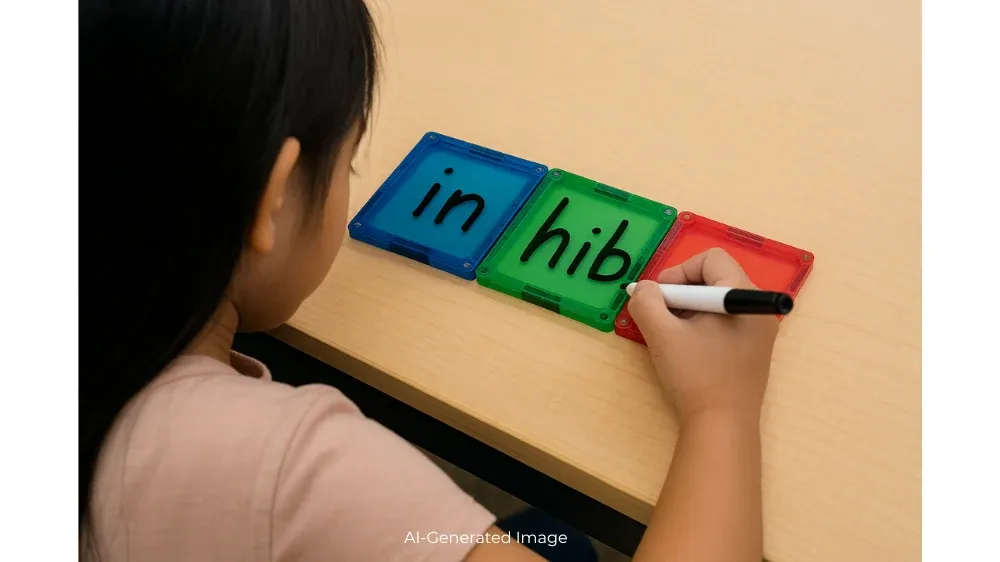
Change the writing surface. Use post-its to represent syllables and have students write the phonemes of the syllable on them. Similarly, use magnetic building tiles and a whiteboard marker.

Resource(s)
Explore the resource(s) to support your implementation of this activity.
Toolkit resources help you implement high-quality instruction. To guarantee student success, these tools must be used in tandem with direct, systematic, mastery-oriented instruction and a high-quality curriculum.