
Intro to Activity
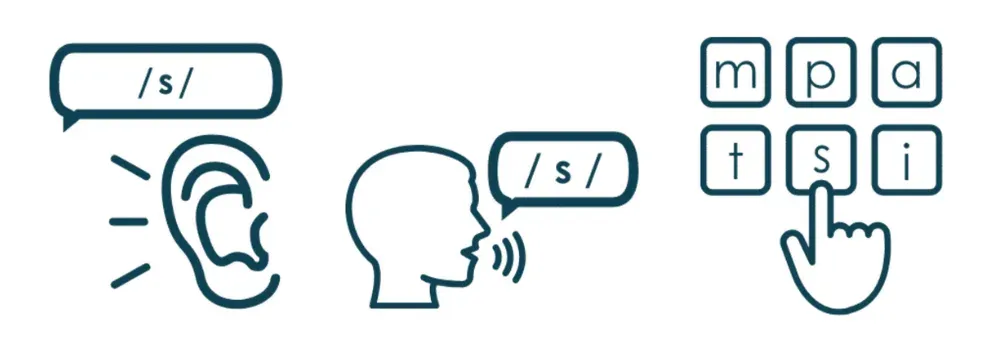
Lights Out is an activity used to reinforce letter-sound correspondences. Students play by listening to the dictated phoneme (sound), then pointing to and flipping over the corresponding grapheme (letter or letters). This activity is easy to implement because it requires little to no preparation, and it can be repeated frequently to help students build accuracy and automaticity over time.
Students
Discover the types of students who may benefit from this activity.
Students transitioning from the Pre-Alphabetic Phase (students have little to no alphabetic knowledge) through the Partial Alphabetic Phase (students recognize some letter-sound relationships) typically benefit from letter-sound instruction and can use Lights Out for letter-sound practice.
Although we know letter knowledge is important, research has not established a definitive threshold for the optimal number of letters a student should know by a specific time. Instead, teachers can use guidelines to support goal setting for this skill. The Head Start Early Learning Outcomes Framework (NCECDTL, 2020) recommends that by 5 years old a child should know 18 uppercase letters, 15 lowercase letters, and several sounds to support future reading success. Full proficiency with letter sounds is typically expected in schools by the end of Kindergarten (ages 5-6). Therefore, we recommend using Lights Out in PreK-Kindergarten and with struggling readers needing additional alphabet knowledge practice. Students who have mastered letter sounds or are in later word-reading phases do not require instructional time devoted to alphabet knowledge.
Getting Started
The steps outlined in the tabs below provide a clear and structured approach for teaching this activity to students.
Cut out a set of previously taught letter tiles for each student that will be used for review. Give each student a tile set, spread out, with the letters facing up.
Tell or remind students that we use letters to represent sounds in words. Explain the purpose of the activity.
Example:
"Let's review some letters we've been practicing. For this activity, you will find the letter that spells the sound I say."
Model how to respond with a teacher-led demonstration.
Example:
"Watch me. If I hear /s/, I know I use <s> to spell /s/. I'll touch <s> and say its name. Then, flip it over."
Initiate by dictating a phoneme and having your students repeat it. Then, depending on the support needed, either tell them it the letter name or ask the students to name the letter. Model how to look at the letter forms to find the grapheme. Have students find the letter in their letter tile set.
Example:
Dictate "/b/".
Students repeat "/b/."
"Name? (<b>). <b> spells /b/. <b> starts with a vertical line and then has a curve. Find /b/. What letter? (<b>).
Students find <b> and flip over.
Dictate additional phonemes while supporting students to find the corresponding graphemes. Monitor student responses for accuracy throughout the activity. Continue prompting students to locate the grapheme that corresponds with each phoneme until “lights out,” or all letter tiles are flipped.
Immediately support students if they make an error.
You can use learned keywords as cues.
Example:
“What is our keyword for /s/? (snake) Do you remember what that letter looks like? What is it called? (<s>)” or “Our keyword for /s/ is snake. Can you find the letter? What is it called (<s>)?”
If the students can't name or find the letter on the second attempt, provide the letter name and have them repeat it. If needed, provide a model of what the targeted letter looks like to support them in finding the correct letter on their desk.
Take Note!
Here are some special considerations when using this activity:
- Scaffold the activity. Lights Out can be made more challenging by including more letter tiles or more supportive by including fewer. Similarly, note that phonemes dictated earlier in the activity (when more tiles are face-up) will be harder than those called later in the activity.
- Teach uppercase and lowercase. Uppercase letters are more visually distinct and typically easier for young children to write due to simpler strokes. Lowercase letters appear more frequently in print, making them essential for reading. While there is some debate about which should be taught first, students ultimately need to learn all 26 uppercase and 26 lowercase letters. Lights Out can support lowercase, uppercase, and even mixed-case letter practice.
- Determine if tiles will include a bottom line. Many manipulatives use a line under letters to show proper orientation (e.g., <b>, <d>, <p>, <q>, <n>, <u>). These can confuse some students since they do not appear when spelling words. Use professional judgment to determine whether to use these symbols with your students and, if using, make sure students understand what they represent. If not, help ensure that each student's letter tiles are oriented appropriately, so that students aren't wondering why they have two <p> tiles but no <d>!
- Extend with digraphs. A digraph is a pair of letters that together represent a single speech sound (e.g., <sh> for /sh/). Digraph sound-letter correspondences must be learned in the same way letter-sound correspondences are learned. Therefore, once digraphs have been introduced in your scope and sequence, consider extending this activity by adding them to Lights Out practice.
- Maximize participation. Ensure that every student practices finding and naming letters. In most situations, providing each student with their own set of letter tiles is best. Avoid large group turn-taking formats that limit practice opportunities.
- Draw students' attention to your mouth. Help students perceive each phoneme correctly by dictating the sound and having them watch your mouth as you articulate it. Be sure to listen to students as they repeat the sounds to ensure they perceived the correct sound. When doing this activity as a whole class, you may want to provide a key word for some voiceless sounds. For example, you might say "/h/, as in hot."
- Review skill overview. For additional considerations when targeting this skill, see the Alphabet Knowledge Overview.
Classroom Connection
See this activity in action through a teacher-led demonstration.
Here, a teacher uses a Lights Out with a small group using lowercase letters. Notice how the teacher monitors students as they work and ensures all students practice touching and naming the letters. Remember, as the activity progresses and more letters are flipped over, it becomes easier for students. As you consider using this activity with your students, think about what letters are easier and could be called first. Which letters might be more difficult?
Differentiation
Learn how you can enhance instruction to meet the needs of diverse learners.
- For students who struggle to differentiate one letter from another (e.g., <i> vs. <j>), try sorting a few letters by their salient features, such as those with circles, straight lines, or curves, to help them tune into what is important to notice. Then directly compare the letters students struggle to differentiate ("Look, <i> has a dot and a straight line. How is that different from <j>?").
- If, after continued modeling and corrective feedback, a student struggles to name a letter, provide choices. Ask, "Is this an <s>, an <m>, or <b>?" and prompt an oral response.
- Receptive naming tasks are generally easier than expressive tasks, and this activity is primarily receptive. You model the phoneme and prompt students to repeat it, but students can still participate successfully just by pointing to the grapheme. To increase the challenge for students who are ready, turn the activity into more of an expressive task. To do this, have students act as the caller and use their set of letters like a calling deck in Bingo. Students will draw a card and dictate the sound for their partner, group, or class.
- Extend this activity by having students trace the letter after identifying it, or write the letter using the tile as a model. This is similar to the Auditory Drill, but offers more support because students have graphemes to choose from.
- For additional differentiation when targeting this skill, see the Alphabet Knowledge Overview.
Coaching Corner
For occasional use: optional ideas to bring energy, engagement, or ease to the activity.
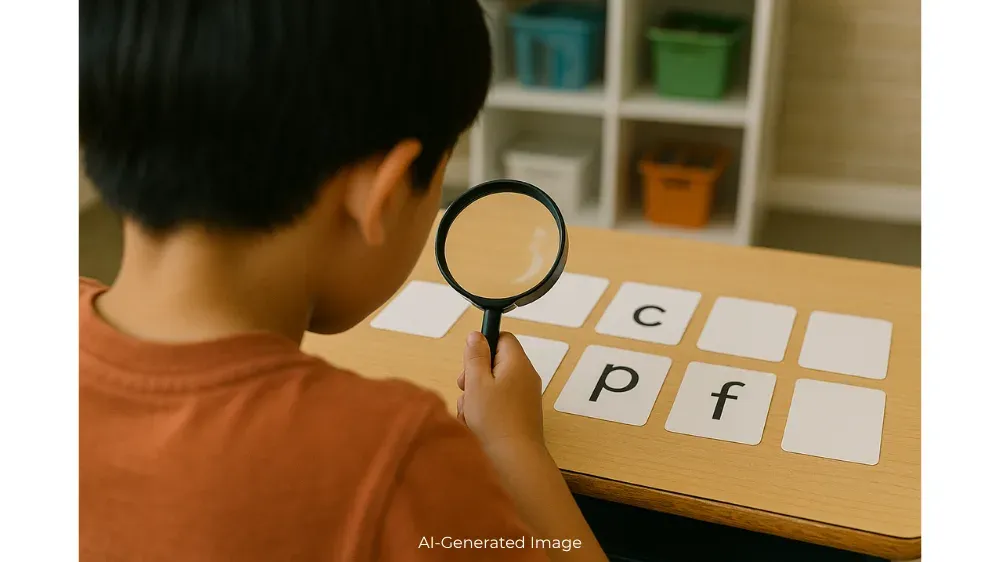
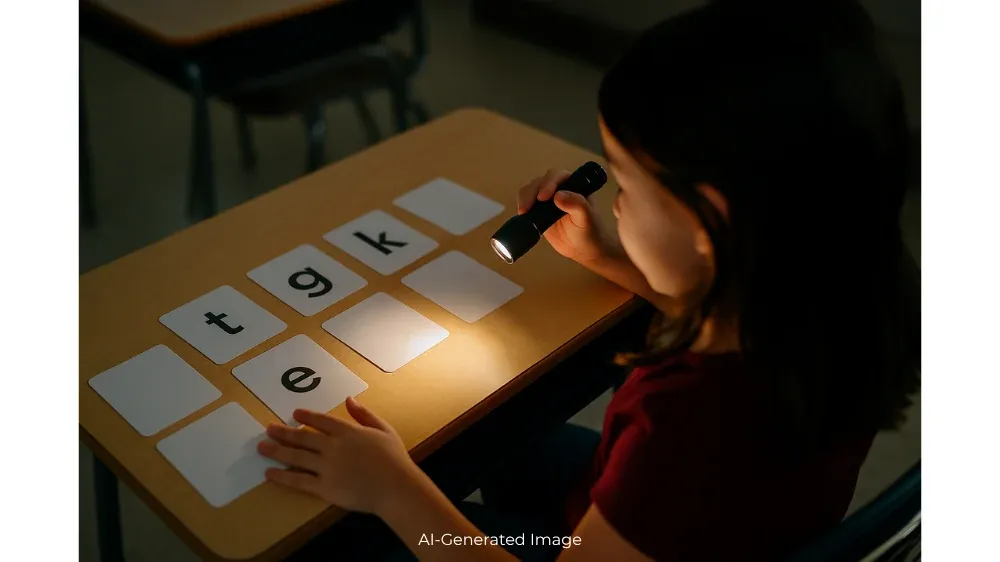
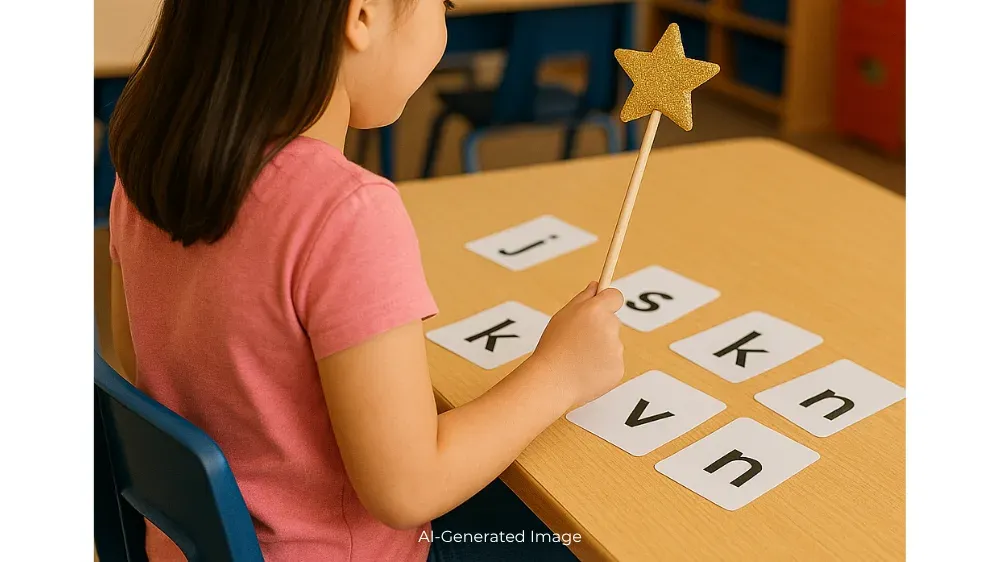
Give students a magnifying glass, spy badge, or another prop to allow students to role-play being a detective searching for the letter.
Resource(s)
Explore the resource(s) to support your implementation of this activity.
Toolkit resources help you implement high-quality instruction. To guarantee student success, these tools must be used in tandem with direct, systematic, mastery-oriented instruction and a high-quality curriculum.