
Intro to Activity
To support the development of fluent oral reading, educators need to consider not only the accuracy and pace with which students read, but also the phrasing and expression they use. To illustrate this need, read the sentence: Let's eat, Grandma! Now, consider how a student who doesn't attune to the comma and its implied phrasing might instead read this as: Let's eat Grandma!
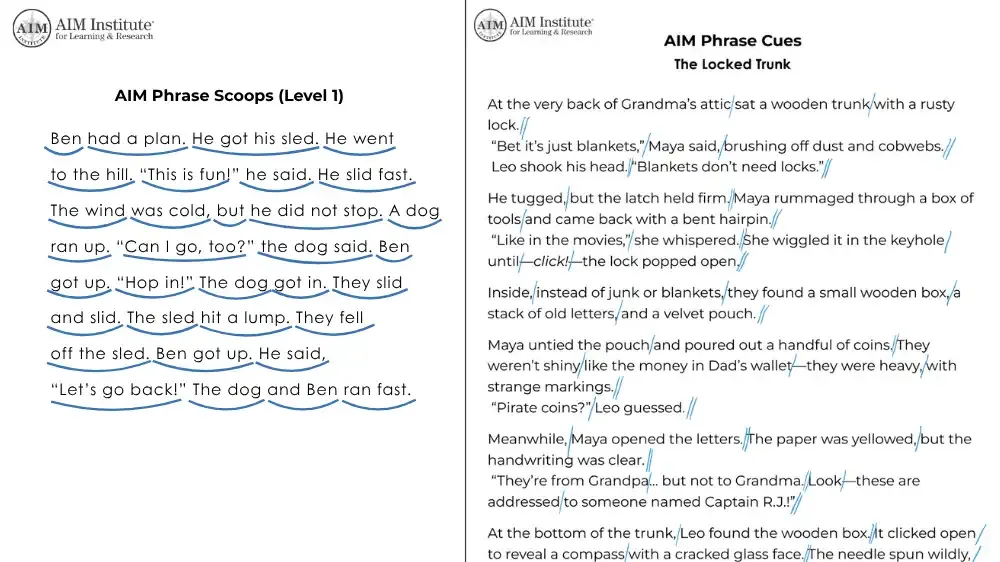
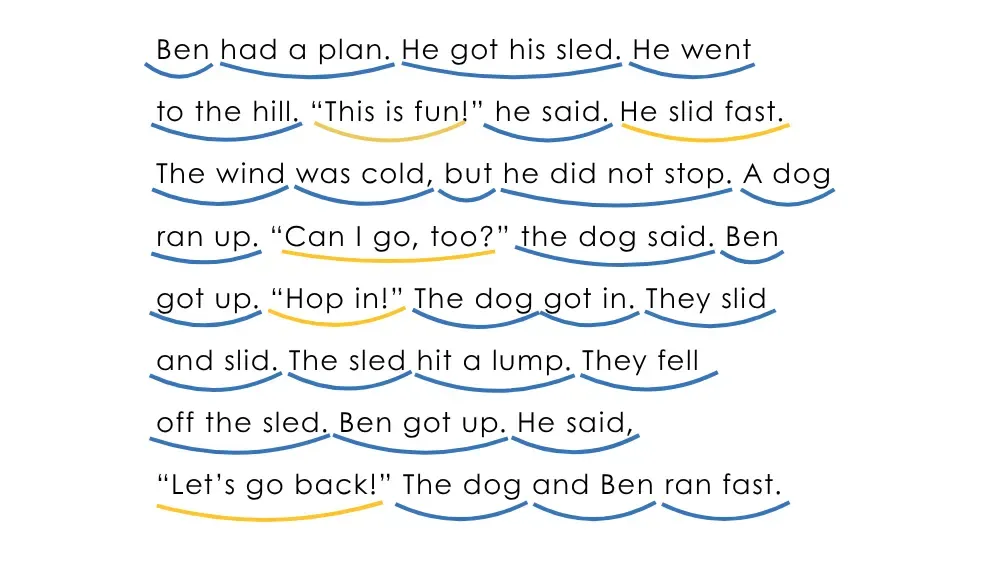
Phrased text reading is one way to support students with the expression component of fluency. The text for this activity is marked to indicate phrase (or unit) boundaries in texts for readers. Younger students may benefit from scooping (drawing curved lines beneath word groups), while older students may benefit from the more subtle look of phrase-cueing (inserting slashes to indicate phrase boundaries). Typically, one slash is used to indicate a short pause at the end of a phrase or unit, while two slashes mark where a longer pause should be observed, usually at the end of a sentence. Note that while this technique is often referred to as marking "phrases," it might be more natural and/or helpful to be flexible in how exactly these word groups are segmented. This idea is discussed more in Take Note! and Differentiation, below.
Both methods help students move beyond word-by-word reading by drawing attention to the syntactic structure of sentences to support text comprehension. These visual supports are especially effective during guided oral reading practice, as they scaffold the prosody component of fluency in a concrete and accessible way. They can be used in tandem with other fluency instructional practices, such as repeated oral reading or choral reading.
Students
Discover the types of students who may benefit from this activity.
This scaffold is a helpful tool for students working on improving their phrasing and expression. It is especially beneficial for students who read in a choppy or monotone voice and/or those who overlook punctuation. Students with weaknesses in syntax knowledge (how the order of words produces meaningful phrases and sentences) may also benefit from these marks.
Generally, scoop marks under the text are used with younger students in Kindergarten and 1st grade. These marks more clearly delineate the boundaries of each phrase and are appropriate for simple texts. In 2nd grade and beyond, students usually transition from scoops under the text to slash marks within the text. These slashes are less obvious than the scoops, and can more easily fit in passages with smaller line spacing.
Getting Started
The steps outlined in the tabs below provide a clear and structured approach for teaching this activity to students.
Choose texts of appropriate length and difficulty level. Most students will benefit from texts that are between 200-250 words long, at their independent level (no more than 1 in 20 words read incorrectly). Although fluency practice often uses texts at a student’s instructional level, selecting texts where students read with even greater accuracy (at their independent level) allows them to focus more fully on the primary goal of this activity: developing appropriate phrasing. Note that if using this activity with a whole class or small group, the chosen text should be considered independent for everyone in the group.
Choose whether you will be introducing scoops or phrase cues (slashes), and mark the text accordingly.
The purpose and interpretation of the phrasing marks (scoops or slashes) should be explicitly introduced and practiced with students the first time they are used. After they have gained familiarity and use with these notations, this scaffold can be integrated into other oral reading fluency activities, such as repeated oral readings.
Let students know that understanding a passage depends not only on reading the words accurately, but also on how we say them. To illustrate this, read the first two sentences from the chosen text aloud in a flat, monotone voice, ignoring punctuation and phrasing. Then ask students whether they understood what you read. Follow up by rereading the same sentences with proper expression and phrasing, and invite students to describe how the second version helped them understand the text more clearly.
Explain that sometimes it can be difficult to know how to read a sentence in a way that makes sense, just by looking at the words. In those cases, we can use visual cues, like scoops/slashes, to give us hints about where to pause or how to group words together. These marks help us read more smoothly and understand the meaning better.
Share a copy of the pre-marked text with students. Model appropriate phrasing of the first two sentences again, this time calling their attention to the inflectional changes and short pauses that coincide with the marks on the text.
Next, students read the same two sentences aloud, matching the phrasing and expression that you have modeled for them.
Students are then encouraged to continue reading the remainder of the text, guided by the phrasing marks. If reading as a class or a group, students may read together chorally.
When a student does not use appropriate phrasing as indicated by the marks on the text, gently redirect them to attempt the sentence again. Depending on how the student misread the text, you may give either a prompt such as:
- "Remember, when you see a slash (or scoop), it means the words before (above) it go together. Try reading that phrase again as one unit.”
OR
- "Remember, when you see a slash (or end of a scoop), it means we're moving from one chunk of words to another one, and we have a slight pause and change in our tone before moving to the next group of words. Try reading those two phrases again as two different units.”
If the student continues to struggle on the second attempt, next try echo reading by reading the impacted portion of the text allowed, and having them echo your tone with their third attempt.
Take Note!
Here are some special considerations when using this activity:
- Scoops or slashes? The grade-level marking suggestions in the Students section above serve as general reference points rather than rigid rules. Individual student needs, preferences, and developmental stages can vary widely. For example, while older students are often introduced to phrase-cueing using slashes, a 2nd-grade student may still benefit from, or even prefer, the more visual and concrete nature of scooping lines. In such cases, it's entirely appropriate to continue using scoops to support phrased reading, regardless of grade level. Teachers should make instructional decisions guided by what best supports each learner's fluency and comprehension, not solely by age or grade expectations.
- This scaffold can be layered with other activities. Teachers should first introduce these scaffolds as a standalone activity while students are learning how to use the marks to guide their reading, and subsequently embed them into other fluency activities, such as repeated oral readings. You may choose to provide these markings as a scaffold for the whole class, or for select students (while providing unmarked text for the remainder of the class).
- Use this scaffold thoughtfully as needed. Keep in mind that the goal of phrasing scoops and slashes are to aid in students' prosody while reading aloud. This would not be an appropriate scaffold for a student needing help with word reading accuracy or automaticity.
- Review skill overview. For additional considerations when targeting this skill, see the Automaticity and Fluency Overview.
Classroom Connection
See this activity in action through a teacher-led demonstration.
Watch as this teacher guides a small group through using phrase scoops to support their fluency while reading a text. Notice the corrective feedback she provides after a student attempts to scoop a sentence inappropriately. Adhering to appropriate phrasing across line breaks can be confusing. How would you support students when one phrase is broken up between two lines?
Differentiation
Learn how you can enhance instruction to meet the needs of diverse learners.
- While this scaffold is generally referred to as phrased text reading, consider that the scoops and slashes you use do not necessarily have to align perfectly with a phrase. For example, there are two phrases in the following short sentence: The dog can run. The noun phrase (The dog) is followed by a verb phrase (can run). Very early readers may benefit from both of these phrases being marked individually, as they begin to transition away from reading slow, choppy, isolated words. Alternatively, slightly more advanced readers may only need one scoop under the entire short sentence.
- Using scoops or slashes can be a powerful tool to help students not only gain prosody, but also to aid in comprehension. When using these marks to help English Learners or those with language difficulties (including developmental language disorder), it will likely be most helpful to consider marking units of meaning, rather than strict phrase boundaries. For example, consider marking the boy with the red backpack as one cohesive unit of meaning, rather than two distinct phrases.
- More advanced students may practice adding their own scoops/slashes to unmarked texts before transitioning away from this scaffold entirely.
- For additional differentiation when targeting this skill, see the Automaticity and Fluency Overview.
Coaching Corner
For occasional use: optional ideas to bring energy, engagement, or ease to the activity.
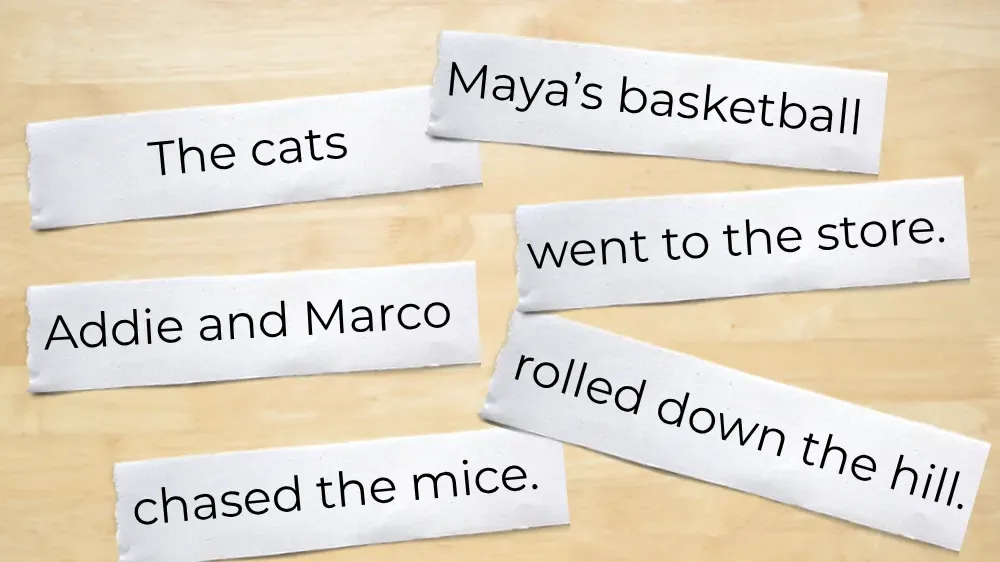
After adding scoops or slashes to separate word units/phrases, cut out each group of words. Allow students to create their own sentences by combining the groups of words into their own (possibly silly) ideas!

Resource(s)
Explore the resource(s) to support your implementation of this activity.
Toolkit resources help you implement high-quality instruction. To guarantee student success, these tools must be used in tandem with direct, systematic, mastery-oriented instruction and a high-quality curriculum.