
Intro to Activity
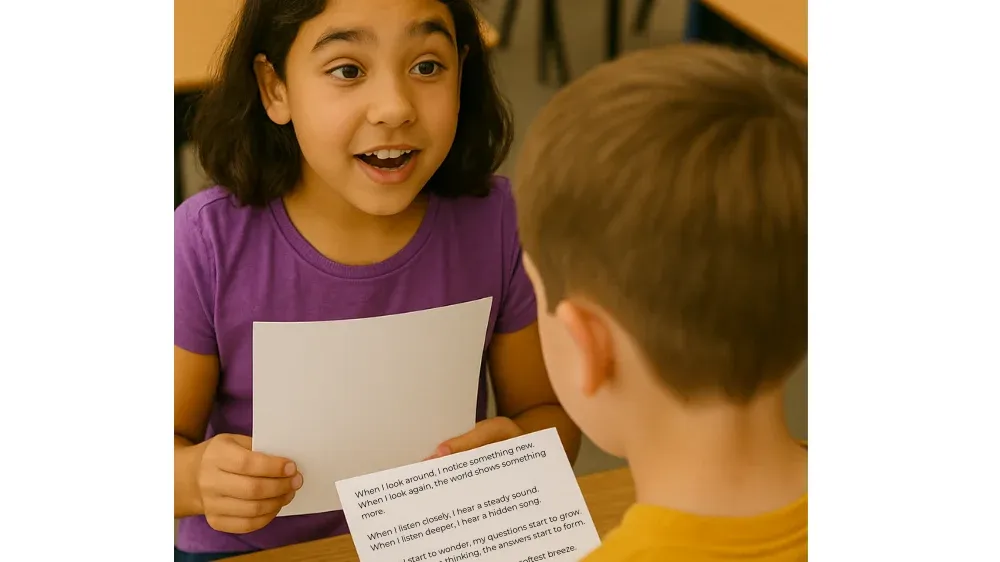
Echo reading is an evidence-based instructional strategy used to support students in developing oral reading fluency. In echo reading, a teacher or fluent reader reads a short segment of text aloud and the students immediately repeat, or "echo," the same segment, attempting to mirror the pace, expression, and overall prosody of the fluent reader. The goal is for students to internalize what fluent reading sounds like by closely imitating the model provided.
By hearing and then reproducing fluent reading, students begin to build automaticity and confidence with increasingly complex texts. Teachers can use echo reading with decodable readers, narrative texts, or informational passages. Over time, as students become more proficient, echo reading can transition from being an activity in and of itself, to a scaffold that is used as needed for a complex sentence that students encounter. This can help promote increased independence while still supporting fluency development.
Students
Discover the types of students who may benefit from this activity.
Echo reading is an effective strategy within a comprehensive approach to fluency instruction for students in grades 1-4. It can also be a helpful strategy for struggling readers in later grades who lack confidence or need additional support with fluency.
Getting Started
The steps outlined in the tabs below provide a clear and structured approach for teaching this activity to students.
Choose a text of appropriate length and difficulty level. Most students will benefit from texts that are between 200-250 words long, at their instructional level (no more than one in ten words read incorrectly).
Introduce the text, and the purpose for the echo read. For example, it may be an introduction to a text that they will continue to practice independently as part of a well-rounded battery of fluency activities.
If this is the first time using the activity, practice how echo reading works by first selecting one sentence to model. Tell your students to repeat the sentence, matching your speed and intonation. Once students understand the activity, begin guided practice. Alternatively, if students are familiar with this activity, a model may not be necessary.
Next, read the following sentence of the text. Students respond by repeating the sentence chorally (all together as a group), matching the teacher's pace and expression.
Oftentimes, echo reading is presented as a highly supportive scaffold before students practice reading the text independently, as part of a broader repeated oral reading exercise. It is used when students demonstrate a need for a high level of support, and is removed when they can practice oral reading more independently.
Even though echo reading often involves students reading in unison after the teacher's model, it still allows for real-time corrective feedback. By listening attentively, you can respond to miscues or issues with expression using brief, effective supports.
For instance, if you hear a group of students read with flat inflection and ignore the pausing between clauses indicated by the comma, stop and model the correction immediately. Then, ask students to echo again with the correction in mind.
Example:
- Teacher reads: “Even though it began to rain, the children continued playing outside."
- (Students echo the same sentence, but fail to echo the appropriate expression.)
- Teacher: “Oops! I heard some of you say, 'It began to rain the children.' Is that what the author meant, that it was raining children? (No!) I want you to look down at the text and notice the comma after the word rain. Put your finger on that comma. That punctuation is separating two different parts of the sentence. Listen again as I read that sentence."
- Model the sentence again, and expect students to echo read in response.
If students continue to struggle after a second attempt, it may be helpful to reduce the length of the text being modeled. Instead of reading the full sentence for them to echo, model one clause at a time.
Take Note!
Here are some special considerations when using this activity:
- Combine with other strategies. Echo reading can be seen as part of an arsenal of fluency instructional practices, rather than the sole or primary activity in and of itself. For example, echo reading may be used along with the technique of choral reading: The students first echo each sentence of a passage in an initial read, before performing a choral read in unison with the teacher on the second attempt.
- Use this tool flexibly to meet student needs. Echo reading can be used as a scaffold when students struggle with a challenging portion of their text. For this reason, the teacher should judge how much text to model for the students to echo. For example, the text excerpt modeled might be more than one sentence to demonstrate the pause and intonation between sentences for a student who seems to read through ending punctuation.
- Mix up the group size. Echo reading can be performed with the whole class, small group, or just with two (teacher/peer and student).
- This isn't a memorization task. Students should follow along with the text both while the teacher models and when they echo the excerpt back.
- Review skill overview. For additional considerations when targeting this skill, see the Automaticity and Fluency Overview.
Classroom Connection
See this activity in action through a teacher-led demonstration.
Watch as this teacher uses echo reading along with both Phrased Text Reading and Choral Reading for a highly scaffolded activity with a small group.
Differentiation
Learn how you can enhance instruction to meet the needs of diverse learners.
- While echo reading can be a whole-class activity, it might be best in pairs or small groups to ensure participation among reluctant and struggling readers.
- Echo reading may benefit English Learners beyond supporting their reading fluency. This scaffold can provide an opportunity to model appropriate word pronunciations (including syllabic stress for multisyllabic words) as well as the overall intonation of English phrasing.
- For students with difficulty reading with appropriate prosody, model how changing the stress of a word or the overall expression/tone of a phrase or sentence alters meaning. For example, consider the different implications in "I found the ticket!" versus "I found the ticket!" How can you read a sentence like "It's mine," differently to convey excitement, nervousness, or anger? Discuss these differences with students, practice different ways of reading the same sentence, and decide which one is most appropriate for the context of the passage.
- If a student continues to struggle even with an echo reading model, consider reducing the text length during the model (such as modeling one clause at a time, rather than a lengthy sentence in its entirety).
- For additional differentiation when targeting this skill, see the Automaticity and Fluency Overview.
Coaching Corner
For occasional use: optional ideas to bring energy, engagement, or ease to the activity.

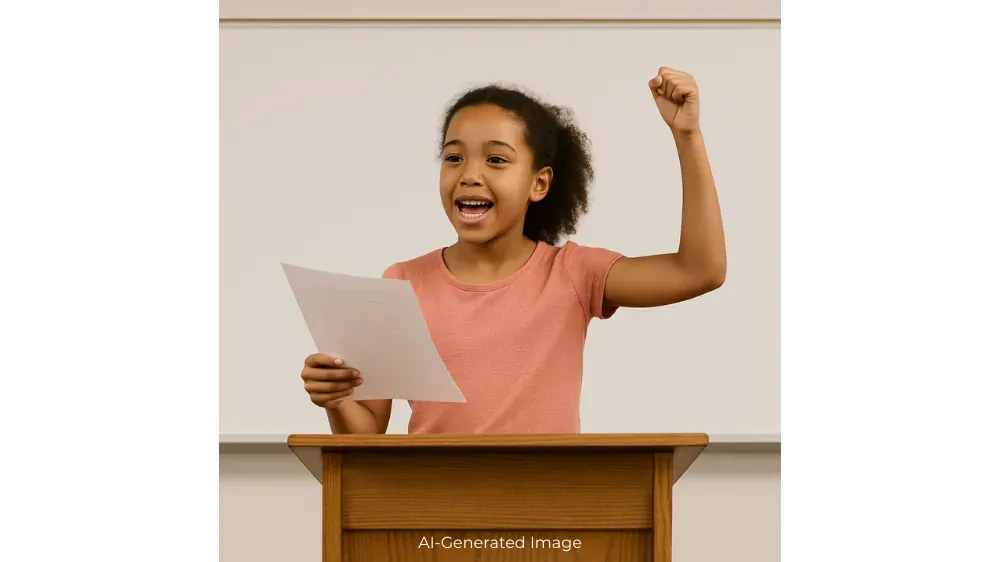
Hand a microphone (pretend is fine!) back and forth between the model reader and the echo reader as they take turns.
Resource(s)
Explore the resource(s) to support your implementation of this activity.
Toolkit resources help you implement high-quality instruction. To guarantee student success, these tools must be used in tandem with direct, systematic, mastery-oriented instruction and a high-quality curriculum.