
Intro to Activity
Partner reading is a structured reading routine in which two students work together to read a text aloud, taking turns and supporting one another. Typically, pairs consist of one stronger and one less fluent reader, allowing the more skilled reader to both model fluent reading and provide supportive feedback and corrections to the less fluent reader. This strategy promotes reading fluency and peer collaboration, and is easily paired with a comprehension-building strategy such as paragraph shrinking. When implemented effectively, partner reading not only provides valuable reading practice but also creates opportunities for students to encourage one another, discuss text meaning, and build confidence in a supportive, low-stakes setting.
Students
Discover the types of students who may benefit from this activity.
Partner reading routines are generally recommended for students from mid-1st grade through middle school when there is a class-wide need for additional reading fluency support. Teachers can determine whether implementing partner reading as a whole-class strategy is appropriate by comparing students' oral reading fluency (ORF) scores to established benchmark criteria. If a significant portion of students are not meeting ORF grade-level expectations (typically defined as performing below the 50th percentile), then partner reading can serve as an effective, low-prep way to support fluency for many students at once.
Getting Started
The steps outlined in the tabs below provide a clear and structured approach for teaching this activity to students.
Use current progress monitoring to list each student by fluency scores (Words Correct Per Minute). Divide the class at the halfway line to create two lists. Pair the student at the top of List A (the student with the strongest fluency score) with the student at the top of List B. Continue with the second students on Lists A and B, and so on down the line.
Next, choose texts of appropriate length and difficulty level for each pairing. Because partner reading is a routine intended to be used for several days in a row, longer texts can be used than in other fluency practice activities. Each pair should read a text at the instructional level (no more than one in ten words read incorrectly) for the student from List B. This means that both students in the pair will have the same text, but that pairs in the classroom may have different texts.
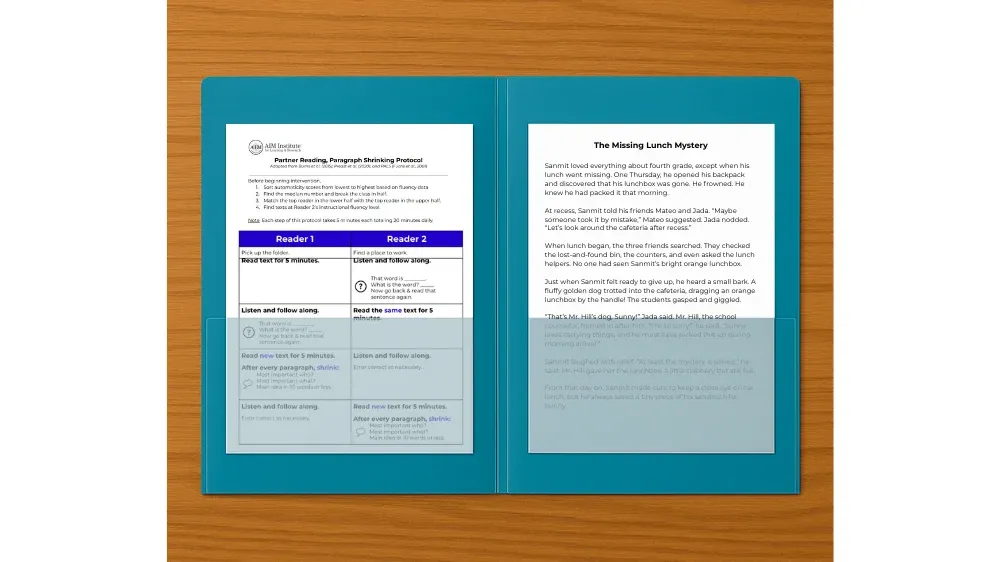
Create a folder for each pair that contains: two copies of the selected text, error-correction guidelines (outlined in Corrective Feedback, below), and the student protocol for paragraph shrinking (see Literacy Toolkit section, below) or other comprehension strategy if applicable.
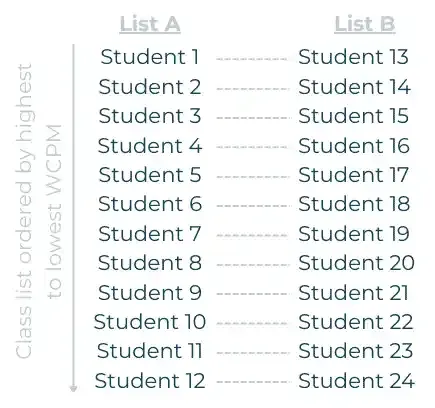
Introduce the purpose of the partner read. The first time you introduce the procedure to students, start by explaining the purpose. For example, "We are going to be learning a new routine called partner reading. We will use partner reading for the next several weeks so that we have lots of opportunities to practice reading and get feedback." In future lessons, the purpose of the activity may be to practice a comprehension strategy, such as paragraph shrinking. There is more on this strategy in Differentiation, below.
Explain the 20-minute procedure to students:
- Student A will begin to read aloud from the text for 5 minutes, while Student B follows along. After the 5 minutes, Student B rereads the same portion of the text aloud, while Student A follows along. Each student will do their best to gently correct any mistakes and provide help for words that their partner struggles with.
- After the initial read/reread set, Partner A will subsequently read new text aloud for 5 minutes. After the time has completed, Partner B will continue where Partner A left off, this time reading new text for the last 5 minutes of the lesson. The non-reading partner will continue to follow along in their copy of the text and provide coaching and corrective feedback.
Explain that we all make mistakes sometimes when we are reading, so partners are there to help us when we make a mistake or get stuck. Explicitly convey to students their role in creating a cooperative partnership and the behavioral expectations for creating a respectful environment.
After you’ve explained how partner reading works, it’s important to model what it looks and sounds like so students know what to expect.
Choose a short, engaging passage and ask another adult or confident student to help you demonstrate. Model smooth, fluent reading while your partner listens actively and follows along in their own text. Read a few words incorrectly to create the opportunity for your partner to provide corrective feedback, and then reread the sentence with better accuracy. Be sure to highlight respectful partner behaviors like using a quiet voice and helping without criticizing. Your model sets the tone, so keep it positive and clear.
Unlike some lesson introductions where guided practice lasts only a minute or two before students transition to more independent work, introducing partner reading often requires an extended period of guided support — sometimes the entire first day or even the first couple of sessions. This is because the routine involves multiple steps, social dynamics, and specific expectations that may be new to students.
During the initial sessions, you’ll need to explicitly introduce the role of each partner, model and rehearse how and when to switch readers, and coach the listening partner on how to provide respectful, helpful feedback. During this time, you're actively monitoring, prompting, and reinforcing behaviors to ensure students internalize the structure. Once students demonstrate consistent understanding and cooperation, you can begin releasing responsibility and shifting toward the Student Practice phase, where they carry out the routine with greater independence.
Once students have internalized the routine and understand the expectations for each part of the partner reading sequence, they can begin to work through the activity with greater independence. At this stage, your role shifts from active guidance to observation and occasional support.
Even though students are more independent, it’s still helpful to keep visual supports accessible, such as a step-by-step routine chart and partner scripts for providing corrective feedback. These can be kept in student folders or displayed in the classroom as a reference. You may also choose to continue using a classroom timer to signal transitions, rather than expecting students to track time on their own. However, the expectation now is that students will hear the 5-minute chime and transition independently to the next step, without needing reminders about what comes next. This gradual release supports autonomy while maintaining structure.
During practice, continue to walk throughout the room to observe and monitor the students' reading, on-track behavior, as well as appropriate and respectful coaching.
Provide students with a script they can use to give respectful, helpful, corrective feedback during partner reading. Practicing this language in advance helps ensure both partners know how to support each other in a structured and encouraging way. Here are some examples:
If the reader misreads a word or pauses for more than 4 seconds:
- "That word is productive. What’s the word?"
- (Wait for the reader to repeat the word.)
- "Good. Now go back and read the sentence again."
If the reader skips a word:
- "Stop. You skipped a word. Try the sentence again."
If the reader adds a word:
- "Stop. You added a word. Try the sentence again."
Make sure to model these prompts before students use them, and remind them to use a calm, friendly tone — the goal is to coach, not criticize. You can also print the scripts on bookmarks or partner cards to keep in student folders for easy access.
Take Note!
Here are some special considerations when using this activity:
- Consider cross-curricular texts. For example, perhaps students partner read using a section or chapter from a social studies text. This activity, especially when paired with a comprehension-building strategy, can be used as a fluency intervention that simultaneously supports learning relevant content.
- Have a schedule. The duration and frequency of partner reading can vary based on grade level, instructional goals, and available time, but it is typically performed for 20 minutes, 3 to 5 days per week for 2- to 4-week blocks. For example, a teacher may initially implement this strategy every day for 2 weeks. The next time they reintroduce this strategy, it may be 3 times per week for 4 weeks. It may be beneficial to retest fluency scores after this interval to monitor progress and adjust student pairs accordingly.
- Emphasize cooperation. Partner reading works best when it’s viewed as a coaching partnership, not a competition. Teachers can set students up for success by pre-teaching expectations, modeling how to offer support, and monitoring interactions. Clear expectations reduce misunderstandings, promote patience, and foster an effective learning environment.
- Actively monitor student pairs. Monitor students' reading fluency, peer feedback, and engagement. Provide models of fluent reading with expression, demonstrate how to provide corrective feedback, and reinforce the expectations around supportive coaching as necessary.
- Keep pairing lists confidential. Although pairings are intentionally made with one stronger and one weaker reader, it’s important not to share these labels with students. Instead, simply identify one student as Reader A and the other as Reader B, so that the stronger reader can model the first reading of the text.
- Be flexible with an odd number of students. If there is an odd number of students in the class (or a classmate is absent), the teacher may pair a student with a classroom aid, assign one group as a triad, or have one student work independently (such as whisper reading to themself or using a recording device), depending on what would best meet the needs of your student.
- Review skill overview. For additional considerations when targeting this skill, see the Automaticity and Fluency Overview.
Classroom Connection
See this activity in action through a teacher-led demonstration.
Watch as this teacher walks two students through an abbreviated version of partner reading. Notice that she chose a slight variation on the routine by having the second student repeat both paragraphs that the first student read, possibly due to discrepant reading abilities or confidence.
Differentiation
Learn how you can enhance instruction to meet the needs of diverse learners.
- Partner reading pairs are traditionally organized by matching students with different words correct per minute (WCPM) scores, but educators can also form mixed pairings depending on other instructional goals. For example, if many students struggle to read with appropriate expression, pairs could be formed with that in mind. Texts could be adjusted accordingly, matching the lower-performing student’s independent level (no more than 1 in 20 words read incorrectly) rather than their instructional level (as typically used in fluency practice). Alternatively, if the goal is comprehension, pairings could be based on students’ comprehension abilities, which may be especially useful in a cross-curricular setting.
- Partner reading pairs very well with comprehension-building strategies. For example, when using expository texts, students can practice paragraph shrinking after each five-minute read. Paragraph shrinking requires the student to provide the most important 'who' and 'what' of the excerpt that they read and use them to state the main idea statement of the paragraph in ten words or less.
- Students can participate in a quick comprehension strategy similar to paragraph shrinking when reading narratives by retelling or summarizing the passage.
- When a small number of students are significantly below the literacy level of their peers, partner reading may not be the most appropriate fit for their needs or for ensuring a productive experience for their potential partners. In these cases, it may be more beneficial for the teacher to work directly with select students to provide more targeted support.
- Teachers may need to be flexible with pairings and make adjustments to ensure the experience is productive for both students. For example, the routine may be less effective if the more fluent reader is not yet confident enough to provide gentle corrective feedback, or if a student lacks sufficient challenge when paired with a peer who requires a significantly different reading level. In these cases, thoughtful regrouping or alternate supports may help both students get more out of the experience.
- For additional differentiation when targeting this skill, see the Automaticity and Fluency Overview.
Coaching Corner
For occasional use: optional ideas to bring energy, engagement, or ease to the activity.

Have fun with partner names! Trade out the labels Partner A and Partner B labels for fun duos like Woody and Buzz or Spongebob and Patrick.

Resource(s)
Explore the resource(s) to support your implementation of this activity.
Toolkit resources help you implement high-quality instruction. To guarantee student success, these tools must be used in tandem with direct, systematic, mastery-oriented instruction and a high-quality curriculum.