
Intro to Activity
Syllables are spoken units of sound that include a vowel sound, and may or may not also have surrounding consonant sounds. For example, the words a, fly, horse, steep and bring all have one syllable, because they each have one vowel sound. Note that we might spell a single vowel sound (such as /ē/) with more than one letter (such as <ee> in steep).
Syllable awareness is a phonological awareness task that involves early stages of conceptualizing words not only as units of meaning, but units of sounds. The first steps in syllable awareness include counting syllables (there are three syllables in gingerbread), segmenting syllables (breaking the word into the chunks: gin-ger-bread), and blending syllables (hearing um-brell-a and recognizing the word).

Students
Discover the types of students who may benefit from this activity.
Most students can clap and count syllables in spoken words by around five years of age, which is also when they begin to notice whether words rhyme. Therefore, practice with syllable awareness can typically be done in preschool or early Kindergarten as part of broader phonological awareness instruction. More advanced syllable-level tasks, such as syllable deletion (e.g., “Say baseball without base”), usually develop around age six—about the same time children begin blending and segmenting short words with two to three phonemes.
Students working on syllable awareness are likely in the Pre-Alphabetic Phase of word-reading development (little to no alphabetic knowledge), or at the very beginning of the Partial Alphabetic Phase (recognize some letter-sound relationships). Remember that although phonological awareness tasks such as syllable blending and segmenting can help establish a foundation for understanding the sound system of the English language, these are not skills that are necessary precursors to continued literacy development. That is to say, teachers should not delay introducing sound-letter correspondences until after students have demonstrated mastery of syllable awareness tasks, despite this being a typical skill progression.
Getting Started
The steps outlined in the tabs below provide a clear and structured approach for teaching this activity to students.
Prepare a list of words to practice with your students. The words should be an assortment of one to three syllables in length (such as hit, highway, or yesterday) to begin with.
Present each student with three manipulatives (such as felt squares, blocks, or note cards) in a straight line in front of them.
Students with experience segmenting syllables may enjoy practicing with longer words, such as alligator and hippopotamus. Adjust the number of available manipulatives accordingly!
State the purpose of the lesson by introducing what syllables are, and that you will learn how to break a word into syllables.
Example: "We can break apart words by syllables. Syllables are parts, or chunks, of a word. Some words only have one syllable, but some words have several. We can feel how many syllables are in a word by how many times our mouth opens when we say it out loud."
Continue to define what a syllable is by modeling syllable blending. Tell your students, "Listen carefully. I'm going to say a word very slowly, syllable-by-syllable. Ba...by. What word was that? That's right! Baby! Baby has two syllables, /bā/ and /bē/. I can feel my mouth opening each time I say a syllable.
Provide a few examples further defining a syllable before adding in the manipulatives. It might be best to begin with words consisting of simple, consonant-vowel (CV) syllables such as ta-co and ba-na-na to help illustrate how the syllables correspond with the mouth opening for each vowel sound, before moving into more complex syllables with several consonant sounds, such as con-struc-tion.
Now model how you can use manipulatives to help segment and count the syllables in a word. Begin with three index cards (or other manipulatives such as blocks or felt squares). Provide a word, such as window, orally, and then repeat the word syllable-by-syllable while physically sliding one card up for each spoken syllable. Then announce that window has two syllables, as indicated by the two cards that were pushed up.
Reset the cards and model again with a one- or three-syllable word.
Next, practice this skill with your students. Continue with both phonologically simple words (e.g. potato, tomato) and compound words (e.g. mailman, bathtub) to begin with. Say the target word aloud and have students repeat it. Then, segment the word in unison with the class, with everyone simultaneously moving their cards. Lastly, announce how many syllables the target word has, and reset for the next example.
Practice several words with your students before proceeding.
Students now provide responses independently. In whole-class instruction, students can take turns segmenting words with a partner.
Closely monitor student responses in both the Guided Practice and Student Practice portions of the lesson. Provide immediate corrective feedback when students provide an inappropriate response.
For example, if a student segments the word elephant into two syllables, model the correct segmentation before having the student repeat the appropriate response.
Take Note!
Here are some special considerations when using this activity:
- Mix it up! Keep in mind that unlike phonemic tasks (working with individual sounds in a word), shorter words aren't necessarily easier than longer words in syllable awareness. You needn't follow a progression of single-syllable words, then two syllables, then three, etc. Change around the number of syllables in the words you provide students to keep them on their toes!
- Don't forget the little guys. Along the same lines as the note above, don't forget to include single-syllable words (e.g., dove, horse, catch)! You might find that these words can trip up students who have had extended practice with multisyllabic words.
- Sounds, not letters. This is a different task than syllabication in written words. How we break spoken words into syllables may not perfectly align with patterns of syllable division in written words.
- Don't let your spelling knowledge get in the way. This is an oral language task focusing on the sounds in the word, not the letters. For example, don't model the syllables of the word bunny as /bŭn/..../nē/ with two medial /n/ consonant phonemes because there is a double <nn> in the spelling of this word. Similarly, English sometimes has syllables that are not spelled with a vowel letter. Take, for instance, the word rhythm, which we pronounce as two spoken syllables despite only having one vowel letter (<y>) in the spelling.
- Consider dialectical variations. This activity is meant to support children's ability to think about the phonological system of English. Due to the rich variances in language, there may be words (such as caramel and crayon) that speakers pronounce with a different number of syllables based on dialect. There may be other words that are "controversial," such as those using diphthongs. Teachers may consider words such as toy as being one-syllable because there is one vowel phoneme (/oi/), but children may feel the movement in their chin multiple times in the pronunciation of this vowel diphthong. There is no need to come to a class-wide consensus on how words are pronounced or get caught in the subtle nuances of English phonology. Consider accepting and acknowledging a variety of responses for words such as these, or avoid potentially confusing words at this stage altogether.
- Incorporate throughout the day. Syllable awareness skills can be practiced in short bursts throughout the day to support students' phonological awareness skills as well as vocabulary development. For example, when encountering a word that students might be unfamiliar with, such as aquarium, binoculars, or delicate, teachers may have the students repeat the word, segment it into syllables, and then repeat the word again. Attending to the phonological structure of the word and repeating it multiple times will increase the likelihood of retaining this new word and increase the chances the student will use the word themselves.
- This is not a precursor skill. Remember that this is not a skill students must master before they can move on to learning sound-letter correspondences or practicing the more refined phonemic awareness. It can be helpful/fun for very young children to "prime the pump" so to speak and start to build their awareness that oral language can be broken into smaller chunks of sound, but educators needn't get stuck here before progressing to skills with a more direct correlation to literacy development.
- Review skill overview. For additional considerations when targeting this skill, see the Phonological/Phonemic Awareness Overview.
Classroom Connection
See this activity in action through a teacher-led demonstration.
Here, a teacher segments words into syllables with a small group. Notice how the teacher slightly exaggerates her pronunciation of each word to aid in this task. How does she scaffold the activity when students provide incorrect responses?
Differentiation
Learn how you can enhance instruction to meet the needs of diverse learners.
- Multiple subskills fall under the umbrella of syllable awareness, including blending syllables into a word, clapping/counting syllables, segmenting a word into syllables, and omitting syllables from a word (i.e., Say cupcake. Now say cupcake again, but don't say cup). Move up and down this progression of syllable awareness as needed to meet the skills of your students.
- Many children find tasks in syllable awareness easiest when using compound words. The reason behind this is twofold. Each syllable is a word itself (e.g., mail | box), which makes it easier for young children to retain in their phonological working memory. Additionally, compound words can be easier for children to work with because they usually consist of only stressed syllables, unlike words such as mountain, which contain an unstressed syllable.
- While some students will find tasks of syllable awareness relatively easy, many will benefit from instruction with these tasks, and some will struggle despite structured practice. Some strategies to try with these students include: encouraging them to hold a hand under their chin while repeating the word to feel their mouth opening with each vowel/syllable; humming the word; or saying the word in an exaggerated way (e.g., talking like a robot or pretending to yell the word to someone across the street).
- Some students may struggle to clap syllables and keep track of how many syllables they clapped. These students may benefit from using manipulatives such as felt squares or blocks to help keep track of the syllables. This may help prevent overly taxing their working memory by counting while also trying to segment.
- The concept of a syllable is present across languages. Teachers can provide an example in the students' native language before practicing words in English to help introduce this task to English Learners.
- For additional differentiation when targeting this skill, see the Phonological/Phonemic Awareness Overview.
Coaching Corner
For occasional use: optional ideas to bring energy, engagement, or ease to the activity.

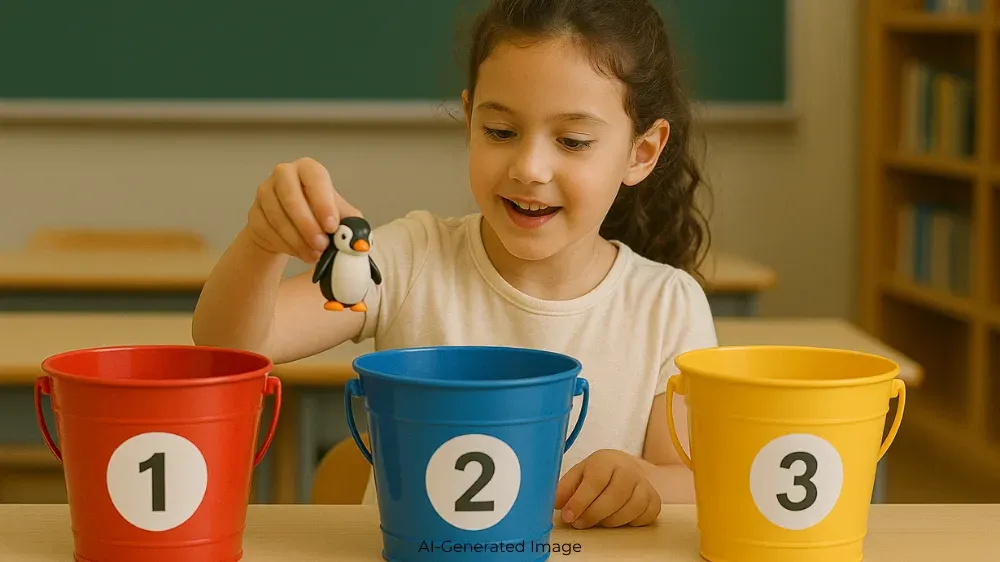
Use blocks, counters, or felt squares where each object represents a syllable. As students say each syllable, they move an object. This provides a tactile way to understand syllable segmentation.

Resource(s)
Explore the resource(s) to support your implementation of this activity.
Toolkit resources help you implement high-quality instruction. To guarantee student success, these tools must be used in tandem with direct, systematic, mastery-oriented instruction and a high-quality curriculum.